Ayu Aulia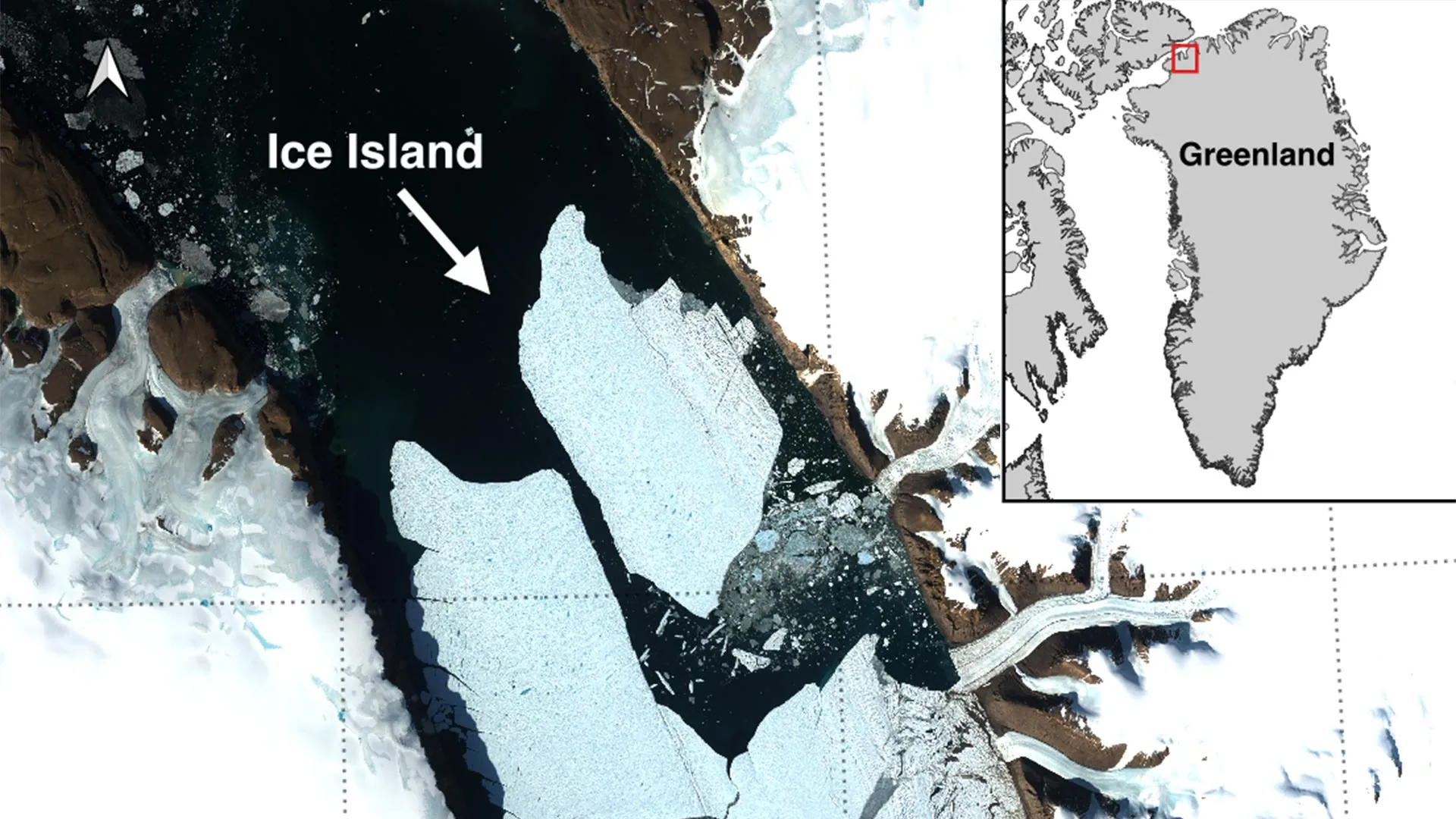
A colossal ice island, comparable in scale to the island of Manhattan, has cleaved from Greenland’s Petermann Glacier, marking a significant event in Arctic glaciology and underscoring the dynamic changes underway in the planet’s polar regions. On August 4, 2026, an international research consortium, including key contributions from the University of Ottawa, documented the detachment of a substantial 76.4 square kilometer ice mass, representing the largest discharge of floating ice from Petermann since 2012 and the most extensive Arctic calving event observed since 2020. This dramatic geological occurrence offers scientists an unprecedented opportunity to meticulously observe the intricate processes governing the formation, oceanic transit, and ultimate fragmentation of vast Arctic ice structures.
The newly liberated tabular iceberg, originating from the expansive floating ice tongue of Petermann Glacier, is estimated to possess a formidable thickness, potentially reaching up to 150 meters. Its immense surface area, strikingly similar to that of Manhattan Island, provides a tangible metric for comprehending the sheer scale of ice loss occurring in the Arctic. The identification of this event was spearheaded by Adam Garbo, a doctoral candidate specializing in glaciology within the University of Ottawa’s Department of Geography, Environment and Geomatics. This pivotal discovery is a testament to the efficacy of an ongoing collaborative research initiative that unites expertise from the University of Ottawa, the University of Stirling, Environment and Climate Change Canada, Lancaster University, and the University of Leeds, highlighting the interconnected nature of modern polar scientific inquiry.
Decades of Observational Insight and Anticipated Change
The Petermann Glacier, situated in the remote northwestern quadrant of Greenland, has long been a subject of intense scientific scrutiny due to its immense size and its critical role as one of the largest remaining floating ice tongues in the Northern Hemisphere. Researchers have diligently monitored the glacier’s evolving state through a robust program of long-term satellite observations initiated in 2019. This sustained surveillance has allowed scientists to meticulously track the progressive development and expansion of intricate fracture networks across the glacier’s floating ice tongue, providing crucial early indicators of an impending major calving event. The detailed data collected over this period served as a predictive framework, enabling researchers to anticipate the eventual separation of a significant section of the ice mass.
Adam Garbo articulated the long-term scientific anticipation surrounding this event, stating, "Petermann Glacier has historically maintained one of Greenland’s most extensive ice tongues. The progression of these fractures has been under close observation for several years, making its ultimate separation a moment of profound scientific significance." The advanced capabilities of the European Space Agency’s Sentinel-1 mission proved instrumental in these observations, delivering high-resolution imagery that distinctly revealed clear signs of structural deterioration along the central axis of the ice tongue on August 3. By 20:00 Coordinated Universal Time (UTC) on August 4, the nascent ice island had fully detached from the eastern flank of the glacier, a precise temporal marker for this major geophysical alteration.
The Distinctive Nature of Arctic Ice Islands
While the Southern Ocean surrounding the Antarctic Ice Sheet is frequently characterized by the presence of large, flat-topped icebergs, comparable ice islands are a considerably rarer phenomenon within the Arctic domain. This comparative rarity imbues Arctic ice islands with heightened scientific value. Their infrequent occurrence and remarkable longevity render them exceptionally important assets for researchers dedicated to understanding the complex dynamics of glacier retreat, the profound impacts of changing oceanographic conditions, and the inherent risks posed by drifting ice masses in the world’s polar regions. The environmental parameters and glaciological characteristics of the Arctic differ significantly from those of Antarctica, contributing to this disparity in ice island frequency. Arctic glaciers, while still immense, are often constrained by narrower fjords and shallower continental shelves, leading to different calving mechanisms and geometries compared to the vast, unconfined ice shelves of Antarctica.
Dr. Anna Crawford, an expert from the University of Stirling, further elaborated on this distinction: "The Southern Ocean’s expansive ice sheets routinely produce substantial tabular icebergs. However, Arctic ice islands are considerably less common. The focused study of these Arctic phenomena allows us to gather specialized knowledge that possesses broad applicability across both polar regions, enhancing our holistic understanding of global cryospheric processes." The scientific insights gleaned from monitoring these Arctic events can inform models and predictions for glacial behavior in other parts of the world, fostering a more comprehensive understanding of global climate change impacts.
Forecasting Future Instability and Cumulative Ice Loss
The August 2026 calving event at Petermann Glacier is not expected to represent the culmination of the structural changes currently unfolding. Scientific projections indicate that two additional, substantial sections of the floating ice tongue are poised to detach in the foreseeable future. These anticipated separations are driven by the continued propagation of long-standing rifts that have been progressively dissecting the ice mass for years. The projected dimensions for these forthcoming ice islands are approximately 94 square kilometers and 84 square kilometers, respectively. Should both of these predicted events occur, the cumulative impact of these three calving events would result in the removal of an estimated 254 square kilometers from Petermann Glacier’s ice tongue. This total loss would represent a reduction of approximately 22 percent of its current extent, profoundly altering the glacier’s configuration and potentially influencing its future flow dynamics.
The ongoing monitoring of these structural instabilities is crucial for understanding the feedback loops between ocean warming, atmospheric temperatures, and glacial retreat. As oceanic waters warm, they can melt the underside of floating ice tongues, thinning them and making them more susceptible to fracturing. Simultaneously, warmer air temperatures can contribute to surface melt, creating melt ponds that can propagate cracks downwards, a process known as hydrofracturing. These combined effects contribute to the observed acceleration of calving events in vulnerable glaciers like Petermann. The continued observation of these impending detachments will provide invaluable data to refine models of glacier-ocean interaction and improve predictions of future ice loss.
Navigational Hazards and the Geopolitical Implications of Drifting Ice
Beyond their profound scientific significance, the formation and movement of these massive ice islands carry substantial implications for marine safety and Arctic operations. These colossal fragments of floating ice can maintain their structural integrity for extended periods, sometimes years, as they traverse oceanic currents. Over time, however, they inevitably fracture into smaller, often more numerous and less predictable pieces, which present formidable challenges for tracking and pose significant hazards to maritime navigation and offshore infrastructure. The increasing accessibility of Arctic waterways due to diminishing sea ice cover has led to a rise in shipping, resource exploration, and tourism, making the accurate prediction and monitoring of these ice hazards more critical than ever.
Environment and Climate Change Canada, through its specialized agencies, maintains continuous surveillance over the newly formed ice island’s trajectory, replicating its established protocols for monitoring previous Arctic ice shelf calving events. This vigilance is essential for evaluating and mitigating potential risks to commercial vessels, research ships, and any offshore energy or resource extraction facilities operating within the Arctic domain. Dr. Abigail Dalton of the Canadian Ice Service, Environment and Climate Change Canada, underscored the enduring threat posed by these ice masses: "These are exceptionally thick blocks of ice, capable of drifting across vast oceanic distances for years. Their eventual fragmentation into smaller, more challenging-to-track pieces creates unpredictable hazards for all forms of marine traffic and critical resource operations in the region."
The economic and strategic importance of the Arctic is growing, with nations and corporations eyeing potential shipping routes, mineral resources, and fishing grounds. The presence of large, unpredictable ice hazards complicates these ambitions, necessitating sophisticated monitoring systems and international cooperation. The data gathered from tracking the Petermann ice island and its future fragments will not only enhance navigational safety but also inform policy decisions related to Arctic governance, resource management, and environmental protection.
A Window into Accelerated Polar Change
The collaborative research team, spearheaded by Adam Garbo, is committed to sustained monitoring of the aftermath of this calving event. Their strategy involves the ongoing utilization of advanced satellite imagery, targeted aerial observations, and comprehensive tracking data to follow the ice island’s journey. This dedicated effort is an integral component of a broader scientific endeavor aimed at achieving a more profound understanding of the complex geomorphological and glaciological processes that drive the calving and subsequent retreat of Arctic ice shelves. The Petermann Glacier event serves as a stark reminder of the accelerating pace of change in the Arctic, a region warming at a rate significantly faster than the global average.
The scientific community recognizes that events like the Petermann calving are not isolated incidents but rather symptomatic manifestations of larger, systemic shifts in Earth’s climate. The insights gained from studying these massive ice detachments are vital for refining global climate models, improving the accuracy of sea-level rise projections, and developing more effective strategies for adaptation and mitigation in the face of ongoing environmental transformations. The Arctic, often referred to as the "canary in the coal mine" for global climate change, continues to offer critical, albeit often alarming, data points that underscore the urgency of addressing anthropogenic impacts on the planet’s delicate cryosphere. The unfolding drama at Petermann Glacier is a powerful narrative of planetary change, demanding continued scientific rigor and global attention.




 Lisa Mariana
 Aura Kasih
 Safa Marwah