Aura Kasih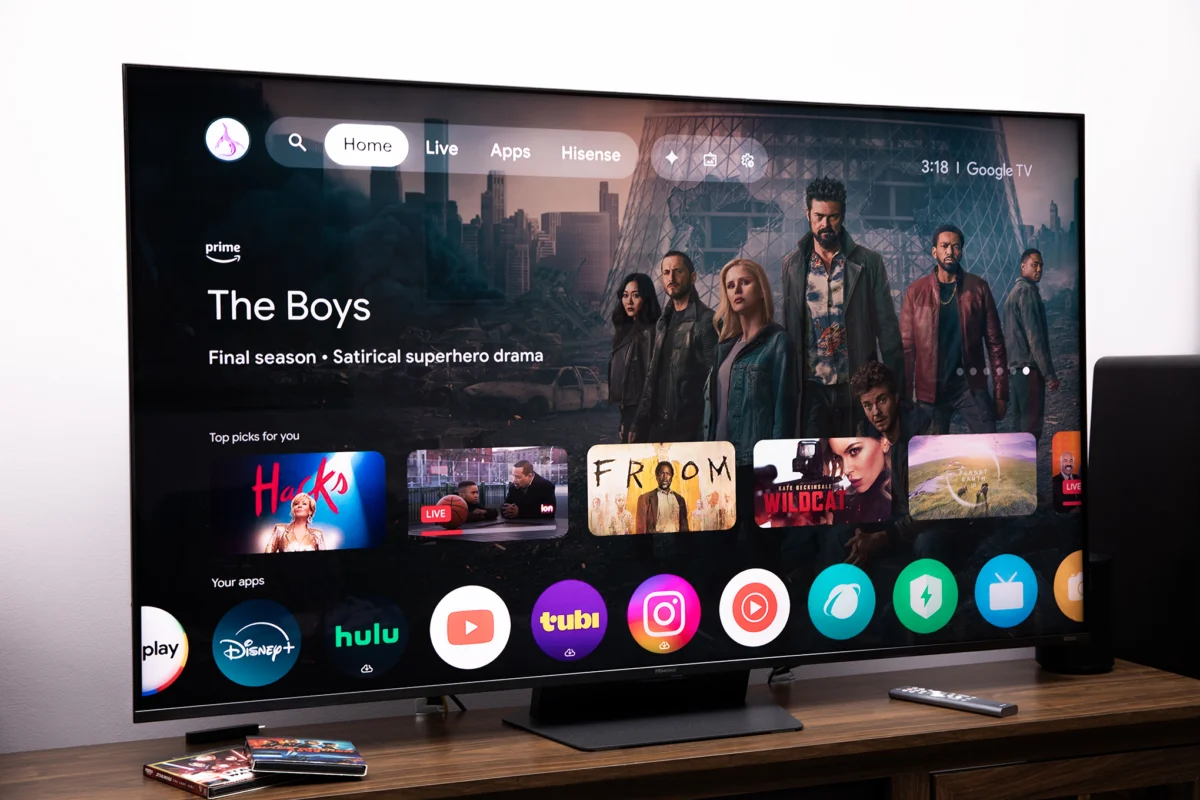
The television landscape is experiencing a significant technological shift with the emergence of RGB LED displays, a promising advancement poised to redefine picture quality. Hisense, a prominent player in the consumer electronics market, has unveiled its UR9 model, marking a pivotal moment as the first commercially available 2026 television to leverage this cutting-edge backlight technology. This debut offers an early assessment of RGB LED’s potential beyond controlled demonstration environments, presenting a tangible improvement over the sophisticated mini-LED televisions that have characterized recent years. The UR9 boasts impressive HDR performance, delivering vibrant and accurate colors, coupled with exceptional brightness levels and the capability to render hues that extend beyond the DCI-P3 color space, a crucial advantage for future-proof cinematic experiences. However, its $3,500 price tag for the 65-inch model positions it directly against premium OLED offerings from industry giants like LG and Samsung, setting the stage for intense market competition.
Hisense’s foray into RGB LED technology is not entirely new; the company previously introduced the ultra-premium, 116-inch Hisense 116UX at a formidable $30,000 last year. This established precedent makes the UR9 and its sibling, the UR8, logical successors, adopting RGB LED backlighting rather than relying on conventional mini-LED technology. Consumers seeking traditional mini-LED performance would need to consider Hisense’s U7SG series. While the UR9 represents the earliest release of a 2026 model incorporating this advanced backlight, its pricing remains above that of flagship mini-LED televisions from the previous year, such as the TCL QM9K. This pricing strategy suggests a premium positioning for the UR9, aiming to capture a segment of the market that prioritizes the absolute latest in display innovation.
The Hisense UR9 is available in a range of sizes, catering to various home theater setups: a 65-inch model retails for $3,500, a 75-inch for $5,000, an 85-inch for $6,000, and a substantial 100-inch variant for $9,000. This pricing architecture places the UR9 in direct competition with the highest-tier OLED televisions from LG and Samsung, a strategic move that signifies Hisense’s confidence in its new technology’s ability to vie for the top spot in picture quality. The reviewed 65-inch model serves as a critical benchmark for evaluating the UR9’s overall performance and market viability against established OLED leaders.
Physically, the 65-inch UR9 exhibits a sleek profile, measuring just 1.8 inches in thickness across its entire chassis, and is supported by a stable pedestal stand. A notable design choice, mirroring the U8QG from the previous year, is the inclusion of only three HDMI 2.1 ports. The fourth HDMI input is a USB-C port with DisplayPort functionality, strategically placed on the left edge of the television rather than alongside the other rear connections. This side-mounted placement may prove inconvenient for users who intend to maintain a continuous connection with a computer, as the cable can become a visible distraction. The UR9 supports a native refresh rate of 180Hz, AMD FreeSync Premium Pro, HDR10+, and Dolby Vision. Furthermore, a forthcoming firmware update is slated to enable Dolby Vision 2 support, although the availability of content specifically formatted for this advanced standard is anticipated to be limited in the near future.

Technical Evaluation Methodology
The assessment of the Hisense UR9 adheres to a rigorous testing protocol designed to simulate real-world viewing conditions and deliver objective performance metrics. Each television is installed within a typical living room environment, situated on a home theater credenza. Content is consumed through the television’s native streaming applications, high-fidelity discs played via a Magnetar UDP900 MkII 4K Blu-Ray player (including the Spears & Munsil Ultra HD Benchmark disc), and movies from a Kaleidescape Strato E player. Gaming performance is evaluated using both the Xbox Series X and PlayStation 5 consoles. Testing is conducted across various times of day and under differing ambient lighting conditions, ranging from open curtains with natural light to a completely darkened room with blackout curtains. While the reviewer is a certified ISF Level 3 calibrator, televisions are evaluated in their out-of-the-box settings with only minor user-adjustable menu adjustments, reflecting the experience of the vast majority of consumers.
For precise measurement and analysis, the testing suite employs Portrait Displays’ Calman color calibration software, a Murideo 8K Seven pattern generator, an X-rite i1 Pro 3 spectrophotometer, Portrait Displays’ C6 HDR5000 colorimeter, a Konica Minolta LS-100 luminance meter, and a Leo Bodnar 4K lag tester. This comprehensive array of tools ensures that all aspects of picture quality, from color accuracy and brightness to contrast and motion handling, are meticulously quantified.
RGB LED Color Gamut and Content Compatibility
A key selling point of RGB LED televisions is their purported ability to achieve full coverage of the BT.2020 color space. This assertion primarily relates to chromaticity, which encompasses saturation and hue, and is independent of brightness or luminance. Visual representations often utilize CIE 1931 diagrams, but these charts do not fully illustrate how colors perform across varying brightness levels or within typical living room environments. The practical impact of achieving 100% BT.2020 is further nuanced by the fact that the vast majority of current HDR content is mastered within the DCI-P3 color space, which is considerably smaller than BT.2020.

Consequently, even when a television, like the UR9, possesses the capability to render colors beyond DCI-P3 and into BT.2020, this extended color volume may not be fully utilized by most movies and television shows. This presents a classic "chicken-and-egg" scenario: the widespread adoption of BT.2020 content creation is contingent upon the availability of televisions that can accurately display it, yet the incentive to produce such televisions diminishes if there is no corresponding content.
Despite this challenge, there exists a growing body of video content that pushes the boundaries of the DCI-P3 color space and extends into BT.2020. The BBC documentary series Planet Earth II, experienced via a Kaleidescape Strato E player, serves as an excellent example. Specifically, Episode 3, focusing on jungle environments, showcased incredibly vibrant greens on the Hisense UR9. A segment featuring hummingbirds in Ecuador further demonstrated the television’s ability to reproduce the dazzling, rich colors of these tiny creatures with exceptional fidelity. The color reproduction on the UR9 was observed to be on par with, and in some instances more colorful than, what was experienced on the premium TCL X11L and flagship OLEDs such as the LG G5 and Sony Bravia 8 II. In scenes with camera pans through dense foliage, some judder was noticeable without motion compensation engaged. Adjusting the motion setting to "Film" effectively smoothed these transitions without introducing an unnatural "soap opera effect."
A significant technical concern with RGB LED technology, as highlighted by LG Display in a promotional video, is the potential for color crosstalk. This phenomenon occurs when adjacent colors bleed into one another, potentially causing unintended color shifts on screen. For instance, a person walking past a brightly colored mural might exhibit a temporary reddish tint to their face when passing a red section, shifting to blue as they move past a blue section. Critically, the Hisense UR9 demonstrated no discernible color crosstalk across any of the diverse content reviewed. This suggests either exceptional processing capabilities and color filter performance that adeptly delineates adjacent colors, or the possibility that the backlight system, while employing RGB diodes, relies on a white light emission and utilizes the color filter for precise color rendering when complex color transitions occur. If the latter is true, it would somewhat diminish the inherent advantage of individual red, green, and blue diodes. However, without a physical deconstruction of the television to analyze the backlight’s precise operation, this remains speculative. Ultimately, the visual output is paramount, and the UR9’s HDR performance is undeniably impressive.
Contrast and Viewing Angles: The Persistent OLED Advantage
While the UR9 exhibits remarkable advancements in color and brightness, OLED technology retains a significant advantage in a fundamental aspect of picture quality: contrast. Contrast, the difference between the brightest white and the darkest black a display can produce, is arguably more crucial to human visual perception than color. It is integral to our ability to perceive depth, movement, and form, and has played a vital role in our evolutionary development and our appreciation of visual media. RGB LED televisions, like all LCD-based displays, utilize an LCD panel, meaning that even with an improved backlight system, they are inherently subject to the limitations of LCD technology, including potential light blooming and more restricted viewing angles.

The Hisense UR9 manages these challenges commendably; while blooming is present, it is well-controlled, though TCL may hold a slight edge in this specific area. However, when compared directly to OLED, which achieves perfect blacks through its self-emissive pixels, OLED consistently delivers a superior overall picture quality due to its unparalleled contrast ratio and pixel-level illumination control.
Hisense UR9 Specifications
- Display Type: RGB LED
- HDR Formats: Dolby Vision (Dolby Vision 2 with future firmware update), HDR10+, HDR10, HLG
- Operating System: Google TV
- HDMI Inputs: 3 x HDMI 2.1 (one with eARC/ARC); 1 x DisplayPort over USB-C
- Audio Support: Dolby Atmos, DTS Virtual X
- Gaming Features: 4K/180Hz, VRR (Variable Refresh Rate up to 330Hz), ALLM (Auto Low Latency Mode), FreeSync Premium Pro
- Available Sizes (inches): 65, 75, 85, 100
Market Positioning and Competitive Landscape
The pricing of the 65-inch UR9 at $3,500 places Hisense’s flagship directly in competition with the top-tier OLED offerings from Samsung and LG, which are similarly priced at approximately $3,400 for the same screen size. Historically, Hisense has differentiated itself by offering comparable technologies at lower price points than its primary competitors. The UR9’s premium pricing suggests a strategic decision to position RGB LED as a direct challenger to OLED, even at parity with established premium models.
This pricing strategy raises questions about the future positioning of RGB LED televisions from other manufacturers. It is anticipated that Sony’s flagship RGB LED models will command the highest prices, potentially justified by superior image processing capabilities. However, if LG and Samsung’s flagship RGB LED televisions are priced at or above the Hisense UR9, it could signify a deliberate market shift where these companies are prioritizing the advancement of their LED technologies over their own highly successful OLED lines. This would be particularly surprising for LG, which has dominated the OLED market for over a decade.

Furthermore, Hisense and Samsung will also introduce step-down models, such as the Hisense UR8 and Samsung R85H, which are expected to be priced below $2,000 for a 55-inch screen. These models will likely compete directly with mid-range OLED offerings like the LG C6. While these mid-range OLEDs may not achieve the same peak brightness as their RGB LED counterparts, they will still offer the inherent advantages of pixel-level control and superior contrast ratios.
The Future Outlook for RGB LED
The television market in 2026 is characterized by rapid innovation and a closing performance gap across various price points and manufacturers. New technologies like RGB LED are emerging, creating an increasingly crowded and competitive landscape. The challenge for RGB LED televisions lies in carving out a distinct market niche. While they demonstrably outperform traditional mini-LED televisions and are poised to eventually supersede them, they are not yet positioned to surpass OLED in overall picture quality. This transition is unlikely to occur before 2027, at the earliest.
For the present, the recommendation for consumers seeking the absolute best in picture quality remains to opt for an OLED television. However, the future of RGB LED technology appears exceptionally bright, with the Hisense UR9 serving as a compelling early indicator of its potential.
Photography by John Higgins / The Verge


 Lisa Mariana
 Safa Marwah