 Lisa Mariana
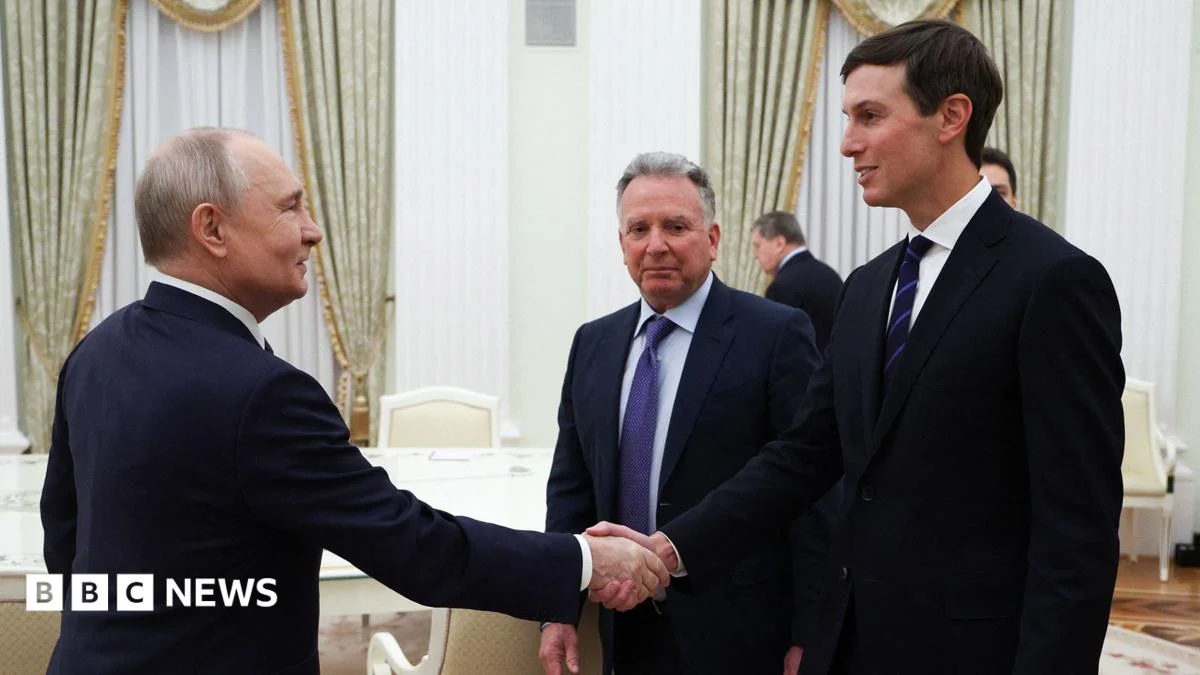
A high-level American delegation, comprising prominent US envoys Jared Kushner and Steve Witkoff, has embarked on a critical diplomatic mission, engaging in intensive discussions with Russian President Vladimir Putin in Moscow before proceeding to meet Ukrainian President Volodymyr Zelensky in Dublin. This sequence of engagements underscores a complex, evolving landscape of peace efforts aimed at resolving the protracted conflict in Ukraine, even as significant obstacles persist and new tensions emerge, particularly regarding vital military communications infrastructure.
The recent round of talks in Moscow, following prior discussions in Abu Dhabi, signals a sustained, albeit challenging, attempt to foster dialogue between the warring nations. Mr. Witkoff confirmed that a subsequent trilateral meeting, which would include European representatives, had already been agreed upon with President Putin. However, the path to a lasting resolution remains fraught with difficulties, as evidenced by escalating rhetoric and critical operational disruptions on the ground.
A significant point of concern arose when President Zelensky reported that Ukraine’s military was once again experiencing "systematic" limitations to its access to Starshield, the military-grade satellite service provided by SpaceX. This disruption, which reportedly impedes Ukraine’s capacity to intercept Russian jet-powered drones, highlights a critical vulnerability in Kyiv’s defense capabilities. Starshield, alongside its civilian counterpart Starlink, has become indispensable for front-line communications and intelligence gathering since Russia’s full-scale invasion in February 2022. The timing and implications of these connectivity issues have raised serious questions within the Ukrainian leadership.
The recent peace talks, particularly those held in the United Arab Emirates, were ostensibly framed around the broad contours of European security arrangements in a post-conflict scenario. Yet, a definitive resolution to the conflict, now in its third year, appears to be a distant prospect. Statements from President Putin and various Kremlin officials consistently indicate an entrenched Russian position, with demands for territorial concessions and Ukrainian neutrality far exceeding any parameters Kyiv has indicated it might consider. This fundamental divergence on core issues continues to be the primary impediment to substantive progress.
Mr. Witkoff’s assertion that European nations would participate in the forthcoming discussions marks a notable development. "They are our partners, and their involvement is crucial to us," Mr. Witkoff conveyed to Russian state television following his meeting with President Putin in the Kremlin. This sentiment signals a potential shift towards a more inclusive diplomatic format, acknowledging the integral role of European stakeholders in any future security framework. Earlier reports had suggested that UK national security adviser Jonathan Powell would join the Dublin talks with President Zelensky, Mr. Witkoff, and Mr. Kushner. However, Downing Street subsequently announced a delay in Mr. Powell’s participation, preventing his attendance at the planned meeting.
President Zelensky’s remarks concerning the Starlink situation on Thursday morning revealed deep-seated anxieties within Kyiv. While acknowledging ongoing efforts to clarify the matter with the American side, he stated that "some things" were already evident: "If decisions are being made in America that fundamentally treat Ukrainian territory as if it is not Ukrainian, then this clearly indicates the direction of unfolding events." He refrained from elaborating further on this potentially inflammatory statement, leaving open interpretations regarding the perceived motives or implications of the Starshield restrictions.
Starshield, developed by Elon Musk’s SpaceX, is engineered specifically for governmental and military applications, offering robust and resilient satellite internet access. Its role in maintaining communication links across the vast Ukrainian front lines is paramount, enabling coordinated troop movements, drone operations, and critical intelligence dissemination. This is not the first instance of such a disruption; a similar connectivity issue plagued the front lines in late October, lasting approximately a week before service was restored. The source of those earlier restrictions also remained unconfirmed, fueling speculation and uncertainty within Ukrainian military circles.
According to President Zelensky, the current disruption had persisted for several days, directly impacting Ukraine’s defensive capabilities. He unequivocally stated that this operational setback was "assisting the Russians in killing more Ukrainians and executing more precise strikes against Ukraine." Such an assessment underscores the profound strategic importance of reliable satellite communication in modern warfare and the devastating human cost of its intermittent failure. The implications extend beyond immediate tactical disadvantages, potentially eroding trust and complicating strategic planning.
Parallel to the Starshield controversy, the US-Russia talks in the Kremlin also addressed long-standing impasses in the peace process. The territorial dispute, as anticipated, remained a central point of contention. President Putin reiterated Russia’s uncompromising stance: "For us, there is only one line of demarcation: the line of the state border. Because then it will be clear that we are here, and you are there. As soon as we start discussing ‘grey zones,’ arguments immediately start, and any agreements become unstable. And there will be no lasting peace." This statement unequivocally rejects any notion of partial territorial concessions or demilitarized zones that do not align with Russia’s claimed borders, effectively foreclosing significant avenues for negotiation.
In a seemingly humanitarian gesture, President Putin proposed organizing a temporary truce to facilitate the evacuation of civilians from a front-line area. He cited last month’s ceasefire in the Russian-occupied city of Oleshky as a potential model, suggesting a similar five-day cessation of hostilities for Kostyantynivka, a contested front-line Ukrainian city in the eastern Donetsk region. However, Kyiv immediately expressed skepticism regarding the true intentions behind such a proposal. Ukraine disputes Russia’s complete control over Kostyantynivka, and a temporary truce, Ukrainian officials fear, could strategically benefit Moscow’s forces by allowing them to consolidate positions or prepare for a final offensive push to seize the city.
Dmitry Lytvyn, a Ukrainian presidential adviser, articulated Kyiv’s reservations to the BBC: "Considering that they brought in equipment and rotated troops in Oleshky under the guise of a humanitarian operation, it’s clear what they want in Kostyantynivka." He emphasized the necessity for "clarification" on the details of any such truce, signaling Ukraine’s deep distrust of Russian proposals, which are often viewed through the lens of strategic opportunism rather than genuine humanitarian concern. The historical precedent of Russia utilizing ceasefires for military advantage further compounds Kyiv’s caution.
At the very core of this week’s diplomatic exchanges lies the fundamental issue of European security architecture. Mr. Kushner articulated the US aspiration to "create a new framework" of security encompassing Ukraine, Russia, and Europe, with the ultimate goal of achieving "lasting peace." Echoing this sentiment from the Russian perspective, Kremlin aide Yury Ushakov candidly stated that it was "clear that the current system does not work." These statements reflect a shared recognition of the inadequacy of existing security structures in preventing or resolving large-scale conflicts in Europe, but they diverge sharply on the nature and principles of a potential replacement.
Ukraine and many European nations have long harbored concerns regarding the current US administration’s commitment to European security, perceiving a potential softening towards the Kremlin and a risk of decisions about their continent being made without their full involvement. President Zelensky openly described the US approach of discussing a new European security order with Russia as "a bit strange," highlighting the discomfort with a bilateral US-Russia dialogue on issues that profoundly affect European sovereignty and strategic interests.
Kristi Raik, Director of the Estonian Foreign Policy Institute, provided critical expert analysis on this shift. She noted that it represents a "significant shift in the US position that the US has now taken on board the Russian demand that the European security architecture needs to be discussed and agreed upon in parallel with the Ukraine peace talks." Raik underscored Russia’s "long history" of seeking to revise European security architecture, often with the aim of challenging core principles such as national sovereignty, territorial integrity, and the prohibition of the use of force to resolve disputes. Historically, Russia has also sought to diminish NATO’s presence on its eastern flank and acquire a de facto veto right over decisions pertaining to European security and defense. "And that’s where it gets even more difficult to imagine that there could be an agreement between the Europeans and the Russians," Raik concluded, highlighting the fundamental incompatibility of these objectives.
President Putin, on Thursday, reiterated Russia’s steadfast position that the presence of foreign troops in Ukraine is "unacceptable." He further expressed Russia’s desire for the Americans to engage proactively with Europe "so that the Europeans can decide what they truly want: peace or war." This statement appears to be a calculated attempt to sow discord between the US and its European allies, and potentially among European nations themselves, by framing the conflict as a choice for Europe rather than a consequence of Russian aggression.
During the initial years of the full-scale invasion, many European nations largely severed direct communications with the Kremlin, opting for a unified stance of non-engagement. However, that position has gradually shifted for some, driven by a growing apprehension that critical decisions affecting the European continent might be made without direct European input. This evolving concern has created an impetus for greater European involvement in diplomatic efforts, even those initiated by the US.
Mr. Kushner notably urged Europe to "identify one person to speak on their behalf" in the ongoing negotiations, suggesting a desire for a more streamlined and unified European voice in the complex diplomatic process. Top EU diplomat Kaja Kallas, speaking on the BBC’s Newshour program, interpreted the prospective presence of a European official at the next meeting as a sign that the Kremlin had "now realized that Europe is a big player here because we are the ones who have been supporting Ukraine."
While acknowledging the increasing financial pressures on European budgets, which are making it "harder to help Ukraine," Kallas issued a stark warning regarding the broader implications of continued Russian aggression. She highlighted "the danger not only for the eastern flank of the European Union but actually for our whole continent" if Russia’s military actions are allowed to persist unchecked. This reflects a growing understanding within European capitals that the conflict in Ukraine is not merely a regional issue but a fundamental challenge to the continent’s security architecture and stability.
The Kremlin has yet to officially confirm the precise composition of next week’s proposed talks. Initially, President Putin had indicated a reluctance for European countries to play a full role, with Russian officials frequently citing Europe’s steadfast support for Kyiv as a significant impediment to their involvement. In his discussions with Mr. Kushner and Mr. Witkoff, President Putin explicitly encouraged them "to work with your European allies so that they finally decide whether they want peace or war in Ukraine," once again underscoring Russia’s strategy of attempting to influence European unity and resolve.
The current diplomatic flurry, characterized by high-stakes meetings and contentious issues, reflects the intricate and multi-layered nature of the Ukraine conflict. From the immediate tactical concerns of satellite communication disruptions to the overarching debate about the future of European security, the path to a sustainable peace remains elusive, fraught with profound disagreements and geopolitical maneuvering. The dual mission of the US envoys represents a crucial, yet uncertain, chapter in the ongoing efforts to navigate this complex and dangerous landscape.



 Aura Kasih