 Ayu Aulia
An incessant torrent of enigmatic, subatomic particles, largely imperceptible, traverses the Earth at nearly the speed of light, passing through all matter, including living organisms, with minimal interaction. These elusive entities, known as neutrinos, are among the most challenging phenomena in the universe to directly observe. Yet, monumental scientific endeavors are gradually unraveling their secrets, offering unprecedented avenues to explore the deepest recesses of the cosmos and the most cataclysmic events it harbors.
The study of neutrinos has profoundly reshaped modern physics, with discoveries concerning these particles earning five Nobel Prizes in Physics. This year, the scientific community lauded physicist Francis Halzen for his instrumental role in establishing the IceCube Neutrino Observatory and confirming the existence of high-energy neutrinos originating from astrophysical sources. This recognition underscores the transformative potential of neutrino astronomy in understanding the universe’s most extreme environments. Distinguished Professor of Physics at the University of California San Diego, George Fuller, a seasoned expert in nuclear physics, particle astrophysics, and cosmology, collaborated with Halzen on foundational research for IceCube. His extensive knowledge illuminates the peculiar characteristics of neutrinos and the compelling scientific imperative behind constructing an colossal observatory beneath the Antarctic ice sheet to scrutinize them.
The Enigmatic Nature of Neutrinos
Neutrinos are categorized as elementary particles, fundamental constituents of matter currently believed to possess no smaller components. They manifest in three distinct "flavors": electron, muon, and tau neutrinos. Unlike most subatomic particles, neutrinos carry no electrical charge, a property that profoundly influences their behavior. While once thought to be massless, experiments have since confirmed they possess a minuscule mass, estimated to be at least 10 million times less than that of an electron. The precise values of their masses and the underlying mechanisms responsible for their generation remain significant unresolved questions in particle physics.
A defining characteristic of neutrinos is their extraordinary ability to traverse vast distances through dense matter with virtually no impedance. Their exceedingly weak interaction with other particles allows them to travel unimpeded from their points of origin, reaching speeds approaching the cosmic speed limit. Neutrinos are incredibly abundant, originating from diverse sources including the Sun’s core, supernovae explosions, and exotic cosmic accelerators in distant galaxies. Estimates suggest the universe is permeated by an astonishing density of these particles, approximately 10^89 neutrinos in total, equating to roughly one billion neutrinos for every atom in existence.
"Neutrinos embody the essence of ghost-like particles," observed Professor Fuller. "Their detection is arduous, their capture even more so. The very notion of their existence and pinpointing their origins represents a monumental scientific challenge."
Ghost Particles and Their Cosmic Message
Despite their elusive nature, neutrinos occasionally engage with matter via the weak nuclear force, one of the four fundamental interactions of nature. This force is remarkably feeble, approximately 20 orders of magnitude weaker than electromagnetism, making neutrino interactions exceptionally rare events. When such an interaction occurs, a neutrino can scatter or be absorbed, producing secondary particles that can be detected. However, the infrequency of these events necessitates the deployment of extraordinarily sensitive and massive detectors to capture meaningful data.
The capacity of neutrinos to penetrate enormous amounts of material makes them invaluable cosmic messengers. Unlike photons (light), which are easily absorbed or scattered by dense gas and dust, neutrinos can escape from the most extreme and opaque environments, such as the immediate vicinity of collapsing stars, supermassive black holes, and other high-energy astrophysical phenomena. They carry pristine information directly from these otherwise inaccessible regions, offering a unique window into the universe’s most violent processes. The sheer scale of this invisible activity is staggering: an estimated 100 billion neutrinos pass through every square centimeter of your body each second, almost entirely unnoticed.
"The interaction is so profoundly weak that neutrinos can penetrate almost anything," Fuller explained. "Light-years of lead would pose no barrier; depending on their energy, they would simply pass right through."
The Journey to Neutrino Detection
The theoretical concept of neutrinos predates their experimental observation by decades. In the 1930s, physicist Wolfgang Pauli proposed the existence of an unknown, neutral particle to account for the apparent deficit of energy observed during certain forms of radioactive decay, specifically beta decay. He initially referred to this hypothetical particle as a "neutron" (a term later adopted for a different particle). Pauli himself recognized the formidable challenge of verifying his hypothesis, famously quipping, "I have done a terrible thing, I have postulated a particle that cannot be detected."
For an extended period, neutrinos remained theoretical constructs, beyond the reach of experimental verification. This changed dramatically in 1956, when physicists Clyde Cowan and Frederick Reines, working on "Project Poltergeist," successfully detected antineutrinos (the antimatter counterpart of neutrinos) emitted from a nuclear reactor. Their groundbreaking experiment conclusively demonstrated the reality of these elusive particles. While Project Poltergeist marked a pivotal breakthrough, detecting neutrinos, especially those of cosmic origin, continued to present immense challenges. Scientists subsequently embarked on developing increasingly sophisticated instruments capable of capturing the rarest and most energetic neutrinos arriving from the depths of space.
Antarctica: A Natural Laboratory for Cosmic Neutrinos
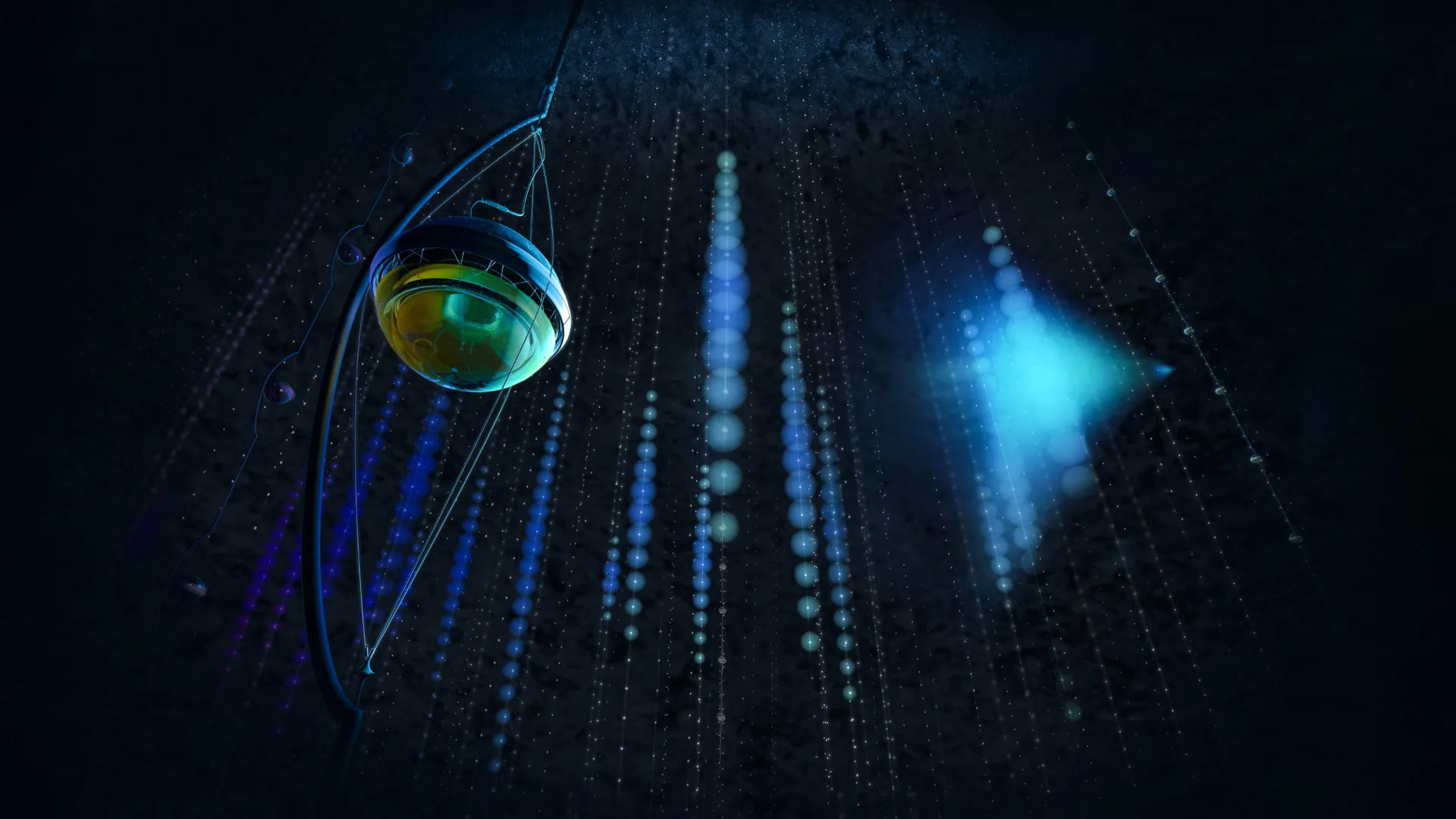
In the 1990s, Francis Halzen recognized the unparalleled potential of the South Pole as a natural laboratory for neutrino research. Deep beneath the Antarctic ice sheet, immense volumes of ice exhibit exceptional clarity, with minimal air bubbles or contaminants that could obstruct the faint light signals generated by neutrino interactions. This vision culminated in the development of the IceCube Neutrino Observatory, an extraordinary scientific instrument spanning approximately one cubic kilometer of ice. Its construction involved drilling 86 holes, each extending 2,450 meters (1.5 miles) deep, into which long strings of highly sensitive optical sensors, known as digital optical modules (DOMs), were lowered. These DOMs, each containing a photomultiplier tube, are designed to detect the subtle flashes of blue light produced by Cherenkov radiation.
Cherenkov radiation occurs when a charged particle, generated by a neutrino interacting with an atom in the ice, travels faster than the speed of light in that specific medium (which is slower than the speed of light in a vacuum). This phenomenon creates a characteristic cone of blue light, analogous to a sonic boom generated by an object exceeding the speed of sound. By precisely recording these fleeting flashes of light, researchers can reconstruct the trajectory and energy of the original neutrino, thereby detecting its passage through Earth, an event that would otherwise remain entirely invisible.
Unveiling Extraordinary Particles from Deep Space
IceCube is uniquely positioned to study neutrinos originating from distant cosmic sources, particularly those possessing extraordinarily high energies. In stark contrast to the vast numbers of relatively low-energy neutrinos continuously produced by the Sun, these powerful cosmic visitors are exceedingly rare. The observatory typically detects only a few dozen of the most energetic examples each year, making each event a treasure trove of astrophysical information.
When one of these high-energy neutrinos interacts with the Antarctic ice, it can produce a rapidly moving secondary charged particle, such as an electron or a muon. A muon, for instance, generates a distinctive cone of Cherenkov light as it traverses the ice. Scientists meticulously analyze the resulting pattern of light signals across the vast array of DOMs to estimate the neutrino’s energy and precisely reconstruct its direction of arrival. This directional information is crucial for pinpointing the cosmic sources of these extreme particles.
For Professor Fuller, these exceptionally energetic neutrinos represent some of IceCube’s most profound discoveries. Their origins and the powerful physical processes responsible for accelerating them to such incredible energies remain largely unknown, representing a frontier in astrophysics. "Some ultra-high-energy neutrinos detected at IceCube possess energies roughly 10 billion times greater than a typical solar neutrino," he stated. "One particular event, recorded by a similar experiment, exhibited an energy 200 times higher than even that. We currently lack a definitive explanation for its origin. The mere fact that such a particle reached us may hold profound implications for our understanding of the universe. In this regard, Halzen’s work truly stands at the forefront of experimental fundamental particle physics."
Neutrinos: Keys to Unlocking the Big Bang’s Secrets
The global scientific endeavor to comprehend neutrinos extends far beyond the Antarctic ice. Researchers at UC San Diego are also deeply involved in another significant observatory poised to offer novel insights into these enigmatic particles and the universe’s earliest epochs. Perched at a high altitude in Chile’s Atacama Desert, the Simons Observatory is meticulously collecting data on the cosmic microwave background (CMB) – the primordial radiation that permeates the universe, a relic from its infancy. Often described as the "oldest light in the cosmos," the CMB provides an invaluable snapshot of the conditions that prevailed just moments after the Big Bang.
UC San Diego played a pivotal role in establishing the Simons Observatory, with Brian Keating, a Distinguished Professor of Physics at the university, serving as its principal investigator. While the observatory’s primary focus is the ancient light of the CMB, its highly sensitive measurements can indirectly reveal crucial information about neutrinos from the universe’s earliest stages. These relic neutrinos, though undetectable individually, subtly influence the properties of the CMB. By meticulously analyzing tiny fluctuations in the CMB’s temperature and polarization, scientists can infer properties of these ancient particles, such as their number density and total mass, providing insights that other experiments cannot yield.
Professor Fuller anticipates that the forthcoming observations from the Simons Observatory will significantly advance humanity’s understanding of the Big Bang, the early evolution of the universe, and other foundational questions regarding the cosmos’s development. "Halzen’s pioneering work, and the vision he inspired in others, was foundational in granting humanity a new window into the universe and into the mysterious and notoriously slippery neutrino," he concluded. The synergy between high-energy neutrino observatories like IceCube and cosmological probes like the Simons Observatory promises a holistic understanding of these ghost particles, from their creation in the most violent cosmic events to their pervasive influence on the very fabric of the early universe, pushing the boundaries of what is knowable about our cosmic home.




 Lisa Mariana

 Aura Kasih