
 Lisa Mariana
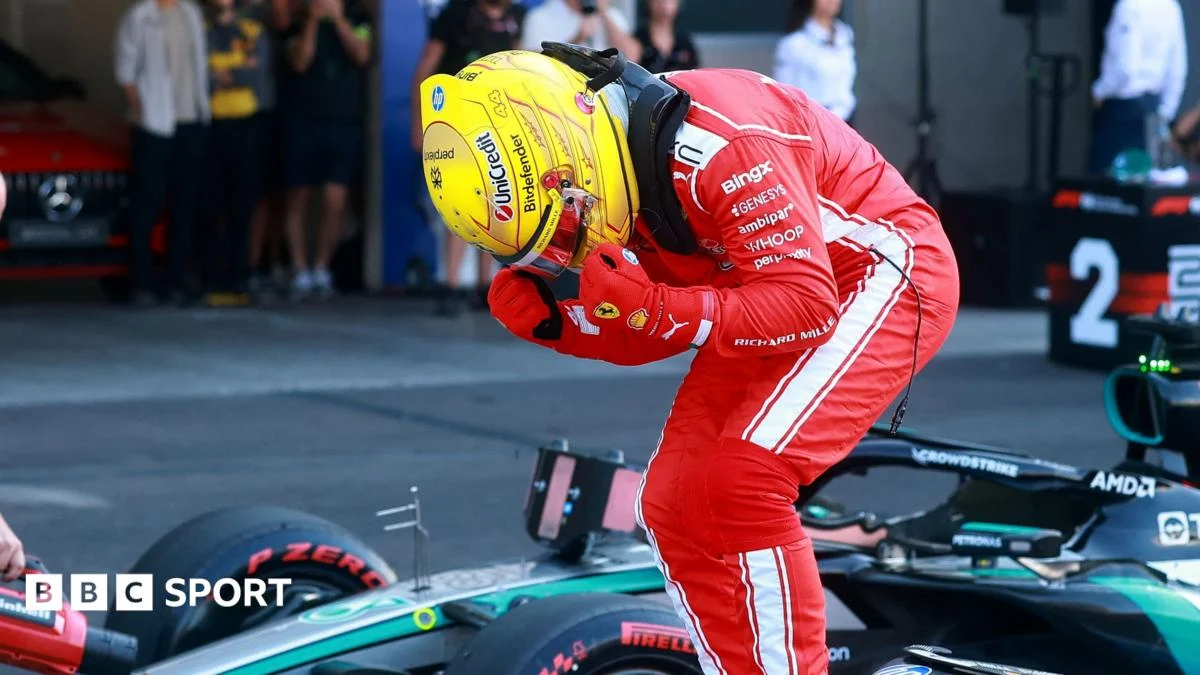
Sir Lewis Hamilton has secured a momentous pole position at the Mexico City Grand Prix, marking his inaugural top grid slot for Ferrari and his first in over three years, a result that significantly alters the strategic landscape for Sunday’s race and intensifies the nascent championship battle. This exceptional performance, delivered with clinical precision on a challenging circuit, underscores the seven-time world champion’s enduring capability and injects considerable momentum into his highly anticipated transition to the Maranello outfit.
The session culminated in a razor-thin margin, with Hamilton outpacing Mercedes teammate George Russell by a mere 0.009 seconds. This front-row lockout by the two drivers still mathematically capable of thwarting Kimi Antonelli’s bid for the world title provides a compelling narrative leading into the race. Antonelli, the prodigious talent who qualified fifth, will commence the Grand Prix from fourth position due to a one-place grid penalty incurred by Red Bull’s Max Verstappen, who originally qualified fourth. The permutations for Antonelli to secure the championship on Sunday are now finely balanced, requiring specific outcomes from Hamilton and Russell to prolong the title fight. Should Russell emerge victorious, Antonelli must finish no lower than ninth to be denied the championship. Similarly, a Hamilton victory would necessitate Antonelli finishing outside the points-scoring positions to defer the title coronation.
Hamilton’s pole position is not only a personal triumph but also a significant statistical milestone. It represents his 105th career pole, a testament to an unparalleled career spanning nearly two decades at the pinnacle of motorsport. This achievement breaks a drought extending since the 2023 Hungarian Grand Prix, a period of three years and three months. Furthermore, at his current age, Hamilton becomes the oldest driver to secure a pole position since the legendary Mario Andretti accomplished the feat for Ferrari at the 1982 Italian Grand Prix. This remarkable longevity and sustained competitive edge highlight a rare confluence of talent, dedication, and adaptability.
The qualifying session unfolded with dramatic tension, particularly in the decisive Q3 segment. Both Hamilton and Russell elected for early runs, laying down formidable initial benchmarks that their rivals subsequently struggled to surpass. Ferrari’s Charles Leclerc was the first to challenge, falling short of Hamilton’s initial time by 0.119 seconds. Antonelli, while demonstrating strong pace throughout the weekend, could not quite find the rhythm to challenge the very front on his final Q3 attempt. The most potent threat to Hamilton’s provisional pole came from Max Verstappen, who appeared poised to snatch the top spot. The Red Bull ace was fastest through the first two sectors of his final lap, showcasing the raw speed typically associated with his dominant performances. However, a critical error in the stadium section, a lock-up into the hairpin, irrevocably compromised his lap, consigning him to a starting position that, compounded by his penalty, places him on the second row.
Hamilton’s post-qualifying reflections conveyed a profound sense of satisfaction and surprise. He acknowledged the challenging nature of the weekend, particularly a significant engine issue encountered on Friday, which severely limited his long-run data collection and placed the team on the back foot. Overcoming such a technical setback to secure pole position speaks volumes about the collective effort of the team and the driver’s ability to maximize limited track time. "I’m lost for words," Hamilton remarked, emphasizing the difficulty of the task. He praised the team’s diligent work on setup, which proved instrumental in unlocking the car’s potential. The emotional weight of achieving his "first pole for Ferrari" was palpable, drawing parallels to the iconic successes of Michael Schumacher with the Scuderia. This moment, he suggested, was a precursor to his future chapter, echoing the historical resonance of legendary figures in Ferrari’s illustrious past.
Interestingly, Hamilton’s initial run in Q3 placed him only fourth, more than 0.4 seconds adrift of Leclerc’s then-leading pace. The magnitude of his improvement on the final run underscores a remarkable ability to extract performance under pressure. He described his final effort as a "super-good lap," confident that he had left no time on the table. This ability to deliver a flawless lap when it matters most is a hallmark of Hamilton’s career and a key differentiator in elite motorsport.
The competitive landscape was further shaped by George Russell’s intriguing strategic decision. Despite a recent spell of inconsistent form, Russell expressed satisfaction with his performance, though he admitted he couldn’t fully explain the sudden resurgence. In a moment of high-stakes intuition, he opted against a preparation lap after his out-lap on his final Q3 run, a unilateral decision contrary to the team’s insistence on a prep lap and the car’s fueling for the extra mileage. While acknowledging the minimal time loss from the additional fuel weight, Russell conceded that even this minute difference could have been greater than the 0.009-second gap to pole. This highlights the razor-thin margins in Formula 1 and the constant interplay between driver instinct and team strategy.
McLaren’s Lando Norris had initially shown strong contention for pole in the early stages of Q3, positioning himself third fastest behind Leclerc and Verstappen on the first runs. However, he was unable to improve on his final attempt, ultimately settling for sixth place. The top ten was rounded out by Red Bull’s Isack Hadjar, the Racing Bulls duo of Liam Lawson and Arvid Lindblad, and Alpine’s Pierre Gasly, showcasing a diverse competitive field.
A particularly poignant moment in qualifying involved Fernando Alonso, who had displayed promising pace for Aston Martin, briefly topping the timesheets in Q2 ahead of several cars that typically outpace his machinery. His hopes for a strong grid position were cruelly dashed when his Honda power unit suffered a water leak in the energy recovery system as he commenced his second Q2 attempt. Lying third at the time, he was instructed to immediately stop the car on track. Alonso’s subsequent interview provided a stark illustration of his palpable frustration, delivering only nine words in response to four questions, confirming an engine problem, acknowledging a lost opportunity, and expressing resignation about his prospects from the back of the grid. This incident encapsulated a season plagued by reliability and performance issues for Aston Martin, a narrative that has become increasingly taxing for the two-time world champion.
The unique characteristics of the Autódromo Hermanos Rodríguez in Mexico City add another layer of complexity to qualifying and race strategy. Situated at an altitude exceeding 2,200 meters (7,200 feet), the track presents significant engineering challenges. The thinner air reduces aerodynamic downforce, necessitating maximum wing angles to compensate, yet still resulting in cars sliding more and having less grip. This low-grip environment places a premium on mechanical balance and driver sensitivity. Crucially, the reduced oxygen density also impacts engine performance, as internal combustion engines struggle to produce their full power output. Turbochargers work harder to compensate, but overall power remains diminished, affecting acceleration and top speed. Furthermore, the thinner air compromises cooling efficiency for both engines and brakes, demanding robust thermal management strategies from teams. Hamilton’s ability to extract pole position under these challenging conditions underscores a masterclass in car setup and driving adaptation.
Looking ahead to Sunday’s Grand Prix, the implications of this qualifying result are multifaceted. For Hamilton, it provides a powerful psychological boost and validates his decision to embark on a new chapter with Ferrari. It demonstrates his capacity to compete at the very sharp end, even as he approaches the twilight of his career, and sets a precedent for his future contributions to the Scuderia. For Ferrari, it represents a significant morale enhancer and a tangible return on their long-term investment in the British driver, generating invaluable positive publicity and reinforcing their ambition.
For Mercedes, the front-row lockout is a bittersweet outcome. While it showcases the underlying performance of their chassis and power unit, it simultaneously highlights the impending departure of their most successful driver and the immediate threat he poses to their season objectives. Russell’s renewed form is a positive, but the team now faces the prospect of competing directly against Hamilton for race victory. Red Bull, with Verstappen starting fourth, faces an unusual challenge from behind. While their race pace is often formidable, overtaking on this circuit can be tricky, and managing tire degradation in the high altitude will be paramount.
The championship fight involving Antonelli remains finely poised. While starting fourth provides a strong platform, the presence of Hamilton and Russell directly ahead, both with clear objectives, adds immense pressure. The young Italian’s ability to manage this pressure and execute a clean race will be critical. Any misstep could open the door for Hamilton or Russell to extend the title battle.
Fernando Alonso’s continued reliability woes for Aston Martin raise broader questions about the team’s long-term engine strategy and its impact on driver retention. Such persistent issues can be demoralizing for a highly competitive driver and could influence future decisions regarding engine suppliers or driver contracts.
The Mexico City Grand Prix promises to be a strategic chess match, heavily influenced by tire management, fuel consumption in the thin air, and the always-present potential for safety car interventions. The outcome will not only determine the race winner but could also reshape the destiny of the 2024 Drivers’ Championship, setting the stage for a compelling conclusion to the season. The resurgence of Lewis Hamilton at the pinnacle of qualifying underscores the enduring power of experience and ambition, promising a dramatic race day with profound implications for the sport’s immediate and long-term future.


 Aura Kasih


 Safa Marwah
