Safa Marwah
Medical Computer Business Services (MCBS), a key provider of administrative and financial solutions for healthcare organizations, has formally acknowledged a substantial cybersecurity intrusion that resulted in the unauthorized exposure of sensitive personal and medical data pertaining to approximately 1.26 million patients. This incident underscores the escalating vulnerabilities within the healthcare ecosystem, particularly concerning third-party business associates that manage vast quantities of protected health information.
The Augusta, Georgia-based company, which specializes in medical billing, coding, accounts receivable management, and practice administration, functions as a critical intermediary in the healthcare data chain. Its role as a data aggregator means it processes and stores patient records on behalf of numerous healthcare providers, making it a lucrative target for malicious actors seeking high-value personal health information (PHI). The confirmed breach, initially detected in 2025, has since been formally reported to the U.S. Department of Health and Human Services, specifying the precise number of impacted individuals at 1,261,464.
The Anatomy of the Compromise: Timeline and Discovery
According to disclosures made by MCBS, unauthorized access to its internal network systems transpired between September 22 and September 26, 2025. While the initial breach occurred in the prior year, the extensive investigation into the incident’s full scope and impact was a protracted process, culminating on May 28 of the current year. This significant delay between the initial network intrusion and the comprehensive understanding of its consequences highlights the complex nature of forensic analysis following sophisticated cyberattacks. Only after this thorough assessment was completed could MCBS ascertain the full extent of the data compromise and the precise number of individuals affected.
The public notification regarding this security event was initially issued by MCBS in late June through a dedicated section on its corporate website. This initial communication provided limited specifics regarding the total number of individuals whose data might have been compromised. The subsequent, more detailed disclosure to federal regulatory bodies provided the definitive figure, signaling the severity and widespread nature of the breach.

Scope of Compromised Data and Its Implications
The investigation revealed that a wide array of personal and protected health information was potentially accessed and exfiltrated during the incident. While the specific data points varied for each individual, the compromised categories included highly sensitive details. Such information, when aggregated, presents a significant risk for identity theft, financial fraud, and medical fraud. For instance, the combination of demographic data with medical service information can be exploited to create fraudulent medical claims, acquire prescription drugs under false pretenses, or even open new lines of credit.
MCBS serves as a business associate for various "covered entities"—the actual healthcare providers—and is entrusted with managing their patient data. The company’s notification explicitly listed several of these entities, including South Georgia Radiology Consultants, SkinPath Solutions, and Stephen W. Brown and Radiology Associates. This detail is crucial, as it indicates that the patients of these specific providers are among those whose information was potentially compromised due to MCBS’s role in handling their data. The legal and ethical implications for these covered entities, whose data was held by a third-party vendor that suffered a breach, are substantial under frameworks like the Health Insurance Portability and Accountability Act (HIPAA).
The Threat Actor: PEAR Ransomware Group’s Allegations
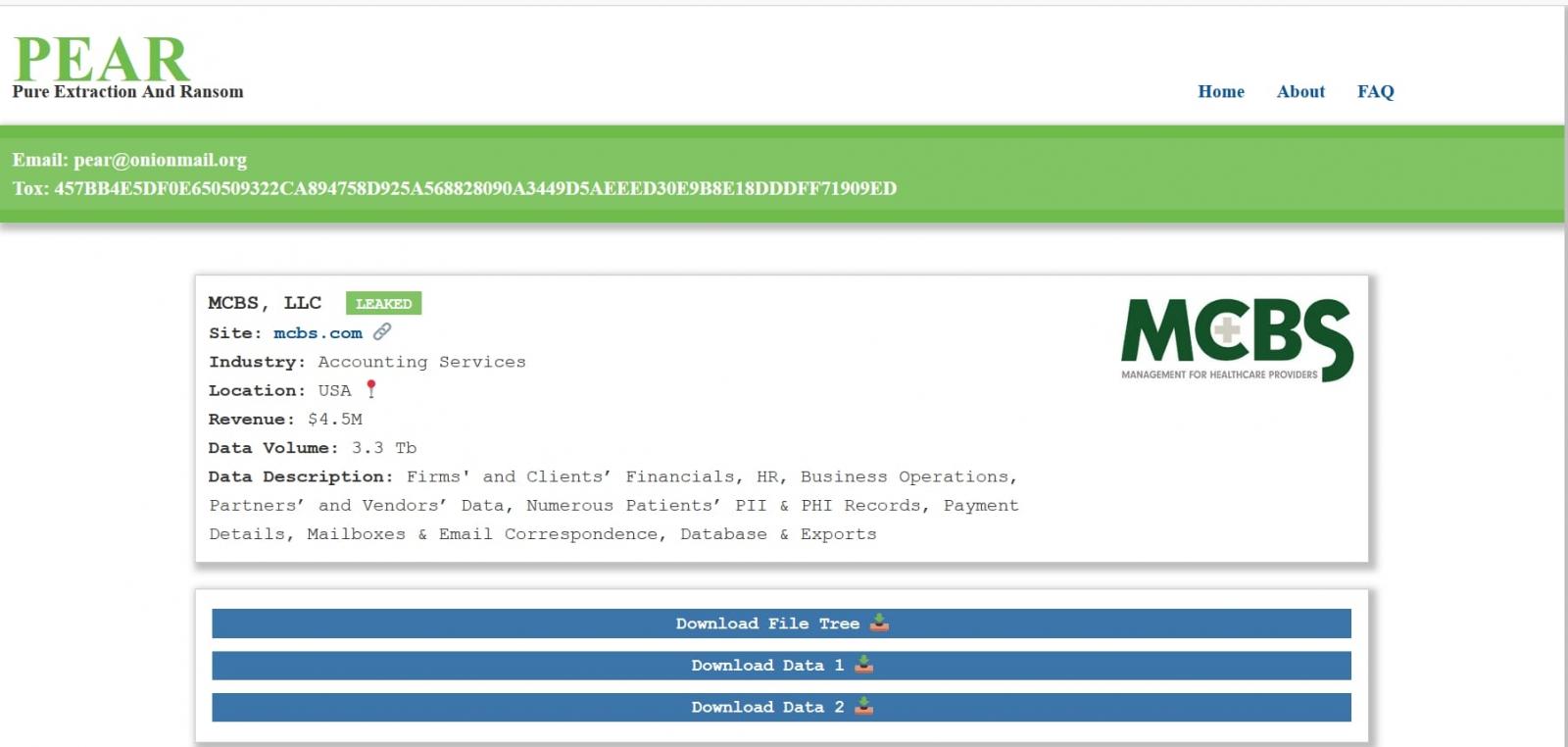
Adding another layer of complexity and concern to the incident, the PEAR (Pure Extraction and Ransom) ransomware group has publicly claimed responsibility for the cyberattack on MCBS. The group asserts that it successfully exfiltrated a massive 3.3 terabytes of data from MCBS’s systems. While the authenticity of this claim and the contents of the alleged data cache have not been independently verified by public sources, the magnitude of the claimed exfiltration aligns with the significant number of affected individuals reported by MCBS.
Beyond the client data specifically highlighted in MCBS’s official announcement, the PEAR group’s claims extend to other critical categories of information. These include human resources data, detailed business operation insights, payment processing information, internal email correspondence, and various proprietary databases. If these additional claims are accurate, the breach’s impact extends beyond patient privacy to include corporate operational integrity, employee data security, and potential competitive intelligence vulnerabilities. The reported full leakage of this data online by the ransomware group further exacerbates the risks, making the compromised information readily accessible to a broader array of malicious actors.

Recommendations for Affected Individuals
In light of the extensive data compromise, MCBS has issued stern recommendations for individuals who believe their information may have been affected. The primary advice centers on proactive credit monitoring and fraud prevention. Individuals are strongly urged to place a fraud alert on their credit files, which signals to creditors that they should take extra steps to verify identity before extending credit. Furthermore, considering a security freeze on their credit file is an even more robust measure, as it restricts access to their credit report, preventing new credit accounts from being opened in their name.
For those who have received medical services in the state of Georgia, it is advisable to directly contact their healthcare providers. This step is crucial to ascertain whether their specific provider utilizes MCBS for billing and administrative services, thereby determining if their personal and medical information could be implicated in this incident. Such direct engagement is essential for individuals to understand their personal exposure and take appropriate protective actions.
The Broader Landscape of Healthcare Cybersecurity and Third-Party Risk
This incident at MCBS is emblematic of a pervasive and growing challenge within the healthcare sector: the inherent vulnerabilities introduced by third-party vendors and business associates. Healthcare providers increasingly rely on specialized firms for services ranging from billing and IT support to electronic health record (EHR) management. While these partnerships streamline operations, they also expand the attack surface, creating additional points of entry for cybercriminals.
Under HIPAA, covered entities are not only responsible for protecting patient data within their own systems but also for ensuring that their business associates uphold similar stringent security standards. Business Associate Agreements (BAAs) are legally binding contracts that mandate these third parties implement appropriate safeguards. A breach at a business associate like MCBS, therefore, carries significant implications not just for the billing firm but also for the healthcare providers whose patients’ data was entrusted to them. This shared responsibility often leads to complex legal and reputational ramifications for all parties involved.
The frequency and sophistication of cyberattacks targeting healthcare organizations have been on a steep upward trajectory. Protected Health Information (PHI) is considered highly valuable on underground markets due to its comprehensive nature, containing everything from social security numbers and addresses to medical histories, which can be leveraged for various forms of fraud. Ransomware groups, in particular, have intensified their focus on healthcare, recognizing the critical nature of these services and the potential for higher ransom payments to restore essential operations quickly. The tactic of data exfiltration, as claimed by PEAR, adds an extortion element, where data is stolen and then threatened to be publicly released if a ransom is not paid, even if systems are restored from backups.
Regulatory Scrutiny and Industry Imperatives
The incident at MCBS will undoubtedly attract significant regulatory scrutiny from agencies such as the Office for Civil Rights (OCR) under HHS, which enforces HIPAA rules. Non-compliance with HIPAA’s security and privacy rules can lead to substantial financial penalties, legal actions, and mandatory corrective action plans. The prolonged timeline between the initial breach and the full scope determination could also be a point of inquiry, as timely breach notification is a critical component of regulatory compliance.
For the broader healthcare industry, this event serves as another stark reminder of the urgent need for robust cybersecurity frameworks that extend beyond an organization’s immediate perimeter. Key imperatives include:
- Enhanced Third-Party Risk Management: Implementing rigorous vetting processes for all vendors, conducting regular security audits, and ensuring comprehensive BAAs are in place and actively monitored.
- Proactive Threat Detection: Investing in advanced security technologies, including intrusion detection systems, endpoint detection and response (EDR), and security information and event management (SIEM) solutions, capable of identifying subtle indicators of compromise.
- Robust Incident Response Planning: Developing and regularly testing detailed incident response plans to minimize the impact of breaches, including clear communication protocols, forensic investigation procedures, and data recovery strategies.
- Employee Training: Continuously educating staff on cybersecurity best practices, phishing awareness, and data handling protocols, as human error remains a significant factor in many breaches.
- Data Minimization and Encryption: Adopting principles of data minimization—only collecting and retaining data that is absolutely necessary—and employing strong encryption for data at rest and in transit.
The extensive data breach at Medical Computer Business Services underscores the persistent and evolving threat landscape facing the healthcare sector. As digital transformation accelerates, the interdependencies within the healthcare ecosystem amplify the risks. Safeguarding sensitive patient information demands a multi-faceted approach, encompassing technological defenses, stringent regulatory compliance, vigilant third-party oversight, and a culture of cybersecurity awareness at every level. The repercussions of such breaches extend far beyond immediate financial costs, impacting patient trust, institutional reputation, and the overall integrity of healthcare delivery.




 Aura Kasih
 Ayu Aulia