Safa Marwah
Abbott Laboratories, a global leader in medical devices and healthcare products, is currently engaged in a comprehensive investigation into two distinct cybersecurity incidents, each involving claims of data exfiltration and unauthorized network penetration, casting a spotlight on the evolving threat landscape faced by the biotechnology and medical technology sectors. These separate breaches, one targeting its Cancer Diagnostics business and another allegedly impacting a customer portal for its Core Laboratory diagnostics, underscore the persistent and multifaceted challenges corporations face in safeguarding sensitive digital assets against sophisticated cybercriminal operations. The company has acknowledged unauthorized access in one instance and is evaluating the validity of claims in the second, while emphasizing that core operations and patient services remain unaffected.
The first incident, attracting significant attention, involves Abbott’s Cancer Diagnostics business, specifically affecting internal legacy systems originally associated with Exact Sciences. This event came to light following the appearance of Abbott Laboratories on the data leak site operated by the notorious ShinyHunters extortion collective. The group initially issued a public ultimatum, threatening to release purportedly stolen data after July 18 unless the company engaged in negotiations, a deadline subsequently extended to July 21. This tactic is characteristic of modern data extortion, where threat actors leverage the threat of public disclosure to pressure victims into payment.
Abbott Laboratories has officially addressed the situation, confirming that it is investigating a cyber incident involving "unauthorized access to a limited number of internal systems" within its Cancer Diagnostics division. The company’s public statement clarifies that this particular breach did not extend to any other Abbott businesses or systems, asserting the distinct separation of the affected legacy Exact Sciences infrastructure from its broader corporate network. Furthermore, Abbott has moved to reassure stakeholders, stating unequivocally that the incident has had no discernible impact on its business operations, product availability, manufacturing processes, laboratory functions, or its capacity to serve patients. In response to the discovery, the organization initiated its established incident response protocols, enlisting the expertise of external cybersecurity specialists and informing relevant law enforcement agencies. The company has also communicated that it does not anticipate this incident to result in a material impact on its overall business performance or financial results.
The methodology behind the ShinyHunters intrusion, as detailed by the threat actors themselves, reportedly involved a sophisticated vishing campaign conducted in mid-June, targeting multiple Abbott employees. Vishing, a form of social engineering, utilizes voice communication, often over the phone, to trick individuals into divulging sensitive information or performing actions that compromise security. According to ShinyHunters, this social engineering effort successfully led to the compromise of a Microsoft Entra single sign-on (SSO) account, which subsequently provided a gateway to internal systems. The exploitation of SSO credentials represents a highly effective vector for cybercriminals, as a single compromised account can grant pervasive access across numerous integrated enterprise applications and services.

ShinyHunters has gained notoriety for its consistent use of social engineering campaigns, specifically targeting corporate SSO accounts across platforms such as Microsoft Entra, Okta, and Google SSO. This strategic focus is due to the pivotal role SSO plays in modern enterprise identity and access management. Once an SSO account is breached, threat actors can often pivot to a wide array of interconnected Software-as-a-Service (SaaS) applications. These typically include critical business platforms like Salesforce for customer relationship management, Microsoft 365 and Google Workspace for productivity and collaboration, SAP for enterprise resource planning, Slack for internal communication, Adobe for creative workflows, Atlassian for project management, Zendesk for customer support, and Dropbox for file sharing, among many others. The potential for widespread data exfiltration from such an interconnected ecosystem is substantial, making SSO compromise a particularly potent threat.
The ShinyHunters group has notably expanded its focus within the medical technology (medtech) sector in recent years, demonstrating a clear pattern of targeting organizations holding high-value intellectual property and sensitive patient data. Previous victims of the group’s activities include prominent names such as Medtronic, OneMedical, and AdaptHealth. Further investigations have also linked ShinyHunters to the data breach at iRhythm and an attempted intrusion against Stryker shortly after that company had recovered from a separate destructive cyberattack. This trend highlights the increasing attractiveness of the healthcare and medtech industries to cyber extortionists, driven by the critical nature of their services, the wealth of personal health information (PHI) and personally identifiable information (PII) they manage, and the proprietary research and development data they possess.
Regarding the specific data allegedly compromised in the Abbott incident, ShinyHunters claims a broad exfiltration encompassing information from Microsoft Entra, ServiceNow, SharePoint, Databricks, and Coupa. The purported haul includes internal documents, corporate contracts, and customer information. More alarmingly, the group asserts the theft of over 30 million rows of customer PII, detailing names, email addresses, phone numbers, physical addresses, dates of birth, and more than one million Social Security numbers. In addition, ShinyHunters alleges possession of over 22 million client notes, which reportedly contain sensitive doctor-patient conversations, alongside more than 20 million medical orders, customer agreements, and non-disclosure agreements (NDAs). While these claims represent a significant and potentially damaging breach of privacy and corporate confidentiality, independent verification of the full scope and nature of the alleged stolen data remains ongoing. Abbott’s statement, referring only to "limited" unauthorized access and no impact on patient services, suggests a divergence from the threat actor’s more expansive assertions.
Concurrent with the ShinyHunters investigation, Abbott is also addressing claims related to a separate cybersecurity incident involving its Core Laboratory diagnostics business. This second alleged breach was brought to light by a threat actor identifying as ShadowByt3$, who communicated directly about their purported access to Abbott’s LabCentral customer portal. The actor asserts that the intrusion into the LabCentral environment occurred on July 4, 2026, through the exploitation of compromised customer credentials after identifying a "weak point" within the system. The reported methodology involved a gradual exfiltration of files by targeting specific API endpoints within the portal.
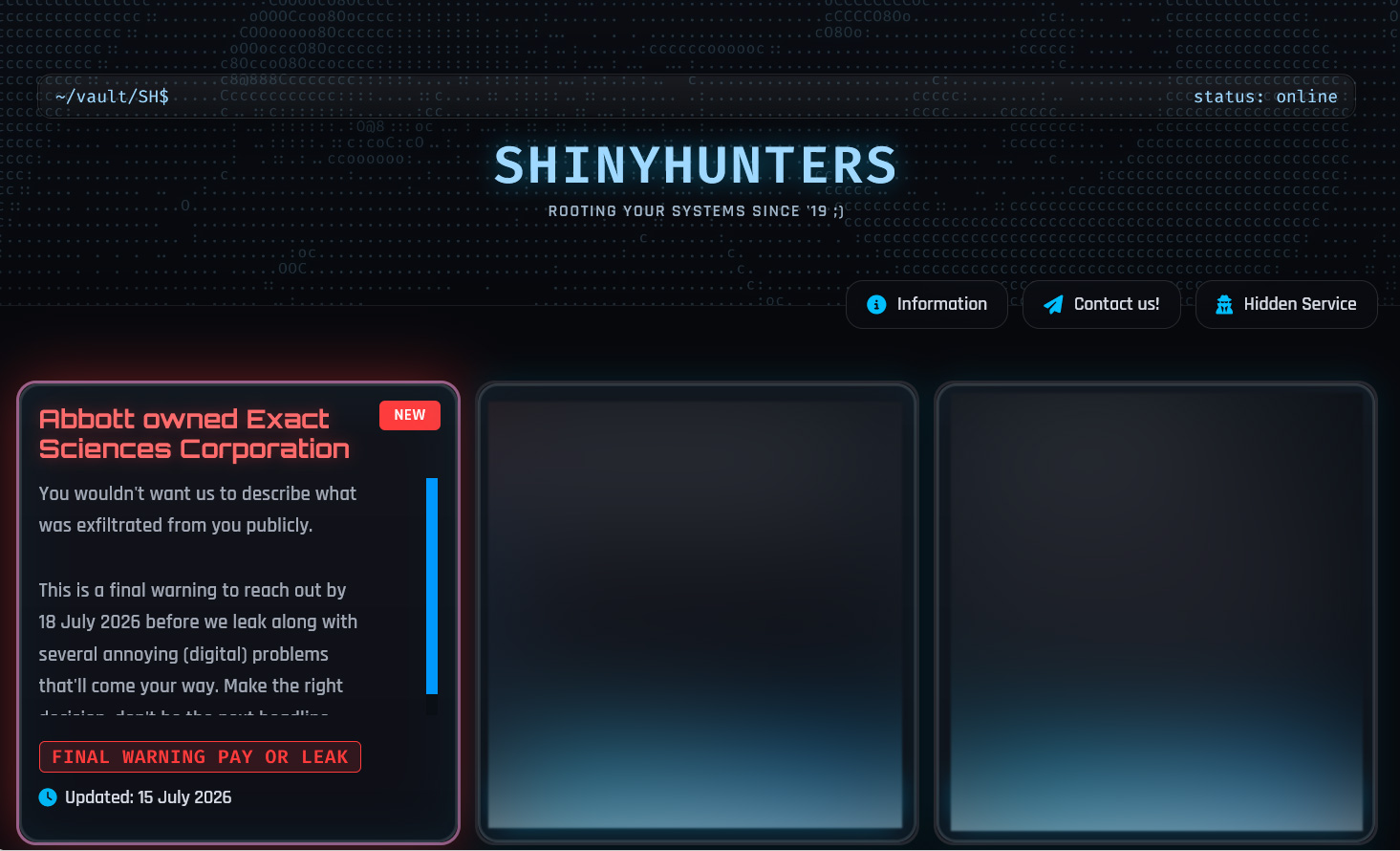
ShadowByt3$ claims to have acquired a range of sensitive corporate documents and intellectual property from the LabCentral portal, including CE manufacturing certificates, operational manuals, technical specifications, regulatory compliance documentation, product requirement archives, calibrator value assignments, and assay files, along with other critical product-related information pertinent to Abbott’s laboratory diagnostic systems. Notably, the group explicitly stated that no customer data was compromised in this particular incident. As purported evidence of their access, ShadowByt3$ furnished screenshots and a listing of the exfiltrated files.
Abbott Laboratories has acknowledged awareness of this "potential" cyber incident concerning the LabCentral portal. However, the company has offered a counter-narrative to the threat actor’s characterization of the data’s sensitivity. An Abbott spokesperson clarified that LabCentral is an "externally facing third-party hosted portal" specifically utilized by its core laboratory diagnostics business. The spokesperson emphasized that the portal primarily houses "publicly available technical product reference documents," such as operating manuals, troubleshooting checklists, and product specifications, and crucially, "does not contain proprietary/sensitive customer or business information." This assertion directly disputes ShadowByt3$’s claim of obtaining sensitive business documents and intellectual property. As of the current reporting, neither ShinyHunters nor ShadowByt3$ has publicly released the data they claim to have acquired from Abbott, suggesting that negotiations may still be underway or the groups are awaiting further developments.
The dual incidents at Abbott Laboratories serve as a stark reminder of the persistent and evolving cyber threats confronting the global healthcare and medical technology sectors. The industry, by its very nature, processes vast quantities of highly sensitive personal health information and PII, alongside invaluable intellectual property relating to medical innovations, diagnostics, and treatments. This concentration of high-value data makes organizations like Abbott prime targets for financially motivated cybercriminals. The tactics employed, from sophisticated social engineering like vishing leading to SSO compromise, to the exploitation of credentials and API vulnerabilities in customer-facing portals, highlight the diverse attack vectors that companies must defend against.
The implications of such breaches extend far beyond immediate operational disruptions. For the ShinyHunters incident, the alleged theft of extensive customer PII and sensitive doctor-patient communications carries significant regulatory and reputational risks. Regulatory frameworks such as HIPAA in the United States, GDPR in Europe, and various other national and regional data protection laws impose stringent requirements for safeguarding personal health data. Non-compliance can lead to substantial fines, legal action, and a severe erosion of patient trust. The alleged compromise of internal documents, contracts, and NDAs could also expose proprietary business strategies, competitive intelligence, and sensitive commercial agreements, potentially impacting Abbott’s market position and relationships with partners and suppliers.

The ShadowByt3$ claims, while disputed by Abbott regarding data sensitivity, point to another critical area of vulnerability: third-party portals and the security of technical documentation. Even if the data is deemed "publicly available," the unauthorized access and potential exfiltration of manufacturing certificates, technical specifications, and regulatory documents could still pose risks. Such information, if misused, could theoretically aid in counterfeiting Abbott’s products, undermine intellectual property rights, or be exploited for competitive advantage by malicious actors seeking to replicate or reverse-engineer medical devices and diagnostic systems. The integrity and authenticity of such documentation are paramount in a highly regulated industry like medtech.
These incidents underscore the critical need for a holistic and multi-layered cybersecurity strategy within the medtech industry. This includes robust identity and access management (IAM) systems, particularly for SSO, complemented by strong multi-factor authentication (MFA) to mitigate the effectiveness of credential-based attacks. Comprehensive employee training programs are essential to counter social engineering tactics like vishing, equipping staff to recognize and report suspicious activities. Furthermore, organizations must implement rigorous security testing for all external-facing applications and APIs, identifying and remediating vulnerabilities before they can be exploited. The security of legacy systems, often overlooked, also remains a persistent challenge, requiring careful isolation, patching, or modernization.
Looking ahead, the landscape of cyber threats will only intensify, demanding continuous vigilance and adaptation from major corporations. For companies like Abbott, effective incident response planning, transparent communication strategies (balancing disclosure with ongoing investigation needs), and proactive engagement with cybersecurity experts and law enforcement are paramount. The ability to quickly detect, contain, and recover from cyberattacks, while simultaneously protecting sensitive data and maintaining public trust, will remain a defining challenge for global leaders in the healthcare and medical technology sectors. The incidents at Abbott Laboratories serve as a powerful case study for the industry at large, highlighting the pervasive nature of cyber risks and the enduring imperative for robust digital defenses.



 Aura Kasih
 Ayu Aulia