Aura Kasih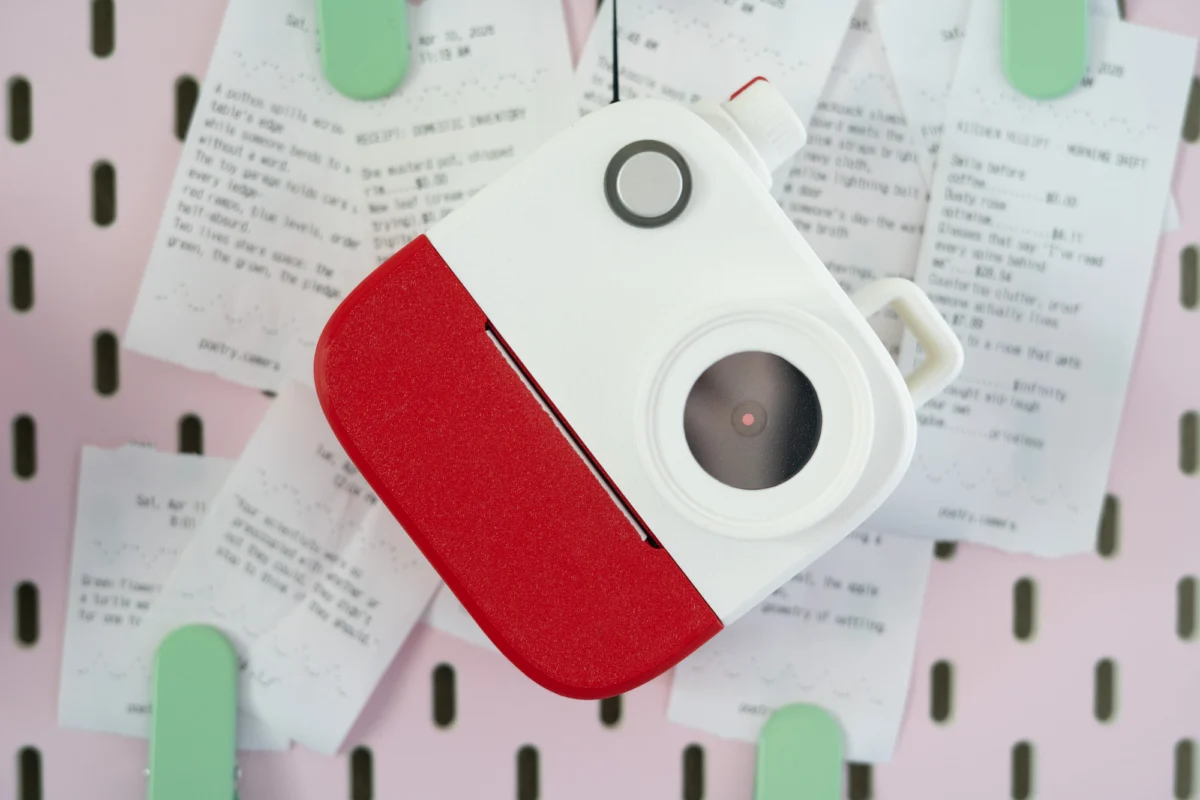
A peculiar device has emerged, blending the tactile charm of analog photography with the nascent capabilities of artificial intelligence, resulting in a product that elicits both admiration for its ingenuity and profound questions about the nature of creativity. This innovative gadget, designed to capture moments not in visual form but through verse, presents a fascinating dichotomy: its aesthetic appeal is undeniable, yet its output often falls short of genuine artistic merit, leaving users in a state of bemused disappointment.
The Poetry Camera presents itself as a delightful anomaly in the consumer electronics landscape. Its design, characterized by a crisp white and cherry red chassis complemented by a matching woven strap, evokes a playful, almost nostalgic, low-fidelity aesthetic. On a retail shelf, its whimsical appearance would undoubtedly draw the eye, promising a unique interactive experience. However, beyond its superficial charm, the device’s fundamental purpose remains somewhat elusive, despite its straightforward function: it is a camera that generates AI-driven poetry instead of photographic prints. The user points, shoots, and rather than receiving a tangible image, is presented with a poem, algorithmically generated and printed on thermal receipt paper, ostensibly inspired by the captured scene. After extensive experimentation, the prevailing sentiment derived from this process is not one of inspiration, but rather a pervasive sense of frustration.

At its core, the Poetry Camera eschews traditional digital interfaces. It features no screen, relying solely on a physical shutter button and a dial that allows users to select from a range of pre-defined poetic styles. Connectivity is essential; the device requires a Wi-Fi network to transmit the captured image and a prompt, dictated by the chosen poetic style, to a cloud-based AI engine. Within approximately thirty seconds, the integrated printer produces the AI’s lyrical interpretation, which can then be detached and shared. The poems themselves, often characterized by a certain superficial profundity, frequently exhibit a predictable, albeit sometimes evocative, structure. For instance, a poem generated from an image of a domestic kitchen might read:
Fingers curve the mug—
white cabinets hold their
secret:
another April.
The genesis of the Poetry Camera lies in the collaboration between Kelin Carolyn Zhang, a former designer at Twitter, and Ryan Mather, an ex-Googler. Their journey from a speculative concept to a functional product involved meticulous development, progressing from a rudimentary cardboard prototype to a sophisticated, deployable device. The founders shared insights into their collaborative process, detailing both the triumphs and challenges in a presentation at Figma’s annual conference. Following their professional separation, Zhang took charge of the production of the Poetry Camera’s second batch. This iteration, assembled in Shenzhen through a residency program with MIT, marked a shift from manual assembly in New York to a more industrialized approach. This subsequent production run was also offered at a reduced price of $349, a significant decrease from the initial $699. The second batch quickly sold out, with a third promised for release in May, indicating a sustained, albeit niche, consumer interest.

The technical underpinnings of the Poetry Camera are notably sophisticated, particularly its seamless Wi-Fi integration without the need for an accompanying mobile application or on-device screen. Connectivity is achieved through a clever implementation: users access a simple web application to generate a QR code, which the camera then scans. This initiates an automatic pairing process, linking the device to the network. Status indicators are provided through an LED surrounding the shutter button, which communicates connection status and any encountered errors. Further feedback is delivered via printed messages from the thermal printer. This method of user interaction, relying on physical, printed output for system communication, possesses a certain quaint charm, offering a tangible connection between the user and the device’s operational state.
A particularly engaging aspect of the Poetry Camera is its customization portal. This feature allows users to refine and rewrite the prompts associated with each poetic style. Initially, this functionality piqued significant interest, as the default poetic interpretations of everyday scenes, while novel, quickly became repetitive. The prospect of tailoring the AI’s output offered a pathway to more personalized and potentially meaningful results.
The process of prompt engineering, however, revealed its own complexities. It was discovered that explicit instructions were often required to prevent the AI from defaulting to poem generation, even when presented with entirely unrelated thematic directives. Nevertheless, successful customization yielded compelling results. One user managed to configure a mode that, upon image capture, would generate an appropriate quote from Jurassic Park based on scene recognition. Another mode was developed to describe current weather conditions and provide a daily forecast. Despite these successes, the iterative nature of prompt refinement, involving trial and error to achieve desired outcomes, proved to be a tedious endeavor.

The device’s power management system contributes to a less-than-ideal user experience. The camera enters a sleep mode after a brief period of inactivity, necessitating a manual restart and a subsequent reconnection to the network. When connection failures occur, the camera responds by printing error messages, styled as poems. While this initial poetic representation of an error was perceived as novel, its repetition quickly diminished its novelty. Furthermore, these stylized error messages lack the diagnostic specificity required to troubleshoot underlying issues, leaving users uncertain about the cause of the malfunction, be it prompt limitations, network instability, or signal strength. Notably, attempts to connect the Poetry Camera to a mobile hotspot proved unsuccessful, confining experimental use to a fixed Wi-Fi environment.
The Poetry Camera is undoubtedly the product of talented and dedicated individuals. However, it appears to be a manifestation of an earlier stage in the evolution of AI language models, reminiscent of the initial widespread fascination with tools like ChatGPT. During that period, the ability of an AI to generate text that mimicked creative output was a novelty, and the public was less saturated with chatbot interactions.
From a critical perspective, the inherent value of an art form like poetry is often intrinsically linked to the human experience and the consciousness of its creator. While an attempt was made to evaluate the Poetry Camera objectively, setting aside pre-conceived notions about AI-generated art, the fundamental disconnect persists. The device produces sequences of words that may possess a superficial semblance of depth and meaning but ultimately feel hollow, akin to consuming empty calories. While artificial intelligence can serve as a potent tool in the development of software and other technological applications, the creation of genuinely meaningful poetry necessitates a level of subjective experience, emotional resonance, and a conscious awareness that current AI systems demonstrably lack. The notion that a machine, devoid of a soul or lived experience, can authentically engage with and articulate the complexities of human emotion through verse remains a contentious one, irrespective of market pronouncements.

In conclusion, while the Poetry Camera offers a unique and aesthetically pleasing approach to integrating AI into a physical object, its ultimate utility and artistic merit are debatable. Its capacity for generating poetic content, while technically impressive, often falls short of evoking genuine emotional depth or artistic significance. The device, therefore, occupies a curious niche, serving as a testament to technological innovation but failing to resonate as a tool for profound creative expression for all users.




 Safa Marwah
 Ayu Aulia