Aura Kasih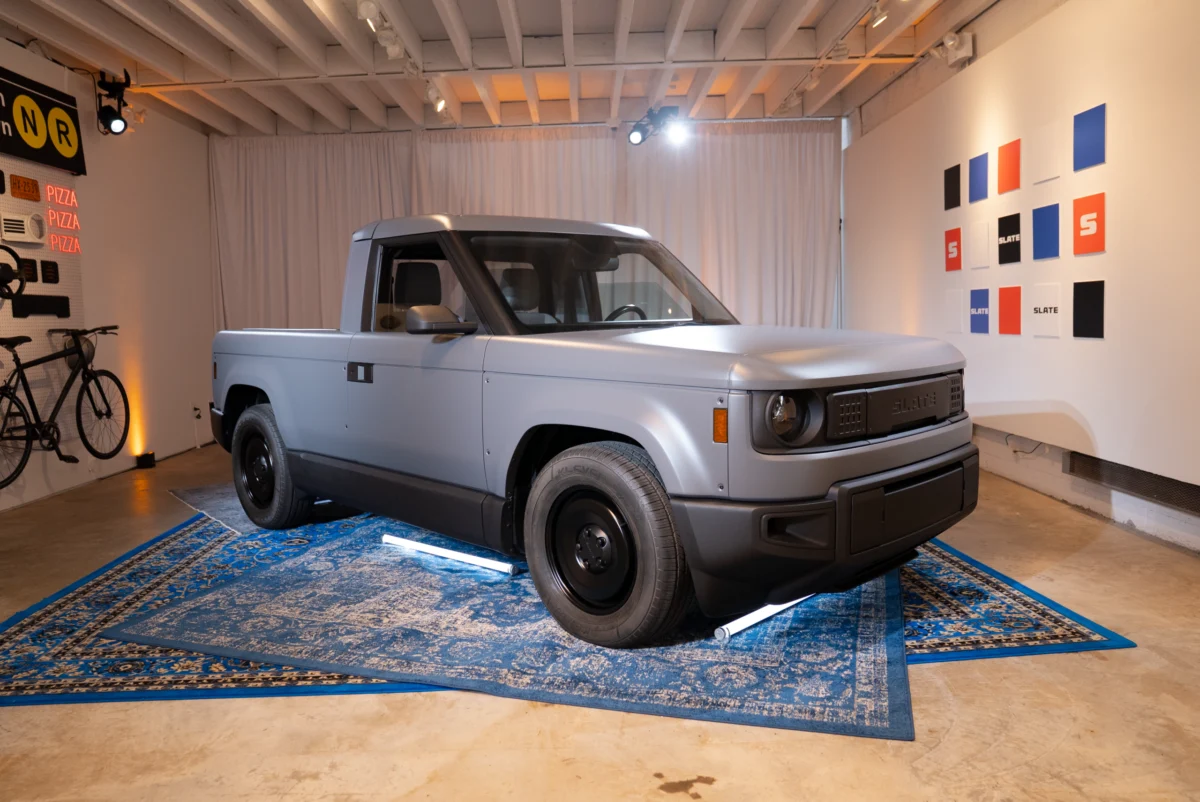
In a significant development for the burgeoning electric vehicle market, Slate Auto, an innovative startup with strategic backing from billionaire Jeff Bezos, has successfully closed a substantial Series C funding round, raising an impressive $650 million. This infusion of capital is earmarked to accelerate the production of its highly anticipated, budget-friendly electric pickup truck, a vehicle poised to enter the market with an accessible starting price in the mid-$20,000 range. The company has signaled its intention to commence deliveries of its inaugural electric model later this year, marking a pivotal moment in its ambitious trajectory.
The latest funding initiative was spearheaded by TWG Global, a formidable investment entity helmed by Mark Walter, founder of Guggenheim Partners and owner of the Los Angeles Dodgers, and renowned financier Thomas Tull. While Slate has maintained discretion regarding the full roster of its new investors, the involvement of Walter and Tull carries particular weight. Both individuals were previously invested in Re:Build Manufacturing, a company owned by Jeff Bezos, from which Slate Auto emerged as a spin-off entity approximately one year ago. This established relationship underscores a deep-seated confidence in Slate’s vision and its potential for market disruption. Although the company has not publicly disclosed its current valuation, recent reports from Bloomberg indicated a valuation of $1.2 billion as of January 2025, suggesting a robust growth trajectory prior to this latest funding round.
Peter Faricy, the Chief Executive Officer of Slate, articulated the strategic significance of this capital injection in a prepared statement. "Our Series C round of funding will empower Slate to advance to the subsequent phases of production this year, adhering to our established timeline and budgetary projections," Faricy stated. He further expressed enthusiasm for the upcoming pre-order phase, announcing, "We eagerly anticipate our future clientele placing preorders for their Slate Trucks commencing in June." This proactive timeline suggests a high degree of operational readiness and confidence in the manufacturing pipeline.
Slate reports a remarkable surge in customer interest, having garnered 160,000 reservations for its debut electric vehicle, the Slate Truck. This model has garnered attention for its minimalist and modular design, initially unveiled last year. A distinctive aspect of the Slate Truck is its stripped-down approach to standard automotive features, deliberately omitting elements such as paint, power windows, a radio, and an integrated infotainment system. This intentional design philosophy positions the vehicle as a highly customizable platform. Slate plans to offer a comprehensive suite of accessories and add-on modules, including a conversion kit designed to transform the two-seater truck into a five-seater SUV. This approach empowers owners to tailor their vehicles precisely to their individual needs and preferences. The company is expected to reveal the definitive retail pricing for its truck in June 2026, a crucial announcement that will solidify its market positioning.
The manufacturing of the Slate Truck will be undertaken at the company’s newly established $400 million factory located in Warsaw, Indiana. This state-of-the-art facility represents a substantial investment in American manufacturing and job creation. Slate projects that its operations in Kosciusko County will generate over 2,000 employment opportunities. Furthermore, the company estimates its long-term economic contribution to the state of Indiana to reach up to $39 billion over a twenty-year period, highlighting a significant commitment to regional economic development and industrial revitalization.
Market Dynamics and Slate’s Strategic Positioning
The automotive industry is currently navigating a period of profound transformation, driven by escalating environmental concerns, evolving consumer preferences, and increasingly stringent regulatory frameworks. The transition to electric vehicles, once a niche market, has now become a central imperative for established automakers and a fertile ground for disruptive startups. Slate Auto’s strategy appears to be meticulously crafted to address a critical gap in this evolving landscape: the demand for affordable electric mobility.
For years, the electric pickup truck segment has been dominated by premium offerings with price tags often exceeding $50,000, and in many cases, well into the six figures. While these vehicles have appealed to early adopters and those seeking cutting-edge technology and performance, they have largely remained out of reach for a significant portion of the truck-buying public. This demographic, traditionally characterized by a preference for utility, durability, and value, has been underserved by the initial wave of EV offerings. Slate’s ambitious target price point of the mid-$20,000s directly confronts this market inertia, aiming to democratize access to electric pickup trucks.
The company’s minimalist design philosophy is not merely a cost-saving measure but a strategic element designed to foster a unique ownership experience and further enhance affordability. By eschewing certain standard amenities, Slate shifts the focus to core functionality and user customization. This approach can be interpreted as a modern reinterpretation of the utilitarian vehicles of the past, where owners were often expected to adapt and maintain their own equipment. In the context of an electric vehicle, this translates to a platform that can be evolved and personalized over time through modular upgrades. This could also appeal to a segment of consumers who prefer simplicity and a less technologically saturated driving experience, or those who value the ability to build out their vehicle’s capabilities incrementally.

The success of this strategy hinges on several factors. Firstly, the perceived value proposition must resonate with the target consumer. The absence of features like a radio or integrated infotainment system, while contributing to cost reduction, must be offset by the truck’s fundamental utility, durability, and the appeal of its modular customization options. Secondly, the aftermarket support and the availability and cost of the planned accessories will be crucial. If the add-on modules are prohibitively expensive or limited in scope, the core promise of customization may falter.
Manufacturing Prowess and Economic Impact
The selection of Warsaw, Indiana, for Slate’s manufacturing hub is a strategic decision that leverages regional strengths and fosters economic growth. Indiana has a robust automotive manufacturing heritage, providing a skilled workforce and established supply chain infrastructure. The investment of $400 million in a new factory signifies a substantial commitment to revitalizing manufacturing capabilities and creating high-value jobs in the region.
The projected creation of over 2,000 jobs is a significant economic boon for Kosciusko County and the surrounding areas. This influx of employment opportunities can stimulate local economies, support small businesses, and contribute to a more prosperous community. The long-term economic impact projection of up to $39 billion for the state over two decades underscores the potential for Slate to become a major economic engine, not only through direct employment but also through its ripple effects on suppliers, service providers, and tax revenues.
This commitment to domestic manufacturing also aligns with broader trends in the automotive industry, which are increasingly focused on supply chain resilience and onshoring production. By establishing its manufacturing base in the United States, Slate can potentially mitigate risks associated with global supply chain disruptions and benefit from a more predictable regulatory and trade environment.
Competitive Landscape and Future Outlook
The electric pickup truck market, while still in its nascent stages, is becoming increasingly competitive. Established players like Ford with its F-150 Lightning, Chevrolet with the Silverado EV, and Tesla with the Cybertruck are vying for market share. However, these offerings generally cater to a higher price point. Startups like Rivian have also carved out a niche, focusing on premium adventure vehicles.
Slate’s disruptive pricing strategy positions it as a unique challenger, aiming to capture a segment of the market that may have been priced out of the current EV offerings. The success of its pre-order numbers, if they translate into actual sales, will indicate a strong pent-up demand for affordable electric trucks.
The coming years will be critical for Slate Auto. The successful launch of its first vehicle, the timely fulfillment of reservations, and the ongoing development of its accessory ecosystem will be paramount. The company’s ability to maintain its cost-efficiency while delivering a reliable and desirable product will be closely watched by industry analysts and consumers alike.
The long-term vision of Slate likely extends beyond its initial truck offering. The modular design and the focus on customization suggest a potential for platform expansion into other vehicle types or specialized commercial applications. The substantial funding secured provides the runway necessary to explore these avenues and solidify its position as a significant player in the evolving electric vehicle landscape. The company’s ability to execute on its ambitious plans will undoubtedly shape the future of affordable electric transportation.




 Lisa Mariana
 Safa Marwah
 Ayu Aulia