Aura Kasih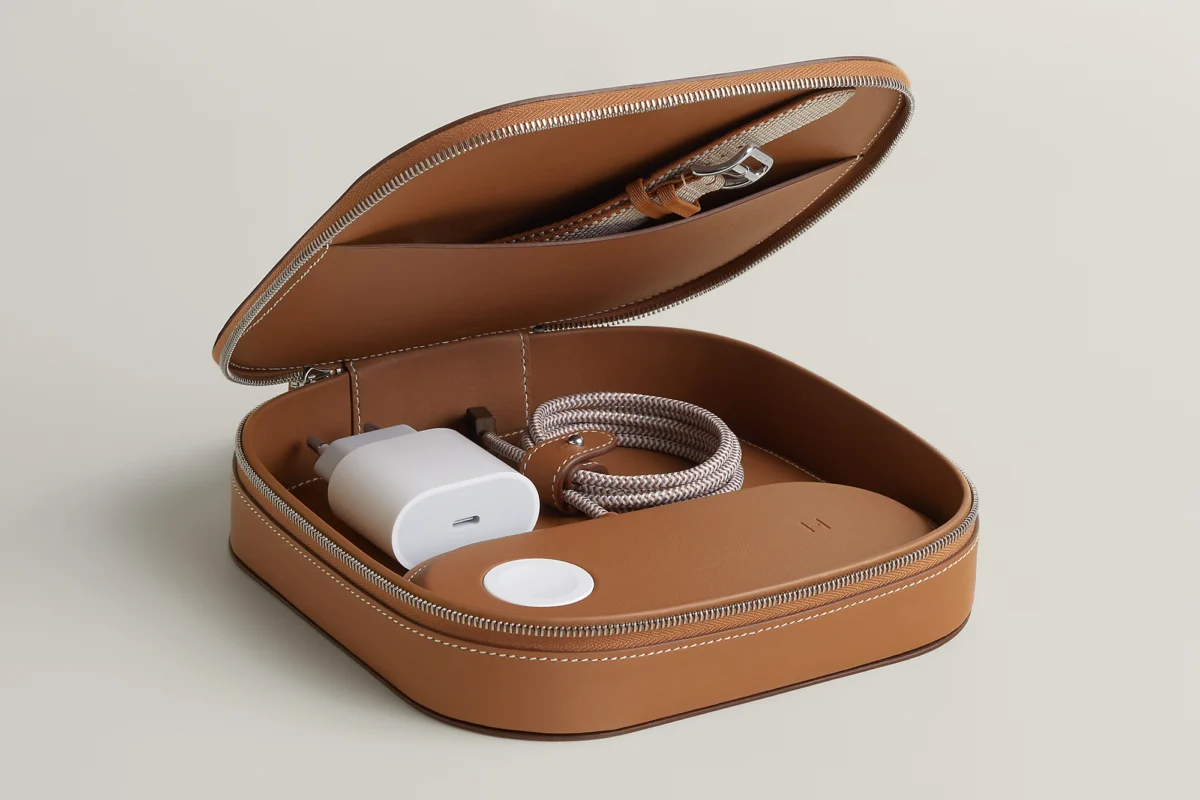
The venerable French luxury house Hermès has introduced a striking new line of premium charging accessories for Apple devices, blending its signature artisanal craftsmanship with modern mobile technology. However, in a move that has sparked considerable discussion within both the tech and luxury consumer spheres, these exceptionally high-end offerings, including a multi-device wireless charger encased in exquisite calfskin leather for a staggering $5,150, do not include the fundamental power adapter required for their operation. This strategic omission, alongside other similarly priced items such as a $1,250 single-device charger and a $1,750 dual-device charging mat, raises intriguing questions about the evolving definition of premium accessories, consumer expectations, and the intersection of functionality and status symbols in the digital age.
The collection, a continuation of Hermès’ long-standing partnership with Apple that dates back to the initial Apple Watch collaborations, represents a bold statement in the burgeoning market for high-end tech peripherals. The flagship Paddock Duo Charger and Grand Paddock Case, priced at $5,150, is not merely a charging station but a statement piece. Encased in Hermès’ iconic gold-colored calfskin leather, meticulously stitched with the brand’s hallmark saddle stitching, it offers ample space to house not only a multi-device wireless charger capable of powering multiple Qi-compatible devices simultaneously but also additional compartments for cables and, critically, the user’s own power adapter. This opulent design aims to elevate the everyday act of charging into an experience of refined luxury, mirroring the brand’s ethos of timeless elegance and unparalleled quality.
At the more accessible, though still exceptionally high, end of this new Hermès range is the Paddock Solo Charger, retailing at $1,250. This offering features a wireless charging puck, also enveloped in the same premium calfskin leather and finished with artisanal saddle stitching. While the precise charging wattage is not explicitly detailed by Hermès, the requirement for a "minimum 20W power" input suggests it is designed to support robust charging speeds, potentially exceeding the standard 15W often found in such accessories. Accompanying this charger is a 3.3-foot USB-C cable, a thoughtful inclusion that complements the sleek aesthetic. However, consistent across all items in this collection is the deliberate exclusion of a power adapter.

This deliberate omission is perhaps the most salient aspect of Hermès’ new product strategy, prompting an analysis of market positioning and consumer psychology. In an era where even mid-range smartphones frequently come bundled with power adapters, the decision by a luxury brand to exclude such a fundamental component from a device costing upwards of a thousand dollars is unconventional, to say the least. This approach can be interpreted through several lenses. Firstly, it aligns with a segment of the luxury market that values exclusivity and customization above all else. Consumers purchasing these Hermès accessories are likely already invested in the Apple ecosystem and may possess a collection of high-performance power adapters, perhaps even from other premium brands. By excluding the adapter, Hermès allows these discerning clients to integrate the charging solution seamlessly with their existing, curated setups, maintaining a consistent level of aesthetic and functional quality.
Secondly, this strategy might be viewed as a subtle assertion of the product’s primary value proposition: its material luxury and design artistry, rather than its raw technological utility. The focus is on the tangible craftsmanship, the provenance of the leather, and the heritage of the brand, positioning the accessory as an object of desire and a testament to sartorial taste, rather than simply a functional electronic peripheral. The expectation is that the user will leverage their existing, high-quality power delivery infrastructure, thereby reinforcing the notion that this is an addition to an already sophisticated technological environment.
Furthermore, this approach could be a nod to the growing trend of reducing electronic waste. While it may seem counterintuitive given the luxury price point, by encouraging users to utilize existing power adapters, Hermès might be subtly contributing to a more sustainable consumption model. Many consumers, particularly those with multiple electronic devices, accumulate a surplus of power adapters. This decision could, in effect, encourage the repurposing of these existing components rather than the production and distribution of new ones, even if the primary motivation is rooted in premium positioning.
The collection also features the Paddock Yoyo, a double-sided wireless charger priced at $1,750. This innovative design allows for the charging of an Apple Watch or any Qi-compatible mobile device, with the flexibility of inverting the charger to suit different needs. Complementing this is the Paddock Duo, also at $1,750, which offers a side-by-side configuration for simultaneous charging of two devices. These models, much like the Solo charger, are presented without an accompanying power adapter, reinforcing the brand’s consistent approach across the entire range.

The Grand Paddock case, the most capacious and expensive of the collection at $5,150, serves as a comprehensive charging hub and accessory organizer. Its generous dimensions are designed to accommodate not only the multi-device wireless charger but also ample space for cables, the user’s power adapter, and other small electronic essentials. This signifies a move towards an integrated, albeit self-supplied, charging ecosystem that prioritizes both functionality and the aesthetic presentation of these essential items.
The implications of Hermès’ pricing strategy and product composition are multifaceted. For consumers who prioritize brand prestige and artisanal quality above all else, the absence of a power adapter may be a minor inconvenience, easily overlooked in favor of owning a piece of functional art. This segment of the market is accustomed to paying a premium for superior materials, meticulous craftsmanship, and the intangible value associated with a luxury brand name. The Hermès charging accessories are not just about charging devices; they are about projecting an image of sophistication, taste, and an appreciation for the finer things in life.
However, for a broader consumer base, particularly those who might be drawn to the product’s aesthetic appeal but are less entrenched in the luxury market, the exclusion of a power adapter could be a significant deterrent. The expectation for a charging accessory, especially one with such a substantial price tag, is that it should be a complete, plug-and-play solution. The need to source a compatible, high-wattage power adapter separately adds an unexpected layer of complexity and potential additional cost, which may not align with the perceived value proposition. This could lead to a scenario where the Hermès accessories are admired from afar but ultimately purchased by a very specific niche of affluent clientele.
Looking ahead, Hermès’ foray into high-end tech accessories, particularly with this deliberate omission, could set a precedent for other luxury brands venturing into the consumer electronics space. It suggests a shift from merely branding existing tech products to creating bespoke, experience-driven accessories that emphasize craftsmanship and material luxury. The success of this strategy will likely depend on the brand’s ability to effectively communicate the value proposition beyond mere functionality and to cultivate an understanding among consumers that these items are an extension of a curated lifestyle. The market will be watching to see if this bold approach to product design and consumer expectation resonates with its target audience, or if it becomes a cautionary tale about the delicate balance between luxury aspirations and practical technological requirements. The inclusion of a USB-C cable is a clear indicator that the brand is aware of modern charging standards, yet the absence of the power brick itself remains a point of contention and a defining characteristic of this opulent, yet incomplete, charging ensemble.




 Safa Marwah
 Ayu Aulia
 Lisa Mariana