Lisa Mariana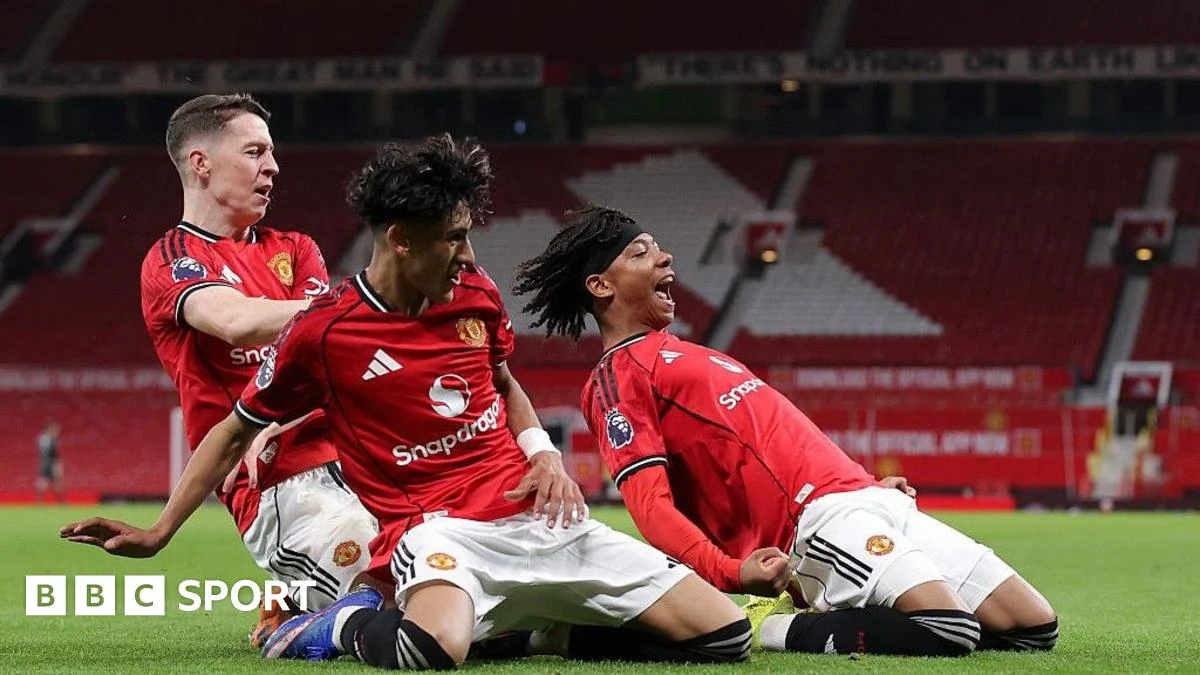
Amidst the fervent anticipation surrounding Manchester United’s next wave of talent, a singular name has begun to resonate with particular intensity: JJ Gabriel. At a mere 15 years of age, Gabriel stands as a beacon of exceptional promise within the club’s esteemed academy, drawing significant attention for his precocious abilities and captivating performances that hint at a future destined for the grand stage of Old Trafford, despite current age restrictions precluding his immediate Premier League involvement. His exceptional displays at the youth level have already captivated a discerning fan base and prompted strategic interventions from the club’s hierarchy, underscoring a belief that he represents a truly rare footballing talent.
The phenomenon of exceptionally young talents breaking through the ranks of elite football academies is a recurring narrative, yet each instance brings its own unique set of circumstances and challenges. Gabriel’s situation is particularly noteworthy given his age. Current Premier League regulations stipulate that a player must have turned 15 by August 31st of the relevant season to be eligible for senior competition. As Gabriel celebrated his fifteenth birthday in October, he currently falls outside this eligibility window, meaning his electrifying skills will not grace the Premier League turf this season. This technicality, however, only serves to amplify the excitement surrounding him; it underscores that his impact is being felt at an age when many peers are still refining fundamental techniques, far from the competitive crucible of top-tier youth football.
His presence on the pitch, particularly in the Under-18 age group, is often a striking visual anomaly. Physically, Gabriel is notably smaller than the majority of his adversaries and even many of his teammates. Yet, this apparent disadvantage is frequently negated by a combination of exceptional spatial awareness, blistering pace, and a close control that allows him to navigate congested areas with remarkable fluidity. His recent performances have provided ample evidence of his burgeoning capabilities. In a pivotal FA Youth Cup fixture against Sunderland, which Manchester United clinched with a 3-2 victory, Gabriel, despite not delivering his most commanding individual performance, still provided moments of undeniable genius. A first-time lay-off in the initial half, delivered with exquisite precision, created a prime scoring opportunity that arguably should have seen United take the lead. Later, a perfectly weighted pass carved open the Sunderland defense, allowing a teammate to unleash the decisive winning strike. Perhaps most thrillingly, a dazzling two-footed manoeuvre near the game’s conclusion showcased his audacious dribbling ability, creating space for a shot and leaving spectators awestruck. These instances are not isolated flashes but rather consistent demonstrations of a player who thinks several steps ahead, possessing both the vision to unlock defenses and the technical proficiency to execute complex plays under pressure.
The journey through a professional football academy is a rigorous test, and for players displaying Gabriel’s level of talent, the path is often accelerated. Manchester United, a club with a storied history of nurturing youth, from the "Busby Babes" to the "Class of ’92," understands the delicate balance between rapid progression and comprehensive development. The club’s academy system is meticulously structured to provide a pathway for its most promising talents, with clear stages from the youngest age groups to the Under-18s, Under-21s, and ultimately, integration into the senior training environment. The FA Youth Cup, a competition Manchester United has historically excelled in, serves as a significant proving ground, offering young players the experience of high-stakes matches and the chance to perform on the iconic Old Trafford pitch. The club’s progression to an Old Trafford semi-final against Crystal Palace, coupled with an impending Premier League Under-18 Cup final clash against the same opponent, signifies the strength of the current youth cohort, with Gabriel at its heart.
Youth coaches, by their very nature, tend to exercise caution when publicly singling out individual talents. The immense pressure that can accompany early recognition is well understood, as is the unpredictable nature of a young athlete’s physical and mental development. However, for a player of Gabriel’s calibre, the burgeoning attention is almost impossible to contain. The club itself has implicitly acknowledged his exceptional status through a series of carefully orchestrated engagements. In August, he was observed in the directors’ box alongside his family during a high-profile league opener against Arsenal. In December, he was photographed with the legendary Sir Alex Ferguson during a senior fixture against West Ham. These are not random occurrences; they are calculated gestures designed to demonstrate the club’s commitment to Gabriel and to reinforce the message that his future lies at Old Trafford. This strategic courtship became particularly evident last summer, when Manchester United’s Technical Director, Jason Wilcox, was reportedly part of a delegation that presented Gabriel with a compelling vision for his development, ultimately persuading the London-born talent to commit his immediate future to the North-West club.
The proactive approach from Manchester United is driven by a stark reality: talent like Gabriel’s is a global commodity, and Europe’s elite clubs are constantly scouting for the next generation of superstars. Despite United’s successful retention efforts so far, the interest from rival clubs will undoubtedly persist, fueled by Gabriel’s remarkable statistical output. He currently leads the Premier League Under-18 scoring charts, a phenomenal achievement for a player of his age, having netted an impressive ten goals in his last nine appearances. Under the stewardship of coach Darren Fletcher, a former United midfielder and current technical director, the Under-18 side is competing on multiple fronts, with Gabriel consistently emerging as a standout performer. His adaptability has also been a talking point; while naturally inclined to operate in wider attacking positions, Fletcher and his coaching staff initially deployed him in a false nine role, providing him with greater space to exploit his technical prowess. The current consensus is that a central position, whether as an attacking midfielder or a withdrawn forward, best mitigates his current physical disadvantage, allowing his vision and technical skills to shine without being overly reliant on brute strength.
The insights from those who work most closely with Gabriel offer the most authentic appraisal of his character and potential. Darren Fletcher, having observed him throughout the season, is arguably the most authoritative voice on his development. In a January assessment, Fletcher spoke effusively about the young prodigy: "I couldn’t speak highly enough of JJ. He’s got an amazing family and amazing support around him. He’s somebody we’re delighted to have at the club. There’s a lot of noise around him and deservedly so because he’s a real talented kid. He works hard. He loves football. He loves training and playing and he loves expressing himself. He has a bright future ahead of him and I’m super excited by his talent. But the most important thing is that he keeps developing because he still has lots to learn." This balanced perspective, acknowledging both his extraordinary talent and the imperative for continuous growth, is crucial for any young player navigating the high-pressure environment of professional football.
The journey from academy star to senior professional is fraught with milestones and historical benchmarks that often capture the imagination. For Manchester United, a club with a rich tapestry of youth development, the records for youngest debutants and goal-scorers are held by revered figures. David Gaskell, a goalkeeper, holds the distinction of being the club’s youngest ever player, making his debut at 16 years and 19 days. Legendary England international Duncan Edwards is third on this list, having debuted at 16 years, six months, and four days. In the Premier League era, Angel Gomes holds the record for the youngest United player, taking to the field at 16 years, eight months, and 20 days. For goal-scorers, Norman Whiteside remains United’s youngest at 17 years and 8 days, while Federico Macheda, with his memorable winner against Aston Villa, is the youngest Premier League scorer at 17 years, seven months, and 14 days. These records highlight both the potential for early breakthroughs and the challenging path that lies ahead. The presence of Wayne Rooney, himself a record-breaking prodigy, at Gabriel’s recent match – with his son Kai an unused substitute – serves as a poignant reminder of these historical trajectories.
Gabriel’s age places him in a unique position to challenge some of these long-standing records. When the 2026-27 season commences on August 22nd, he will be 15 years and 320 days old. Should Manchester United, as a European qualifier, enter the EFL Cup at the third-round stage, it is highly probable that these fixtures would occur before his 16th birthday. This timeline presents a realistic opportunity for Gabriel to potentially become one of the youngest players in the club’s illustrious history, should the coaching staff deem him ready for senior exposure. However, historical precedents also offer a note of caution; while some who broke early records went on to achieve legendary status, others found that early promise did not translate into sustained senior success. The transition requires not only immense talent but also mental fortitude, physical resilience, adaptability, and a degree of fortune.
For the immediate future, Gabriel will continue to hone his craft within the Under-18 system, with numerous objectives still to be achieved both individually and as part of a highly promising team. The focus remains on his comprehensive development, ensuring that his technical brilliance is complemented by physical conditioning, tactical understanding, and mental resilience. The involvement of senior figures like Ruben Amorim, who reportedly called Gabriel into a senior training squad, albeit with a "lukewarm" response, serves as a vital learning experience, exposing young players to the elevated demands and intensity of the first-team environment. Similarly, Michael Carrick’s recent comments on the youngster reflect the wider club interest in his progress. These interactions are critical stepping stones, providing a taste of what is required at the highest level.
The anticipation among the Manchester United faithful is palpable, a clear indication that Gabriel’s impact extends beyond mere statistics. His captivating style of play, combined with his remarkable youth, has created a sense of burgeoning excitement. While the club remains committed to a carefully managed progression, the question of when Gabriel will make his senior debut is no longer a matter of if, but merely when. His potential to shape the future of Manchester United, and indeed English football, is a compelling narrative that many are eagerly awaiting to unfold. The journey from academy prodigy to Old Trafford star is one of the most demanding in football, but JJ Gabriel has already demonstrated he possesses many of the attributes required to navigate it successfully.



 Aura Kasih
 Safa Marwah
 Ayu Aulia