Aura Kasih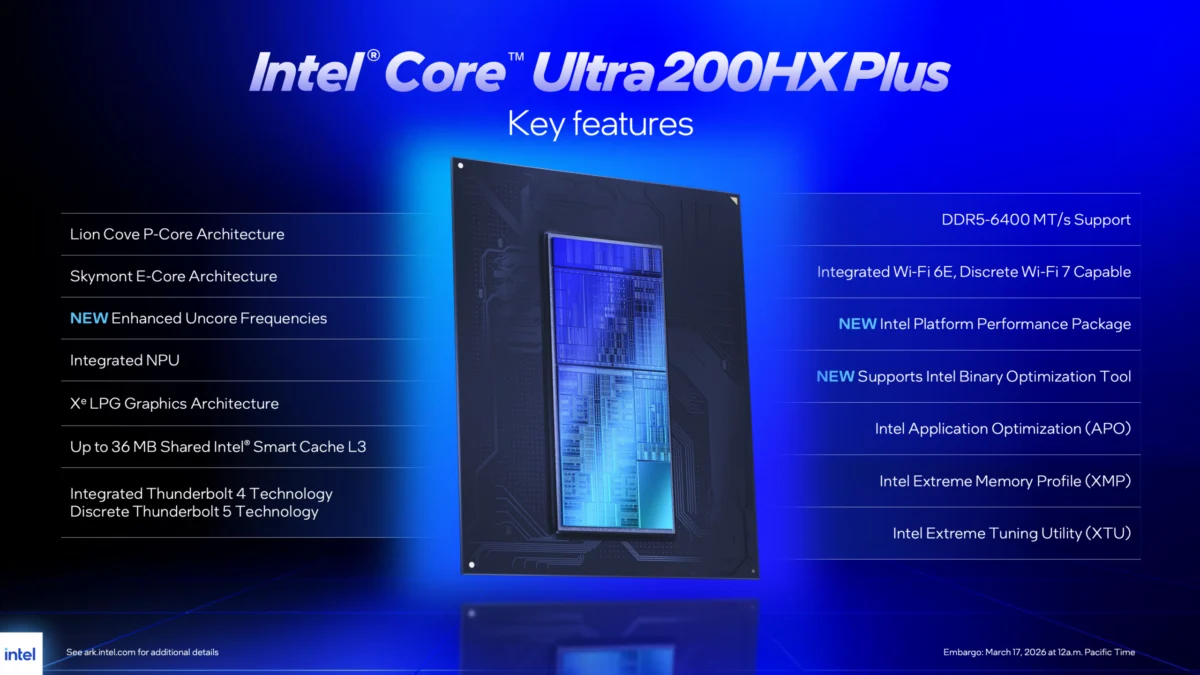
Intel has officially unveiled its latest advancements in mobile processing power with the introduction of the Core Ultra 200HX Plus series, specifically engineered to elevate the performance benchmarks for high-end gaming laptops and professional content creation workstations. This new lineup, spearheaded by the Core Ultra 9 290HX Plus and Core Ultra 7 270HX Plus, represents a significant leap forward in mobile computing, promising enhanced capabilities for the most demanding users.
The Core Ultra 200HX Plus processors are built upon Intel’s refined Arrow Lake architecture, signaling a strategic push to deliver even greater processing prowess to the mobile computing segment. The flagship Core Ultra 9 290HX Plus boasts an impressive configuration of 24 cores and 24 threads, while the Core Ultra 7 270HX Plus offers a robust 20 cores and 20 threads. These specifications position these new chips at the pinnacle of mobile CPU performance, catering to a discerning market that demands uncompromised speed and efficiency. This release directly follows Intel’s recent announcements regarding their desktop counterparts, indicating a unified strategy to push the boundaries of performance across their entire product portfolio. The "Plus" designation signifies that these processors have been meticulously optimized and "pushed further for enthusiasts," suggesting an emphasis on unlocked potential and maximum performance for overclocking and extreme use cases.

A key innovation accompanying these new processors is the Intel Binary Optimization Tool. This proprietary software aims to unlock further performance gains by optimizing application binaries, particularly in select gaming titles. This approach underscores Intel’s commitment to not only providing raw processing power but also ensuring that software can effectively leverage the hardware’s capabilities. By fine-tuning the interaction between the CPU and specific applications, Intel aims to deliver a more seamless and responsive user experience, especially in the latency-sensitive environment of competitive gaming.
The strategic importance of the Core Ultra 200HX Plus series cannot be overstated. The gaming laptop market, in particular, has witnessed a sustained demand for increasingly powerful mobile solutions capable of delivering desktop-like experiences. Users are no longer willing to compromise significantly on graphical fidelity or frame rates when opting for a portable gaming rig. Similarly, content creators, video editors, 3D artists, and other creative professionals require substantial computational resources to handle complex projects efficiently. The Core Ultra 200HX Plus processors are designed to meet these evolving demands head-on, providing the horsepower necessary for demanding workloads such as high-resolution video rendering, intricate 3D modeling, and the immersive gameplay experiences that define modern gaming.

Intel’s stated objective with these new processors is to "deliver meaningful, real-world performance gains so users can experience smoother gameplay, faster creation workflows, and more responsive workstation performance." This commitment to tangible improvements is crucial in a competitive landscape where incremental upgrades are commonplace. The emphasis on both gaming and professional applications highlights Intel’s strategy to appeal to a broad spectrum of high-performance computing users.
While specific performance benchmarks for the Core Ultra 7 270HX Plus have not been extensively detailed, Intel has provided performance uplift figures for the flagship Core Ultra 9 290HX Plus. The company claims an approximately 8% increase in gaming performance for the 290HX Plus compared to its direct predecessor, the Core Ultra 9 285HX. While this might seem modest in isolation, it represents a significant enhancement in a segment where every percentage point counts. More impressively, Intel projects a substantial uplift of up to 62% in 1080p gaming performance at high settings when compared to a four-year-old processor like the "Alder Lake" Core i9-12900HX, which featured a 16-core, 24-thread configuration. This dramatic improvement showcases the generational leap in architecture and efficiency that the new Core Ultra series brings to the table.

The performance gains extend beyond gaming into the realm of professional applications. Intel’s comparative data suggests that the Core Ultra 9 290HX Plus achieves a 7% higher score in Cinebench 2026 single-thread performance when pitted against the 285HX. Furthermore, the uplift compared to the older i9-12900HX is cited as a remarkable 30%. These figures are critical indicators for creative professionals who rely on strong single-core performance for tasks such as photo editing, light video manipulation, and general application responsiveness. The increased core counts and architectural improvements contribute to significant gains in multi-threaded workloads, such as video rendering and complex simulations, enabling users to complete projects faster and more efficiently.
Beyond raw core counts and clock speeds, Intel has also focused on enhancing inter-component communication within the laptop. The Core Ultra 200HX Plus processors will feature an impressive "up to 900MHz boost to the die-to-die frequency." This enhancement is designed to reduce system latency by significantly increasing the speed of the critical link between the CPU and the memory controller. In high-performance computing scenarios, particularly those involving rapid data access and processing, minimizing latency is paramount. A faster die-to-die interconnect can translate into quicker load times, smoother transitions between applications, and an overall more fluid user experience. This focus on optimizing the internal data pathways is a testament to Intel’s holistic approach to mobile performance, recognizing that a powerful CPU alone is insufficient without efficient communication with other system components.

The integration of these new processors into premium gaming laptops is expected to further drive innovation in the laptop design and thermal management spaces. To effectively harness the power of the Core Ultra 200HX Plus chips, laptop manufacturers will need to implement sophisticated cooling solutions capable of dissipating the heat generated by these high-performance components. This often involves advanced vapor chamber technology, multiple high-speed fans, and intelligent thermal throttling algorithms. The performance capabilities of these CPUs will likely push the boundaries of what is considered feasible in terms of sustained performance in a mobile form factor, potentially leading to the development of even thinner yet more powerful gaming laptops.
The announcement of the Core Ultra 200HX Plus series signifies Intel’s continued commitment to innovation in the mobile CPU market. By offering processors that cater to the extreme demands of gamers and content creators, Intel aims to solidify its position as a leading provider of high-performance mobile computing solutions. The introduction of the Intel Binary Optimization Tool also suggests a growing trend towards software-driven performance enhancements, allowing users to further tailor their hardware experience to specific applications.

While the exact launch dates for laptops featuring these new processors remain under wraps, Intel has indicated that leading Original Equipment Manufacturers (OEMs) such as Asus, Acer, MSI, Alienware, Lenovo, HP, and Razer are expected to release new models incorporating the Core Ultra 290HX Plus and Core Ultra 7 270HX Plus chips soon. This widespread adoption by major laptop manufacturers suggests strong industry confidence in the capabilities of these new processors and their potential to redefine the high-end gaming laptop market. Consumers can anticipate a new wave of premium laptops equipped with these cutting-edge CPUs, offering unparalleled performance for both gaming and demanding professional workflows. The continued evolution of mobile processing power, exemplified by Intel’s Core Ultra 200HX Plus series, promises an exciting future for users seeking the ultimate in portable computing performance.




 Safa Marwah
 Ayu Aulia
 Lisa Mariana