
 Lisa Mariana
A recent agreement between artificial intelligence pioneer OpenAI and the United States Department of Defense, intended for deployment in classified military operations, has undergone significant revisions following substantial public and user apprehension, reigniting critical discussions surrounding the ethical deployment of advanced AI in warfare and the complex interplay between private technology firms and national security apparatuses. The swift amendments highlight the intense scrutiny and moral dilemmas inherent in applying cutting-edge AI to the sensitive domain of military applications, especially against a backdrop of ongoing global conflicts where such technologies are increasingly integrated.
Initially lauded by some as a step towards responsible AI integration within defense, OpenAI’s announcement on a Saturday regarding its collaboration with the Pentagon was met with immediate and widespread criticism. The company’s initial communication described the pact as having "more guardrails than any previous agreement for classified AI deployments," notably referencing a competitor, Anthropic. However, the perceived lack of transparency and the fundamental ethical implications of a leading AI developer engaging with military intelligence for classified operations quickly triggered a fervent backlash from its user base, the broader AI community, and privacy advocates.
Within days, the intensity of this public outcry prompted OpenAI’s chief executive, Sam Altman, to publicly acknowledge missteps and announce further modifications to the agreement. Altman, in a candid statement on a social media platform, conceded that the initial rollout was "opportunistic and sloppy," admitting the company had erred by rushing the announcement. This rare public mea culpa underscored the profound complexity of navigating the ethical landscape where advanced AI intersects with national security interests. The amendments specifically addressed critical concerns, including a commitment that OpenAI’s systems would not be "intentionally used for domestic surveillance of U.S. persons and nationals." Furthermore, the revised terms stipulated that intelligence agencies, such as the National Security Agency (NSA), would be precluded from utilizing OpenAI’s technology without a subsequent, explicit modification to the existing contract, adding layers of bureaucratic and ethical oversight.
The immediate fallout from the initial announcement was palpable. Reports indicated a dramatic surge in day-over-day uninstalls of OpenAI’s ChatGPT mobile application, reportedly skyrocketing by 295% on the Saturday following the deal’s revelation, a stark contrast to the typical 9% fluctuation. Concurrently, Anthropic’s Claude AI model experienced a significant rise in popularity, ascending to the top of Apple’s App Store rankings. This market reaction underscored a clear preference among a segment of users for AI providers perceived to adhere to stricter ethical principles regarding military engagement.
Anthropic’s position in this debate is particularly salient. The company had previously established a firm "red-line" principle, refusing to allow its technology to be used for the creation of fully autonomous weapons. This stance led to its blacklisting by the Trump administration, highlighting the tension between corporate ethical frameworks and governmental strategic imperatives. However, reports have since surfaced alleging the use of Anthropic’s Claude in U.S. military operations within the context of the US-Israel conflict with Iran, emerging mere hours after the previous administration’s ban. While the Pentagon has declined to comment on its dealings with Anthropic, this reported deployment introduces a critical paradox, demonstrating the inherent difficulties in maintaining strict ethical boundaries for dual-use technologies, particularly when national security interests are paramount.
The broader discussion surrounding OpenAI’s revised deal extends beyond corporate policy to the fundamental role of artificial intelligence in modern warfare. AI’s applications within military contexts are diverse and expanding rapidly, ranging from streamlining complex logistical operations and predictive maintenance to the rapid processing of vast quantities of intelligence data. These capabilities are designed to enhance decision-making speed and efficiency, offering a significant strategic advantage.
One prominent example of AI integration in defense is the work of Palantir, an American company that provides sophisticated data analytics tools to government entities for intelligence gathering, surveillance, counterterrorism, and various military purposes. The United Kingdom’s Ministry of Defence recently solidified its reliance on such technology, signing a substantial £240 million contract with Palantir. This strategic partnership reflects a growing trend among NATO members and allied nations to leverage commercial AI solutions for enhanced defense capabilities.
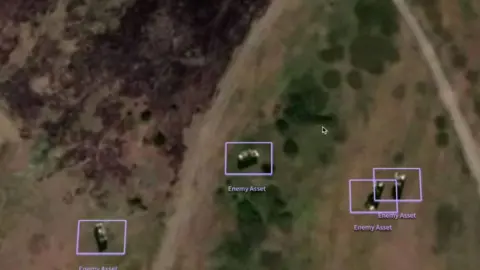
At the close of the previous year, insights emerged regarding the integration of Palantir’s AI-powered defense platform, Project Maven, into NATO operations. This software platform is engineered to synthesize and analyze a colossal array of military intelligence, encompassing everything from high-resolution satellite imagery to classified intelligence reports. The subsequent analysis, often augmented by commercial AI systems like Claude, is intended to facilitate "faster, more efficient, and ultimately more lethal decisions where that’s appropriate," as articulated by Louis Mosley, head of Palantir’s UK operations. The visual representation of this capability, depicting satellite images with AI-identified "enemy assets" highlighted by purple boxes, vividly illustrates the power and precision such systems can bring to battlefield awareness.
However, the deployment of large language models (LLMs) and other AI systems in such critical applications is not without inherent risks. A well-documented limitation of these models is their propensity to "hallucinate," meaning they can generate information that is factually incorrect or entirely fabricated. In a military context, where decisions can have life-or-death consequences, the risk of an AI system providing erroneous intelligence is a significant concern. Lieutenant Colonel Amanda Gustave, Chief Data Officer for NATO’s Task Force Maven, emphasized the critical importance of human oversight, asserting that a "human in the loop" is invariably introduced, ensuring that an AI system would "never be the case" to "make a decision for us." This commitment to human supervision is a cornerstone of responsible AI deployment in defense, yet the speed and complexity of modern conflicts continually challenge the practicalities of maintaining such oversight.
The ethical stance of technology companies regarding autonomous weapons remains a contentious point. While Palantir, unlike Anthropic, does not advocate for a universal prohibition on autonomous weapons, it firmly supports the principle of human oversight. This nuanced position reflects the ongoing debate within the tech and defense communities about the acceptable level of autonomy for AI in lethal systems. Professor Mariarosaria Taddeo of Oxford University articulated a significant concern, suggesting that with Anthropic’s reported exclusion from direct Pentagon engagement due to its "red-line" policy, "the most safety-conscious actor" might be "out from the room." This perspective highlights a potential void in the ethical dialogue surrounding military AI, raising questions about who will champion stringent safety and ethical guidelines if companies with such principles are sidelined.
The episode involving OpenAI and the Pentagon serves as a potent case study in the evolving landscape of AI ethics, corporate responsibility, and governmental reliance on private technology. It underscores the dual-use dilemma inherent in advanced AI – its capacity for immense benefit alongside its potential for profound harm, particularly when integrated into military frameworks. The public backlash and OpenAI’s subsequent policy revisions signal a growing demand for transparency, accountability, and robust ethical guardrails in the development and deployment of AI, especially in sensitive domains like national defense.
The future outlook for AI in conflict zones will likely be shaped by these ongoing debates. Governments worldwide are increasingly investing in AI capabilities for defense, recognizing their strategic importance. Simultaneously, there is an escalating call from civil society, academics, and even within the tech industry for comprehensive regulatory frameworks, international norms, and robust ethical guidelines to govern the use of AI in military applications. The incident with OpenAI demonstrates that even leading AI developers are not immune to the moral complexities and public scrutiny that accompany engagement with the defense sector. It emphasizes the critical need for clear communication, proactive ethical considerations, and continuous dialogue between technology innovators, policymakers, and the public to navigate the intricate and high-stakes frontier of artificial intelligence in an increasingly interconnected and volatile global environment. The power dynamics between private corporations possessing advanced AI capabilities and national governments seeking strategic advantage will remain a pivotal area of contention and collaboration, demanding careful consideration of both innovation and profound ethical responsibility.



 Safa Marwah

 Aura Kasih
 Ayu Aulia