Aura Kasih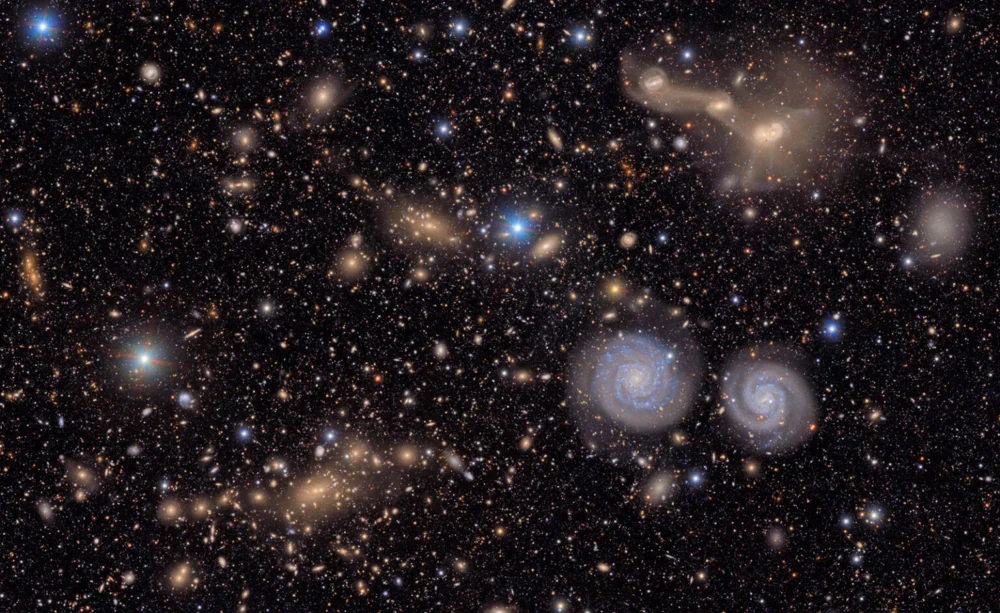
The Vera C. Rubin Observatory’s sophisticated automated alert system has commenced operations, inundating the astronomical community with an unprecedented volume of celestial phenomena requiring immediate attention, signaling a profound shift in how transient cosmic events are detected and studied.
The Vera C. Rubin Observatory, a groundbreaking facility perched atop Cerro Pachón in Chile, has officially activated its advanced automated alert system, a development poised to revolutionize the field of observational astronomy. In its inaugural 24-hour period of public operation, the system generated an astounding 800,000 alerts, flagging an array of dynamic celestial occurrences ranging from near-Earth objects to the explosive deaths of stars and the ravenous appetite of supermassive black holes. This initial deluge, while substantial, is merely a precursor to what is anticipated as the observatory ramps up its observational capacity, with projections indicating that the daily alert rate could eventually climb into the tens of millions.
This remarkable achievement follows the successful deployment of the observatory’s monumental Legacy Survey of Space and Time (LSST) camera, a device roughly the size of a small car, which began capturing its first cosmic vistas in June of the previous year. However, the activation of its real-time alert system represents the true operational dawn for Rubin, a moment eagerly awaited by researchers and amateur astronomers worldwide. The LSST camera’s primary function involves the meticulous nightly acquisition of approximately 1,000 high-resolution images. These images are then rigorously compared against a meticulously established baseline reference image captured during the telescope’s initial commissioning phase. Any deviations or discrepancies detected between the current observation and the reference image are automatically flagged as potential events of interest. A sophisticated algorithmic pipeline then meticulously analyzes these anomalies, differentiating between phenomena such as the fleeting signatures of supernovae and the trajectory of potentially hazardous asteroids. This rapid processing allows for the swift dissemination of alerts to relevant scientific consortia and interested parties, often within minutes of detection. Such expediency is critical for observing transient celestial events, many of which are ephemeral and require immediate follow-up observations to capture their full observational profile.
The sheer volume of data generated by such a powerful instrument necessitates an equally sophisticated and nuanced alert dissemination strategy. Fortunately, the Rubin Observatory’s system is designed with flexibility and scalability in mind, mitigating the risk of overwhelming researchers with an unmanageable flood of notifications. The alerts are not a monolithic stream; rather, they are highly configurable and can be meticulously filtered based on a variety of parameters. Astronomers can specify their interests by event type, such as focusing solely on supernovae, gamma-ray bursts, or variable stars. Furthermore, alerts can be tailored based on observed brightness, allowing researchers to prioritize events that are particularly luminous or, conversely, those that are faint but potentially significant. The system also allows for the temporal filtering of events, enabling scientists to receive notifications for multiple occurrences within a specific timeframe or to focus on isolated, singular events. This layered approach to alert management is crucial for optimizing scientific productivity, ensuring that researchers can dedicate their attention to the most scientifically compelling discoveries without being inundated by less relevant data. As the Rubin Observatory steadily increases its observational cadence and data acquisition rates, these advanced filtering capabilities will become increasingly indispensable in navigating the ever-expanding universe of transient astronomical phenomena.
The Vera C. Rubin Observatory represents a paradigm shift in astronomical observation, moving from a model of deliberate, targeted observation to one of comprehensive, automated sky surveying. Its design philosophy centers on the concept of ")।" – meaning “fast” or “rapid” in Spanish – a nod to the observatory’s mission to detect and respond to celestial events with unprecedented speed. The LSST camera, the heart of the observatory, boasts an astonishing 3.2-gigapixel resolution, making it the largest digital camera ever constructed for astronomical purposes. This immense sensor array, coupled with the telescope’s wide field of view, allows it to survey vast swathes of the night sky with remarkable detail. Unlike traditional observatories that might spend weeks or months focusing on a single object or region, Rubin is designed to perform a complete survey of the entire visible sky every few nights. This relentless pace of observation generates an immense dataset, far exceeding the capacity of manual analysis. Hence, the development of an automated alert system was not merely an enhancement; it was a fundamental necessity for the observatory’s scientific mission.

The implications of this automated alert system extend far beyond simply cataloging more celestial objects. It fundamentally alters the timeline of astronomical discovery. Historically, the detection of transient events like supernovae or the orbital changes of asteroids relied on serendipity or painstaking, labor-intensive surveys. Scientists would often discover these events days, weeks, or even months after they occurred, limiting the ability to study their initial phases. Rubin’s system, by contrast, can alert astronomers within minutes of a significant change being detected. This rapid response capability opens up entirely new avenues of research. For instance, the precise moments of a supernova’s explosion, the initial moments of a black hole accreting matter, or the very early stages of a near-Earth object’s trajectory can now be observed in unprecedented detail. This allows for the testing of fundamental astrophysical theories, the refinement of models describing stellar evolution and death, and the improved characterization of potential cosmic threats.
The deluge of alerts also presents a significant challenge and opportunity for the global astronomical community. The initial 800,000 alerts are just the beginning. As the observatory’s operational tempo increases, the number of daily alerts is projected to reach tens of millions. This necessitates a robust and collaborative framework for processing, verifying, and distributing this immense volume of data. The Rubin Observatory is not acting in isolation; it is designed to integrate with a global network of telescopes and observatories. When Rubin flags a significant event, the alert can be disseminated to other facilities around the world, allowing for multi-wavelength follow-up observations. This coordinated approach, often referred to as “time-domain astronomy,” leverages the strengths of various instruments to gain a more comprehensive understanding of celestial phenomena. The ability to rapidly dispatch telescopes to observe a newly detected event is crucial for capturing its full spectral and temporal characteristics.
Furthermore, the data generated by the Rubin Observatory will not be confined to academic institutions. The observatory’s commitment to open data principles ensures that its discoveries will be accessible to researchers worldwide, fostering collaboration and innovation. This democratization of astronomical data has the potential to accelerate discoveries and empower a new generation of scientists. The sheer scale of the data also presents opportunities for the application of advanced computational techniques, including machine learning and artificial intelligence, to sift through the vast datasets, identify subtle patterns, and even predict future events. The development of new algorithms capable of handling and interpreting this unprecedented flow of information will be a critical area of research in the coming years.
The focus on near-Earth objects (NEOs) is particularly significant. The ability to detect potentially hazardous asteroids with greater frequency and with earlier warning times could have profound implications for planetary defense. While the majority of the alerts are expected to relate to more common astronomical events, the capacity to identify even a small fraction of newly discovered asteroids on impact trajectories with significant lead times is an invaluable asset for safeguarding our planet. The detailed observational data provided by Rubin will allow for more accurate orbital calculations and a better assessment of potential risks.
Looking ahead, the Vera C. Rubin Observatory’s alert system is poised to become an indispensable tool for astronomers. Its sustained operation will undoubtedly lead to a continuous stream of groundbreaking discoveries, reshaping our understanding of the universe. From the most distant galaxies to the asteroids in our own cosmic backyard, the observatory’s vigilant gaze and rapid reporting capabilities promise to unlock cosmic secrets at an accelerated pace. The era of the ")।" survey is not just about observing more; it is about observing smarter, faster, and more collaboratively, ushering in a golden age of discovery in the dynamic cosmos. The ongoing refinement of its alert filtering mechanisms and the integration with an ever-expanding network of observational facilities will be key to maximizing the scientific return from this revolutionary observatory. The sheer volume of data will also spur innovation in data science and computational astrophysics, driving advancements in fields beyond pure astronomical research.



 Lisa Mariana
 Safa Marwah
 Ayu Aulia