Aura Kasih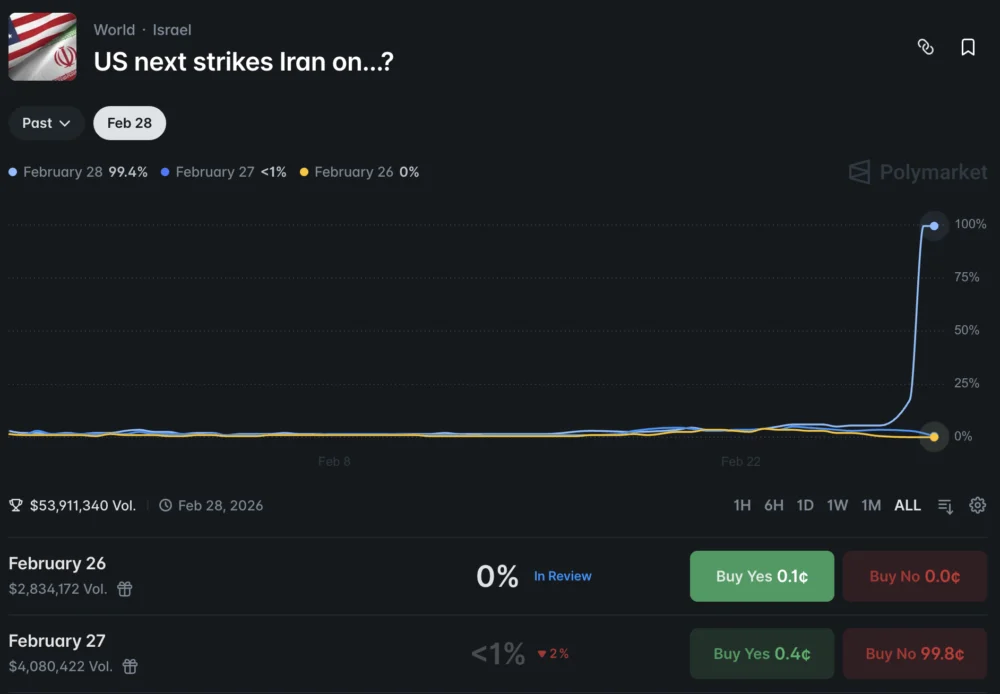
In the wake of escalating geopolitical tensions and the tragic loss of life, the prediction market platform Polymarket has found itself at the center of a significant ethical debate. The company has defended its decision to facilitate betting on the outbreak and progression of warfare, particularly concerning recent events in the Middle East, by characterizing these markets as an "invaluable" source of information and forecasting. This stance, however, has ignited widespread criticism, raising profound questions about the commodification of human suffering and the role of such platforms in disseminating potentially sensitive geopolitical insights.
Polymarket, known for its decentralized prediction markets where users can bet on the outcomes of various events, has previously courted controversy. Past instances include allegations of insider trading related to Super Bowl halftime shows and the uncanny accuracy of bets predicting the capture of Venezuelan President Nicolás Maduro. The platform’s latest venture into betting on potential military strikes against Iran, and subsequently on the actual conflict and its casualties, has amplified these concerns to an unprecedented level.
The platform’s defense of its operations, articulated in a statement on its website, posits that prediction markets serve a crucial function in aggregating collective intelligence. According to Polymarket, these markets can provide "accurate, unbiased forecasts for the most important events to society," an ability they deem "particularly invaluable in gut-wrenching times like today." The company asserts that in the immediate aftermath of attacks and amidst profound uncertainty, prediction markets can offer answers and clarity in ways that traditional news media and social platforms like Elon Musk’s X (formerly Twitter) allegedly cannot. This framing suggests a belief that by allowing users to speculate on the likelihood and trajectory of conflict, a more objective and predictive understanding can emerge.
However, the implications of such a perspective are far-reaching and ethically complex. The core premise of prediction markets is to leverage the "wisdom of the crowd" by incentivizing individuals to research and forecast outcomes accurately. In theory, this can lead to more informed decision-making across a variety of fields, from business and finance to public policy. Yet, when the subject matter involves active warfare, loss of life, and immense human suffering, the application of this principle enters morally precarious territory.
The argument that betting on war provides "answers" is particularly contentious. Critics argue that transforming real-world tragedies into speculative financial instruments risks trivializing the gravity of these events. The act of placing a wager on the continuation or escalation of a conflict, or on the number of casualties, can be perceived as a form of detached profiteering from human misery. This perspective suggests that the "wisdom of the crowd" in this context might be distorted by the financial incentives, potentially prioritizing short-term gains over a nuanced understanding of the complex geopolitical and humanitarian dimensions.
Polymarket’s statement implicitly criticizes traditional media outlets, suggesting they may not offer the same level of immediate or unbiased information. While traditional journalism faces its own challenges regarding objectivity and speed, its fundamental purpose is to report events, provide context, and foster public understanding, not to facilitate financial speculation on their outcomes. The comparison to platforms like X also highlights the ongoing debate about the reliability and impact of social media in shaping public discourse during crises. Polymarket seems to position itself as a more rigorous and data-driven alternative, even if its methodology involves turning human conflict into a betting proposition.

The underlying technology of Polymarket, which is built on blockchain and smart contracts, aims to ensure transparency and immutability of transactions. This decentralization is often lauded for its ability to circumvent censorship and centralized control. However, in the context of sensitive geopolitical events, this same lack of centralized oversight raises questions about accountability and the potential for misuse. While the platform may not directly profit from individual bets, it benefits from the volume of activity on its markets.
The debate surrounding Polymarket’s operations intersects with broader discussions about the ethics of financial markets and their role in society. Historically, markets have been criticized for their potential to amplify existing inequalities and for their detachment from real-world consequences. The application of these market mechanisms to events involving human life and death forces a confrontation with the ethical boundaries of financial innovation.
From an analytical standpoint, the "invaluable" nature of prediction markets in times of crisis, as claimed by Polymarket, warrants closer examination. While it is true that aggregate predictions can sometimes offer a more accurate forecast than individual expert opinions, the conditions under which these predictions are generated are crucial. If the "crowd" is incentivized by financial gain rather than a genuine desire for objective truth or humanitarian concern, the resulting forecasts may be skewed. Furthermore, the information available to participants in such markets is often incomplete or subject to speculation itself, further complicating the notion of unbiased forecasting.
The company’s reference to consulting "those directly affected by the attacks" before enabling betting markets suggests an attempt to address ethical concerns. However, the interpretation of whether such consultation adequately mitigates the ethical challenges remains subjective. The very act of engaging affected parties in the context of a betting market, rather than through direct humanitarian aid or diplomatic channels, can be seen as problematic.
Looking ahead, the controversy surrounding Polymarket’s war betting markets is likely to intensify. As geopolitical instability continues to be a defining feature of the global landscape, the demand for information and analysis regarding potential conflicts will remain high. Prediction markets, by their nature, will likely continue to emerge or expand their offerings in these areas. This necessitates a robust public and regulatory dialogue about the ethical boundaries of such platforms.
Policymakers and regulators may need to consider new frameworks for addressing the ethical implications of prediction markets, particularly those that deal with sensitive or potentially harmful subject matter. This could involve defining specific categories of events that are off-limits for betting, implementing stricter oversight mechanisms, or promoting greater transparency regarding the data and incentives that drive these markets.
Moreover, the broader societal conversation about the commodification of information and events, especially those involving human suffering, needs to be amplified. The question is not simply whether prediction markets can generate accurate forecasts, but whether it is ethically permissible to turn such forecasts into financial instruments, regardless of their predictive power. The "invaluable" nature of information, as Polymarket suggests, must be weighed against the inherent dignity and sanctity of human life. The continued existence and growth of platforms like Polymarket suggest that this is a conversation that is only just beginning.




 Lisa Mariana
 Safa Marwah
 Ayu Aulia