Lisa Mariana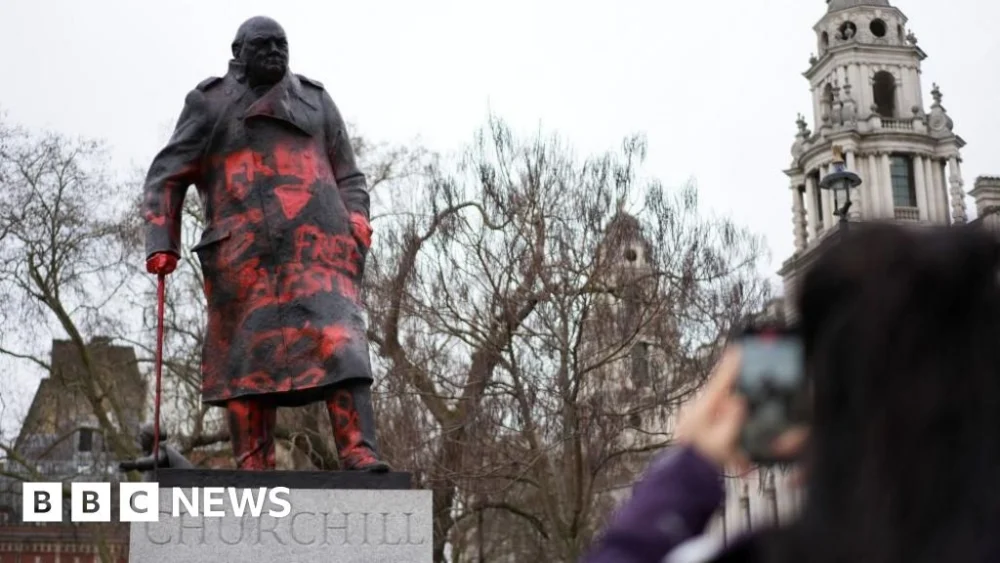
A significant act of defacement targeting the statue of Sir Winston Churchill in London’s historically resonant Parliament Square has led to the formal charging of an individual with criminal damage. The incident, which saw graffiti applied to the prominent monument, has not only initiated a swift legal process but also reignited broader discussions regarding the protection of national heritage, the boundaries of public protest, and the complex legacies of historical figures represented in urban landscapes.
The individual identified as Caspar San Giorgio, 38 years of age and recorded as having no fixed address, was apprehended in the early hours of Friday morning, shortly after 04:00 GMT, following reports of vandalism at the revered statue. Law enforcement officials acted promptly, taking Mr. San Giorgio into custody. By Saturday morning, formal charges of criminal damage had been officially laid against him. He has since been remanded in custody, awaiting his appearance at Highbury Corner Magistrates’ Court, scheduled for later today, where the initial proceedings of this high-profile case are expected to commence. The rapid sequence of arrest and charging underscores the seriousness with which authorities are treating acts of damage to public monuments, particularly those of significant national importance located within the heart of the capital’s political district.
The Iconography and Vulnerability of Parliament Square
Parliament Square stands as a symbolic epicentre of British democracy, surrounded by the Houses of Parliament, Westminster Abbey, and the Supreme Court. It serves as a stage for both national celebration and public dissent, hosting numerous statues of influential historical figures who have shaped the nation’s trajectory. Among these, the bronze likeness of Sir Winston Churchill, erected in 1973, holds a particularly revered position. As the wartime Prime Minister, Churchill remains a towering figure in British history, synonymous with national resilience and defiance during World War II. However, his legacy, like many historical personalities, has become subject to increasingly critical scrutiny in contemporary discourse, particularly concerning his views and actions on colonialism and race. This dual perception often renders his statue a focal point for both veneration and protest, making it especially vulnerable to acts of symbolic expression, including vandalism.
The act of defacing this specific statue, therefore, carries layers of meaning beyond simple criminal damage. It often reflects deeper societal tensions and ongoing debates about how historical narratives are presented and interpreted in public spaces. Previous incidents of vandalism targeting this very statue, notably during periods of heightened social activism, highlight its status as a canvas for both political statement and historical re-evaluation. The latest incident adds another chapter to this evolving narrative, prompting immediate questions about the motivations behind such acts and their broader implications for civic order and cultural preservation.
Legal Framework and Potential Consequences
In the United Kingdom, criminal damage, as defined by the Criminal Damage Act 1971, encompasses a wide range of offences from minor graffiti to significant destruction of property. The severity of the charge and subsequent penalties are typically determined by the extent of the damage and the monetary value of the property affected. Given the cultural and historical significance of the Churchill statue, any damage, even if cosmetic, is likely to be viewed gravely by the prosecuting authorities and the judiciary. Penalties for criminal damage can range from community service orders and substantial fines to imprisonment, depending on the circumstances, the defendant’s intent, and any prior convictions.
For an act involving a national monument in a high-profile location like Parliament Square, the courts often consider aggravating factors such as the symbolic value of the target and the potential for public disorder or distress. The swift arrest and charging of Mr. San Giorgio indicate the police’s commitment to deterrence and maintaining public order. The upcoming court appearance will provide the initial legal context for the incident, with the prosecution outlining its case and the defence presenting its arguments. The outcome will be closely watched by those interested in the enforcement of laws protecting public property and heritage.
The Interplay of Protest, Expression, and Preservation
The incident inevitably brings into sharp focus the complex interplay between the rights to freedom of expression and peaceful protest, and the imperative to protect public property and cultural heritage. While democratic societies uphold the right of individuals to voice dissent, legal frameworks generally draw a clear line when such expression involves the destruction or defacement of property. This boundary is often contested, particularly when monuments represent figures whose legacies are perceived by some as contentious or even oppressive.
From a sociological perspective, acts of monument defacement can be interpreted in various ways. They can be seen as direct challenges to prevailing historical narratives, attempts to force a re-evaluation of national heroes, or expressions of frustration against perceived systemic injustices. For others, such acts are simply vandalism, disrespectful to shared heritage, and counterproductive to constructive dialogue. This divergence of views underscores a persistent societal tension: how does a nation reconcile the historical context of its monuments with contemporary values and evolving understandings of history?
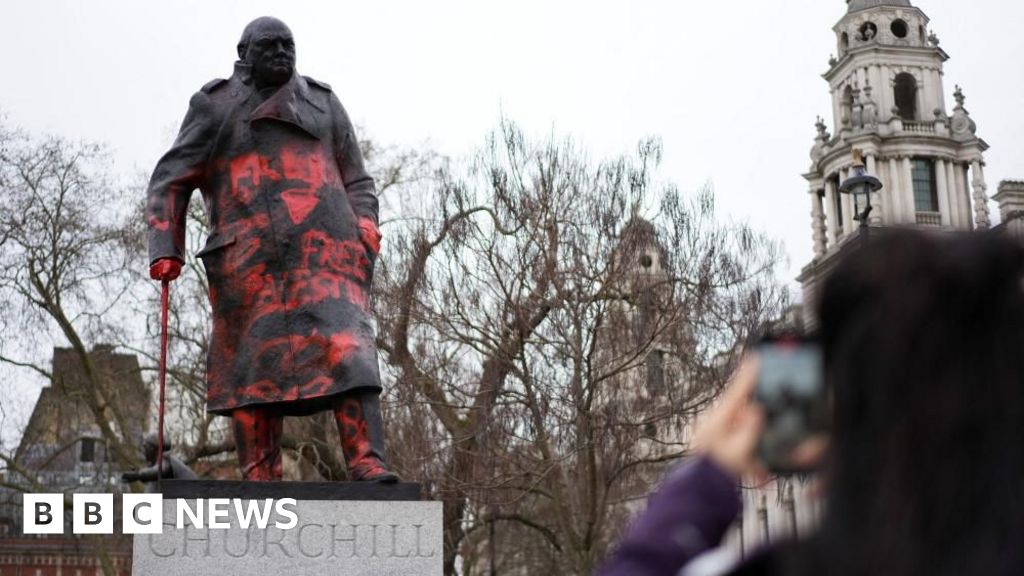
Expert analysis suggests that these acts are rarely random. They often target symbols that embody specific historical grievances or political statements. The Churchill statue, having been the subject of protest previously, particularly in relation to issues of racial justice and colonial history, fits this pattern. The act of defacement, in this context, can be viewed as a disruptive tactic intended to provoke public debate and draw attention to particular critiques of historical figures or state institutions.
Security and the Future of Public Monuments
The recurring nature of such incidents raises critical questions about the security protocols surrounding high-value public monuments. Parliament Square is typically under constant surveillance, with numerous CCTV cameras and a visible police presence. The fact that the vandalism occurred in the early hours suggests a potential window of opportunity exploited by the perpetrator, or a deliberate attempt to evade immediate detection.
In response to previous incidents and the increasing politicisation of public statues, authorities have explored various preventative measures. These range from enhanced physical security, such as barriers or increased patrolling, to technological solutions like advanced surveillance systems, including AI-powered monitoring that can detect unusual activity. However, there is a delicate balance to strike. Overly aggressive security measures can inadvertently transform public spaces into fortified zones, diminishing their accessibility and symbolic openness. The challenge lies in implementing effective protection without alienating the public or creating an environment that feels overly policed.
Beyond immediate security, there is a broader ongoing discussion about the future of public monuments themselves. Should statues of controversial figures be removed, recontextualised with additional information, or left as they are, serving as catalysts for debate? While the immediate focus remains on legal action against Mr. San Giorgio, the incident inevitably feeds into this larger societal conversation. It prompts policymakers, heritage organisations, and community groups to consider sustainable strategies for managing public spaces and historical representations in an increasingly diverse and critically aware society.
Global Context and Precedents
This incident is not isolated to the United Kingdom; it is part of a broader global phenomenon. Across continents, statues and monuments have become flashpoints for social movements, particularly those challenging colonial legacies, racial injustice, and historical narratives perceived as exclusionary or glorifying problematic figures. From statues of slave traders being toppled in the UK and the US, to monuments of former dictators being defaced in Eastern Europe, the act of targeting public sculptures has emerged as a powerful, albeit controversial, form of protest.
These global trends suggest that such acts of vandalism are often symptoms of deeper societal shifts and unresolved historical grievances. They force societies to confront uncomfortable aspects of their past and to re-evaluate who and what they choose to honour in their public spaces. The legal response, while necessary to uphold law and order, does not fully address the underlying motivations or the complex historical and social contexts that often fuel these acts.
Conclusion
The charging of Caspar San Giorgio for criminal damage to the Sir Winston Churchill statue in Parliament Square marks the beginning of a legal process that will address the immediate offence. However, the incident’s reverberations extend far beyond the courtroom. It serves as a stark reminder of the ongoing tensions surrounding historical memory, national identity, and the acceptable parameters of public expression in a democratic society. As the legal proceedings unfold, the wider societal debate about the role, protection, and interpretation of public monuments will undoubtedly continue, urging a deeper examination of how nations grapple with their past in an ever-evolving present. The incident reinforces the need for nuanced approaches that balance the rule of law with the complexities of historical consciousness and the dynamics of social change.




 Aura Kasih
 Safa Marwah
 Ayu Aulia