Lisa Mariana
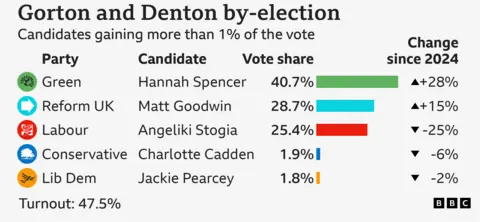
The political landscape in Greater Manchester has been dramatically reshaped following a groundbreaking by-election victory for the Green Party in the historically Labour stronghold of Gorton and Denton, a result that has profoundly escalated pressure on the embattled Prime Minister, Sir Keir Starmer. This unprecedented win marks a significant realignment of electoral power, prompting immediate introspection within the Labour Party and generating ripple effects across the national political spectrum as other parties assess its wider implications.
The by-election, triggered by the unexpected resignation of the previous Labour incumbent, saw a seismic shift in voter allegiance. Labour, which had dominated the constituency for nearly a century, suffered a humiliating third-place finish. This represented a substantial erosion of their traditional support base, signalling a profound discontent among voters who have historically aligned with the party. The surprise runner-up position was secured by Reform UK, further highlighting a fragmentation of the traditional two-party system and the emergence of alternative protest votes.
The historic nature of the Green Party’s triumph cannot be overstated. Hannah Spencer, a 34-year-old local plumber and councillor, became the first Green Member of Parliament to represent a constituency in the north of England. Her victory is a testament to a carefully executed, long-term strategic effort by the Green Party, which had identified Gorton and Denton as its 127th target seat. This win demonstrates their capacity to transcend their traditional strongholds and appeal to a broader demographic, leveraging local issues alongside their core environmental platform. The outcome has irrevocably altered the narrative surrounding the Green Party’s electoral viability, positioning them as a genuine contender in specific regional contests.
The repercussions for Sir Keir Starmer’s leadership are immediate and severe. Entering the Gorton campaign already facing the challenges of persistently low approval ratings and a series of high-profile policy reversals, the by-election loss has amplified calls for a re-evaluation of his strategic direction. His recent shifts on key policy positions, perceived by some as opportunistic or indecisive, have contributed to an image of vulnerability and have fuelled internal dissent. The result now serves as a stark barometer of public sentiment ahead of crucial May elections across Scotland, Wales, and various English councils, which are widely considered a critical test of his premiership’s stability and future trajectory.

In the wake of the defeat, Sir Keir Starmer adopted a defiant stance, pledging to "keep on fighting" and asserting his commitment to "getting on with the hard yards" required to reverse Labour’s fortunes. This rhetoric, while intended to project resolve, did little to quell the immediate wave of criticism emanating from within his own party. Angela Rayner, a prominent figure on Labour’s left and a potential future challenger, articulated the widespread concern, describing the defeat as a "wake-up call" and urging the government to adopt a "braver" and more assertive policy agenda. Her comments underscore a growing impatience within Labour ranks for a more distinctive and compelling vision.
Further exacerbating the internal turmoil was the controversial decision by the Prime Minister to prevent Andy Burnham, the highly popular Mayor of Greater Manchester and another frequently cited potential leadership candidate, from contesting the Gorton and Denton seat. This move, interpreted by some as a strategic attempt to neutralise a powerful rival, now appears to have backfired spectacularly. Burnham’s absence from the ballot, in a constituency he might have been expected to win, has only intensified speculation about his future ambitions and the degree of autonomy afforded to influential regional figures within the party. His conspicuous silence following the result, and his refusal to engage with reporters, spoke volumes in the immediate aftermath of the by-election.
The Gorton and Denton constituency itself offered a complex electoral battleground, characterised by its historical working-class roots, a significant student population, and a substantial Muslim community. These diverse demographics meant that the by-election was not merely a straightforward contest but a multifaceted strategic test for all parties involved. In an unusual move, Sir Keir Starmer penned a letter to Labour MPs following the defeat, in which he launched a scathing critique of the Green Party. He accused them of employing "divisive, sectarian" political tactics and asserted that they were "not the harmless environmentalists they pretend to be." He further branded their policies as "extreme" and dismissed their ability to replicate this victory in a general election, citing a perceived lack of "resources, the activist base or the local knowledge."
This robust condemnation from the Prime Minister elicited an equally strong retort from Green leader Zack Polanski, who accused Starmer of attempting to "smear voters as extremists." Hannah Spencer, the newly elected MP, vehemently rejected the accusations of sectarian politics, contending that her party had successfully united voters around common concerns related to the cost-of-living crisis, the state of public services, and the ongoing conflict in Gaza. Her statement underscored a strategic broadening of the Green Party’s appeal beyond purely environmental issues, tapping into a wider current of voter disillusionment and specific local grievances.
Spencer, in her victory speech, emphasised a message of inclusivity and representation: "I know in my heart, and everyone knows here, everybody here belongs. Everybody deserves to have their needs met. Everyone deserves a voice in our democracy." She framed the result, in what was previously considered an ambitious target, as a powerful demonstration that the Greens "can win anywhere" and declared it "just the beginning" for her party. She expressed confidence in further gains in the upcoming May elections for English councils and the Welsh Senedd, suggesting a sustained momentum for the Green movement.

Under the leadership of Zack Polanski, who assumed the party’s helm five months prior, the Greens have adopted an "eco-populist" platform, deliberately courting voters with a progressive left-wing economic agenda alongside their established environmental focus. Their policy proposals include empowering local councils to implement rent controls, expanding free school meals to all children, and introducing a new ‘wealth tax’ on assets exceeding £10 million. This expanded policy remit aims to address broader social and economic inequalities, thereby widening their electoral appeal beyond their traditional environmentalist base.
The by-election was also shadowed by reports of "family voting" at polling stations, a concern that was swiftly seized upon by both the Conservative and Reform UK parties. Democracy Volunteers, a group of election observers, brought these claims to public attention. Reform UK subsequently called for a formal inquiry by Greater Manchester Police and the Electoral Commission into the allegations, a demand echoed by the Conservatives. These concerns, while yet to be formally investigated, introduce an additional layer of scrutiny over the electoral process in the constituency.
Matt Goodwin, the Reform UK candidate who secured a strong second place, asserted that his party had "embarrassed Labour in one of their strongest seats." He further characterised the Green victory as a "coalition of Islamists and woke progressives," arguing that it marked "the emergence of a dangerous sectarianism in British politics." This provocative interpretation reflects Reform UK’s strategy of positioning itself as a challenger to the political establishment and leveraging cultural anxieties.
Conservative leader Kemi Badenoch issued a scathing assessment of the by-election’s outcome, declaring that it "shows Keir Starmer’s premiership is finished" and suggesting the Prime Minister would resign "if he had any integrity." Despite her party’s strong rhetoric, the Conservatives themselves endured a dreadful night at the polls in Gorton and Denton, securing only 706 votes and consequently losing their election deposit, a fate also shared by the Liberal Democrats. This outcome underscored the difficulties faced by both established mainstream parties in connecting with the local electorate in this specific contest.
The immediate public condemnation of Sir Keir Starmer following the by-election loss has primarily come from a familiar cohort of Labour backbenchers who are frequent critics of his leadership, including figures such as Karl Turner, Richard Burgon, and Nadia Whittome. However, the depth of internal disquiet was further revealed through anonymous statements from other Labour MPs to BBC Radio 5 Live’s Matt Chorley. One described the by-election result as "a punch in the face for the Labour Party and for Keir Starmer’s premiership," while another grimly observed, "Keir must reflect on how unpopular he is with the public."
Despite the palpable anger and disillusionment, a significant current of caution also runs through the party. Some MPs advised against "knee-jerk responses that address the concerns of one wing of the support we need, at the expense of losing the other." This highlights the intricate balancing act Labour faces in trying to appeal to its diverse electoral coalition. Crucially, several MPs articulated a pragmatic concern that there was "no obvious alternative" to Sir Keir, and that instigating a leadership contest at this juncture would be "disastrous" for the party’s broader electoral prospects. This sentiment suggests that while Starmer’s position is undeniably weakened, the immediate threat of a formal leadership challenge may be mitigated by a lack of consensus around a viable successor and the fear of further internal division.
The Gorton and Denton by-election stands as a potent symbol of a shifting political landscape in the UK, where traditional loyalties are increasingly fragile, and protest votes can coalesce around emergent forces. For Labour, it represents a profound challenge to its strategy and leadership, forcing a critical re-evaluation of how it connects with diverse communities and articulates a compelling vision. The Green Party’s historic win, coupled with Reform UK’s strong showing, indicates a growing appetite for alternatives and a potential fragmentation of the progressive vote, which could have significant implications for the upcoming local elections and the next general election. The road ahead for Sir Keir Starmer and the Labour Party appears fraught with complex strategic dilemmas and intense internal scrutiny as they navigate this turbulent electoral environment.




 Aura Kasih
 Safa Marwah
 Ayu Aulia