Lisa Mariana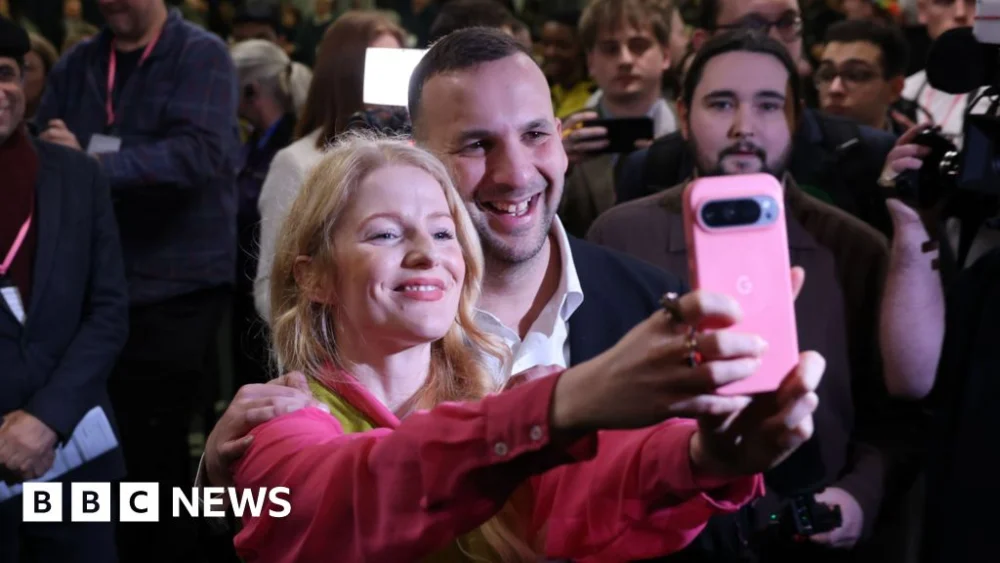
In a profound electoral realignment that has sent reverberations through the British political establishment, the Green Party has secured an unprecedented by-election victory in the Greater Manchester constituency of Gorton and Denton. Hannah Spencer’s triumph marks a seminal moment, representing the Greens’ inaugural win in a Westminster by-election and pushing the Labour Party, long considered a bastion of support in the region, into an astonishing third place behind Reform UK.
This dramatic outcome underscores a significant shift in the electoral landscape, challenging deeply entrenched political orthodoxies. The Gorton and Denton constituency, historically a Labour stronghold for over a century, witnessed a monumental swing that obliterated a substantial Labour majority from the 2024 general election. The magnitude of this overturn—the sixth largest Labour majority to be reversed in a by-election since the Second World War—serves as a stark indicator of widespread voter dissatisfaction and a growing appetite for alternative political representation.
Hannah Spencer, a local plumber and an established councillor, secured 14,980 votes, translating to nearly 41% of the total ballots cast. This represented a colossal 26.4% swing from Labour to the Green Party, a figure that political analysts are scrutinizing for its potential broader implications. Reform UK’s candidate, Matt Goodwin, captured second place with 10,578 votes, while Labour’s Angeliki Stogia trailed in third with 9,364 votes. The Conservative Party’s Charlotte Cadden registered an abysmal 706 votes, marking their lowest ever by-election performance, with the Liberal Democrats’ Jackie Pearcey garnering 653 votes. The minor parties collectively secured less than 200 votes each, highlighting a concentration of anti-establishment sentiment towards the Greens and Reform UK.
The by-election was necessitated by the resignation of former Labour health minister Andrew Gwynne, who stepped down after losing the Labour whip following revelations of offensive WhatsApp messages a year prior. This context provides an initial layer of understanding regarding the electorate’s disillusionment, suggesting a punitive response to perceived ethical failings within the established party.
Hannah Spencer, now the Green Party’s fifth Member of Parliament, delivered an emotionally charged acceptance speech, vowing to "fight" for those who feel marginalized and overlooked. She articulated a vision of representation rooted in authenticity, stating that voters had chosen "someone like me, who is actually just pretty normal." Spencer emphasized the importance of genuine engagement, asserting, "All we have done is… listen to people." She highlighted the economic struggles faced by many constituents, lamenting that for too many, "a nice life" has become unattainable, with individuals "working to line the pockets of billionaires." Her commitment extended to advocating for "my Muslim friends" as well as "white, working class communities," reflecting an attempt to bridge diverse segments of the electorate. In a touch of relatable candour, she also offered apologies to her plumbing clients for needing to cancel scheduled jobs, a gesture that further cemented her image as an accessible, community-focused figure.
Green Party leader Zack Polanski hailed the victory as a testament to the party’s growing national reach, declaring on BBC Breakfast that Gorton and Denton, despite being only their 127th target seat, demonstrated "there’s no no-go areas for the Green Party." This statement signals an aggressive expansion strategy, potentially targeting more traditionally Labour-held seats across the country.
Reform UK’s Matt Goodwin, clearly buoyed by his party’s strong second-place finish, expressed confidence in their broader appeal. He commented that his performance had "embarrassed Labour in one of their strongest seats," adding, "I think if we can do this here, we can do this pretty much anywhere." Goodwin’s analysis, however, also contained a controversial assertion, attributing the Green victory to a "coalition of Islamists and woke progressives" and warning of "the emergence of a dangerous sectarianism in British politics," which he claimed the Greens were "riding a very dangerous wave." These remarks immediately drew criticism and highlighted the increasingly polarized nature of political discourse.
The repercussions for the Labour Party are particularly acute. This marks their second by-election loss since their general election victory in 2024, both to parties with only a handful of sitting MPs. The Gorton and Denton result amplifies the scrutiny on Sir Keir Starmer’s leadership, particularly ahead of crucial May elections across Scotland, Wales, and various English councils. Transport Secretary Heidi Alexander, a Labour figure, acknowledged the "disappointing" result but urged caution against over-interpretation, suggesting "different dynamics" operate during by-elections compared to general elections. She posited that the public had not yet felt the positive impact of the government’s long-term decisions, making it "a hard message for us to land."
Internally, Labour’s candidate selection process for Gorton and Denton has come under retrospective fire. There was a significant internal debate regarding whether Andy Burnham, the popular Mayor of Greater Manchester, should have been allowed to stand. The Prime Minister reportedly backed the decision to prevent Burnham from running, a move that some Labour MPs, including Karl Turner, now believe was a critical misstep. Turner described the outcome as "catastrophic" for Labour, directly attributing the defeat to "unpopular" policies. Labour’s deputy leader, Lucy Powell, who had previously supported Burnham’s potential candidacy, deflected questions about whether he would have secured a victory, stating, "That’s a different discussion for a different day." She pointed out the consequence of a potential mayoral by-election across Greater Manchester had Burnham won. Powell conceded that the party needed to "change how we operate," echoing the Prime Minister’s recent sentiments.
Further compounding Labour’s challenges, Sharon Graham, the influential leader of Unite, Labour’s largest trade union backer, issued a stinging rebuke. She demanded that the party "ditch the gimmicks and get back to being Labour." Graham articulated the widespread economic distress, stating, "Workers and families are hurting. We have a cost of living crisis largely being ignored and investment in jobs for the here and now being blocked by a Treasury that doesn’t seem to understand the basics of what is needed to build Britain." Her concluding admonition, "Stop listening your rich mates and start listening to everyday people," encapsulates a significant segment of traditional Labour voter disillusionment.
Beyond the immediate electoral outcomes, the by-election was marred by concerns over electoral integrity. Democracy Volunteers, an election observer group, reported observing instances of "family voting" in an alarming 68% of polling stations—the highest level recorded in their ten-year history. This practice, where two voters share a single polling booth and potentially influence each other’s choices, is illegal. Nigel Farage, leader of Reform UK, seized on these observations, raising questions "about the integrity of the democratic process in predominantly Muslim areas" and controversially claiming the election was "a victory for sectarian voting and cheating." Manchester City Council, however, countered these claims, stating that no issues had been officially reported and expressing disappointment that Democracy Volunteers had waited until after the close of polls to voice their concerns. Green leader Zack Polanski acknowledged the need for investigation if wrongdoing occurred but referenced the council’s denial of any reported problems. This exchange highlights an increasing vulnerability of the electoral process to questions of legitimacy, particularly in politically charged contexts.
The Gorton and Denton by-election represents far more than a localized political contest; it is a microcosm of evolving national political dynamics. It underscores the fragility of traditional party loyalties, the growing electoral potency of smaller parties, and the profound impact of local issues and candidate authenticity. For Labour, it is a clarion call for introspection and strategic recalibration. For the Green Party, it is a validation of their expanding appeal and a potential springboard for further electoral gains. For the broader political landscape, it signals a period of heightened volatility and an urgent need for all parties to re-engage with an electorate that is demonstrably willing to abandon long-held affiliations in pursuit of more responsive and relevant representation. The road to the next general election will undoubtedly be shaped by how effectively these lessons are absorbed and acted upon by the major political players.




 Aura Kasih
 Safa Marwah
 Ayu Aulia