Lisa Mariana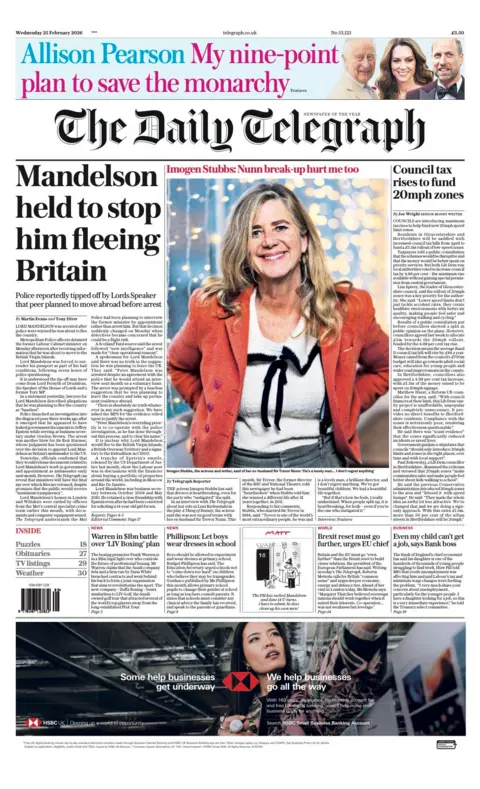
This week’s global and domestic news cycles have been dominated by significant geopolitical developments, including a notable diplomatic absence at a pivotal war anniversary, alongside intense scrutiny of prominent political figures and burgeoning debates over critical social policies, all reflecting a landscape of shifting priorities and heightened public contention.
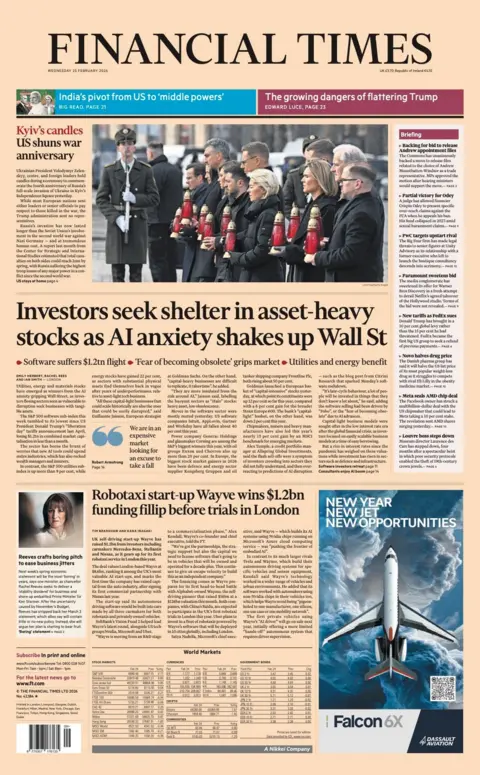
The fourth anniversary of the conflict in Ukraine, a somber milestone marking years of profound geopolitical instability and human suffering, served as a focal point for international diplomacy in Kyiv. Ukrainian President Volodymyr Zelensky, flanked by various European leaders, participated in a poignant commemorative ceremony at Independence Square. The collective presence of these leaders, holding commemorative candles, underscored a visible show of solidarity and shared commitment to Ukraine’s sovereignty and territorial integrity. However, a conspicuous absence at this critical gathering drew considerable attention: the United States, under the current Trump administration, did not dispatch a representative to the event. This diplomatic omission has prompted widespread speculation regarding its implications for the transatlantic alliance, the ongoing conflict, and the future trajectory of global security partnerships.
The Echoes of Absence: US Stance on the Ukraine Conflict
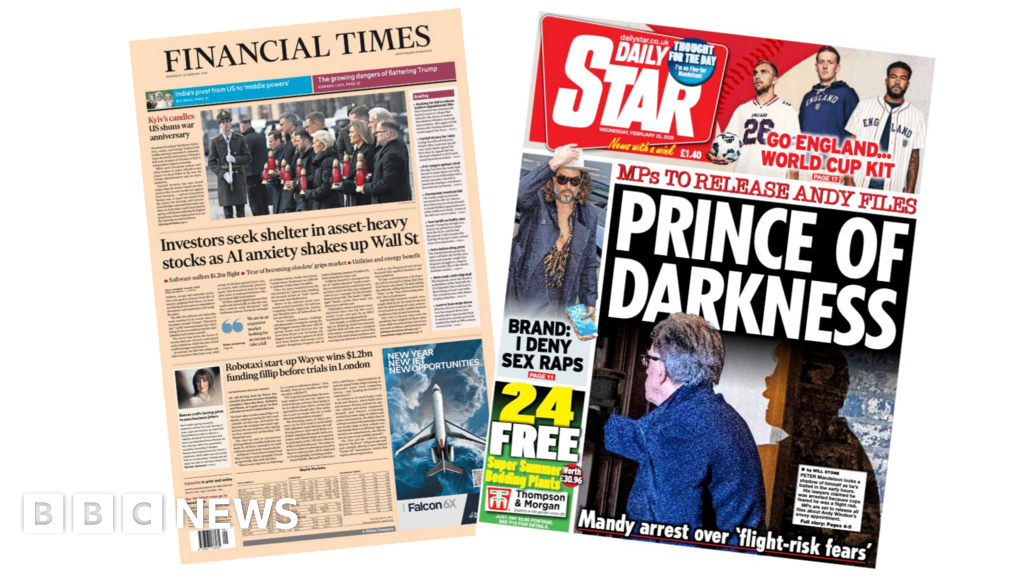
The decision by the Trump administration not to send an official delegate to Kyiv’s fourth-anniversary commemoration of the war in Ukraine represents a significant departure from traditional US foreign policy engagement and has sent ripples through diplomatic circles. Historically, the United States has positioned itself as a staunch ally of Ukraine, particularly since the escalation of the conflict, providing substantial military, financial, and humanitarian aid. The absence of a high-level representative at such a symbolically charged event can be interpreted in multiple ways, each carrying weighty implications.
From Kyiv’s perspective, the lack of a US presence could be perceived as a weakening of resolve or a signal of shifting priorities from Washington. President Zelensky and his government rely heavily on consistent international support to sustain their defense efforts and to project an image of a united front against aggression. A perceived diminution of US commitment, even if purely symbolic, risks undermining morale and potentially emboldening adversaries who might interpret it as a crack in the Western alliance. It could force Ukraine to re-evaluate its strategic dependencies and potentially seek stronger assurances or alternative forms of support from European partners.
For European leaders, who were present in force, the US absence might prompt a deeper introspection into the future of transatlantic security. While European nations have significantly increased their own support for Ukraine, the strategic weight and military capabilities of the United States remain unparalleled. A consistent pattern of disengagement from Washington could accelerate calls for greater European strategic autonomy and a more robust common defense policy, potentially leading to a re-calibration of NATO’s operational focus and funding mechanisms. This could manifest in increased defense spending across EU member states and a more unified, albeit potentially more isolated, European stance on global conflicts.
International relations analysts are keenly observing this development. Dr. Alistair Finch, a senior fellow at the Global Security Institute, commented, "The symbolism of diplomatic representation at critical junctures cannot be overstated. An absence, particularly from a key ally, speaks volumes about priorities and potentially signals a recalibration of strategic alignment. It forces other partners to question the long-term reliability of such commitments." The geopolitical ramifications extend beyond the immediate conflict, potentially influencing US relations with other allies and adversaries worldwide. It could be seen as an indicator of a broader "America First" doctrine being applied to international security, where direct US interests are prioritized above collective security frameworks or alliance maintenance. Conversely, proponents of the administration’s policy might argue that direct military or financial aid is more impactful than ceremonial attendance, or that the absence is a strategic message aimed at pressuring other allies to shoulder a greater share of the burden.
The implications for Russia are also significant. Moscow could interpret the US absence as a sign of fragmentation within the Western alliance, potentially encouraging further aggressive actions or a hardened negotiating stance, believing that the international consensus against its actions is weakening. The long-term outlook for the conflict and regional stability remains precarious, with the US’s diplomatic posture adding another layer of complexity to an already intricate geopolitical chessboard. The question of whether this absence is an isolated incident or indicative of a fundamental shift in US foreign policy will shape international relations for years to come.
The "Prince of Darkness" Affair: A Political Figure Under the Legal Spotlight
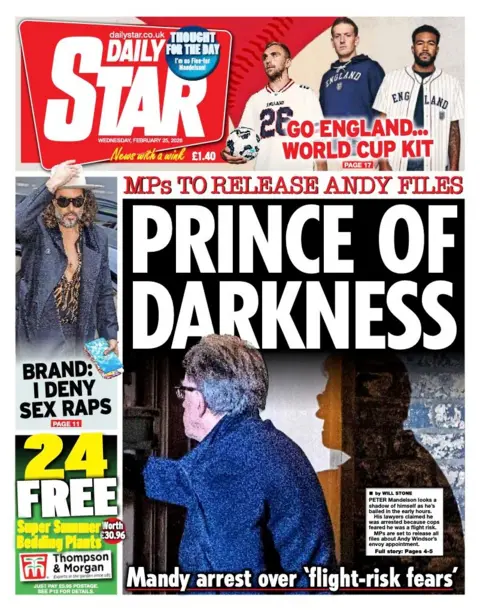
In domestic political news, the arrest and subsequent release of Lord Mandelson, a former Labour minister and prominent political figure, on suspicion of misconduct in public office, has ignited a fierce debate regarding political accountability, due process, and media sensationalism. Dubbed the "Prince of Darkness" by the Daily Star, a moniker historically associated with his influential and often controversial political maneuvering, Mandelson’s encounter with law enforcement has drawn extensive coverage across national newspapers.
Lord Mandelson, described in the source as a "former US ambassador," a descriptor that underscores his high-profile international political standing rather than a specific diplomatic post, was reportedly taken into custody in the early hours of Tuesday morning. Following his arrest, he was subsequently released, but the incident has plunged him into a new wave of public scrutiny. Sources close to Lord Mandelson maintain his unequivocal position: he has not acted criminally and was not motivated by financial gain in any alleged actions. This assertion sets the stage for a protracted legal and public relations battle.
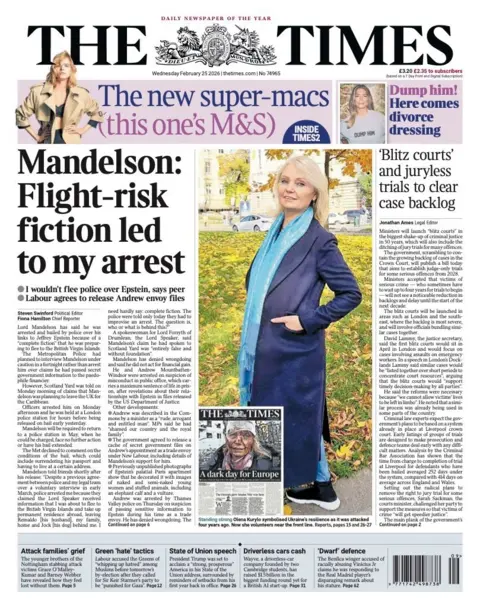
The circumstances surrounding the arrest have become a significant point of contention. The Guardian reported that Lord Mandelson’s apprehension was driven by police concerns that he posed a "flight risk." This assertion was allegedly based on information suggesting the peer was preparing to relocate abroad, specifically to the British Virgin Islands. However, Lord Mandelson’s legal representatives have vehemently dismissed these claims as "baseless," asserting that Scotland Yard had previously agreed to conduct an interview under caution at a later date, rather than resorting to an immediate arrest. The Times corroborated this narrative, headlining its coverage with Mandelson’s own reported statement: "Flight-risk fiction led to my arrest." The newspaper also noted that police declined to comment on the specific conditions of his arrest, including whether his passport had been confiscated. This lack of transparency from law enforcement has further fueled speculation and criticism regarding the necessity and proportionality of the police action.
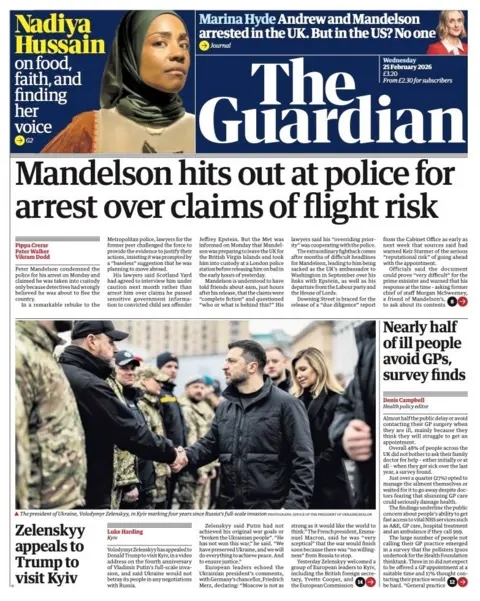
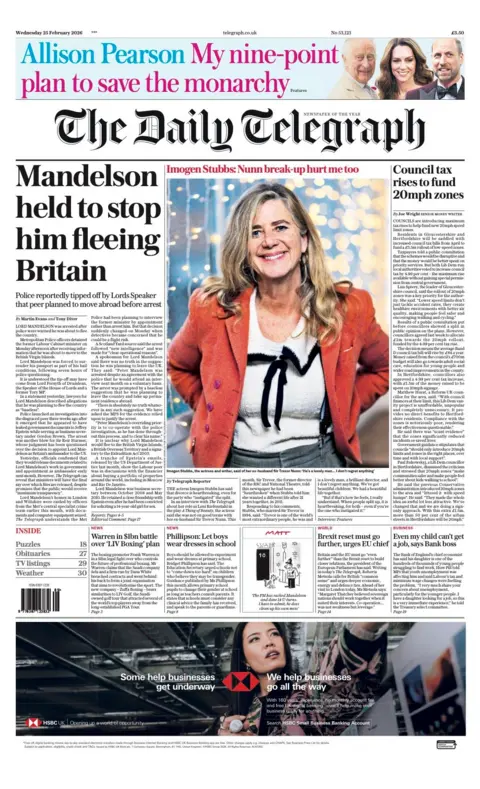
The Telegraph, meanwhile, highlighted a parallel development: officials have committed to releasing documents pertinent to Lord Mandelson’s tenure in government during early March. This move, however, comes with a caveat: Members of Parliament will retain final authority over which documents are ultimately made public. This aspect of the story intertwines issues of transparency, public interest, and the inherent tensions between executive power and legislative oversight. The release of such documents could either exonerate Mandelson or provide further fuel for the allegations, depending on their content and the extent of public disclosure.
Legal experts have weighed in on the procedural aspects of the case. Professor Eleanor Vance, a specialist in public law, noted, "The decision to arrest someone on suspicion of flight risk, especially when an interview under caution had been pre-arranged, typically requires compelling evidence of imminent departure. If such evidence is lacking, it raises questions about police discretion and the potential for a politically charged arrest." The "misconduct in public office" charge itself is a serious one, pertaining to an abuse of power by a public official, and often carries significant legal and reputational consequences.
The "Prince of Darkness" epithet, long attached to Mandelson for his strategic political acumen and sometimes controversial role in Labour Party politics, has resurfaced with renewed vigor in the sensationalist press. This incident not only affects Lord Mandelson’s personal reputation but also reignites broader discussions about the integrity of public office and the accountability of high-ranking political figures. The public will be watching closely as the legal process unfolds and as the promised government documents become available, with the outcome having potential implications for future standards of conduct in British politics.
Royal Conduct Under Scrutiny: "Former Prince" Andrew’s Latest Controversies
The British royal family continues to face intense public and political scrutiny, with "former prince" Andrew Mountbatten-Windsor once again at the center of a storm. Stripped of his royal duties and military titles following previous controversies, Andrew’s conduct remains a subject of national debate, underscored by recent parliamentary criticism and symbolic social repercussions.
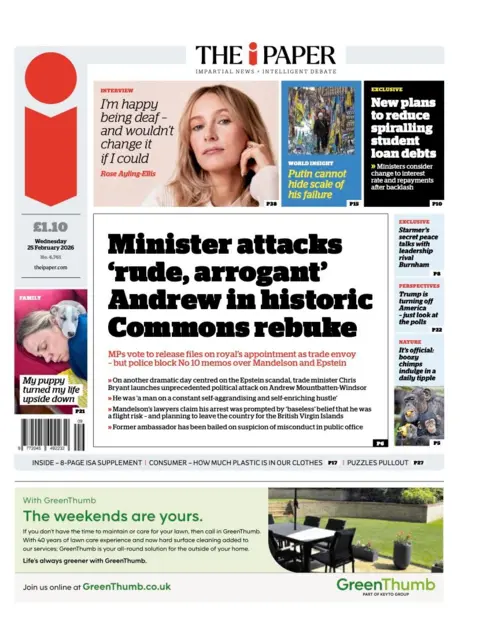
The i Paper reported an "unprecedented political attack" on the former prince by trade minister Chris Bryant during a session in the House of Commons. Bryant reportedly described Andrew Mountbatten-Windsor as a man "on a constant self-aggrandising and self-enriching hustle." This public rebuke from a government minister represents a rare and significant moment, highlighting the depth of official disapproval and the erosion of traditional deference towards even former members of the Royal Family. The accusations of "self-aggrandising and self-enriching" behavior resonate with previous allegations and public perceptions that have tarnished his image, linking him to various questionable dealings and a lifestyle seen as inconsistent with public service.
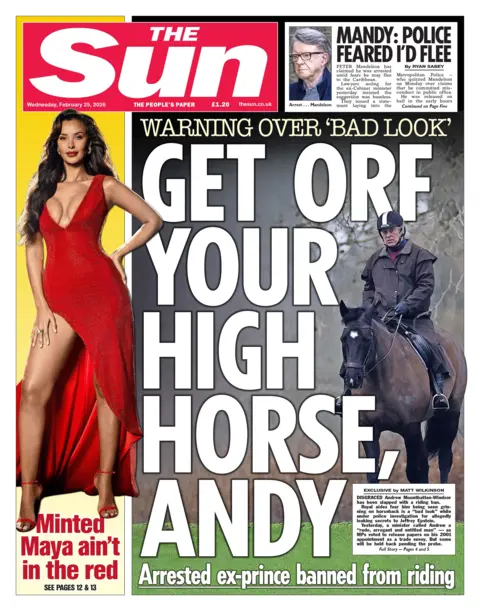
Further underscoring his fall from grace, The Sun featured Andrew on its front page under the headline "Get orf your high horse Andy," reporting that the former prince has been banned from horse riding. While the article text attributes this ban to "his arrest," it is crucial to clarify that this refers not to the Mandelson affair, but likely to the wider fallout from his ongoing controversies and loss of royal privileges. The prohibition from an activity historically associated with the aristocracy and royalty serves as a potent symbolic punishment, reinforcing his diminished status and the public’s desire for accountability. It signifies a further removal of the trappings of privilege that he once enjoyed, directly impacting his public life and personal freedoms.
The criticism leveled against Andrew reflects a broader societal shift in expectations for the Royal Family. Modern monarchies are increasingly judged on their perceived value, conduct, and alignment with public sentiment. Any hint of misconduct or self-serving behavior, particularly when juxtaposed with public financial support, attracts swift and often severe condemnation. The parliamentary attack indicates that even without formal royal duties, the conduct of former members of the Royal Family remains a matter of public and political concern, impacting the institution’s overall standing.
Constitutional experts suggest that such parliamentary interventions, while rare, signify a growing demand for transparency and accountability from all public figures, including those with royal connections. Dr. Sarah Jenkins, a commentator on constitutional affairs, remarked, "The public and political mood has decisively shifted. There is a strong expectation that even former royals must adhere to the highest standards of conduct, and any perceived deviation will be met with strong criticism, no longer shielded by tradition." The ongoing scrutiny of Andrew Mountbatten-Windsor highlights the monarchy’s delicate balancing act between tradition and modernity, and its continuous struggle to adapt to evolving public demands for integrity and relevance. The future role and public perception of the Royal Family will undoubtedly be shaped by how it addresses these challenges and holds its members accountable.
Divergent Domestic Agendas and Social Policy Debates
Beyond the international stage and high-profile individual controversies, several domestic policy debates are capturing public attention, reflecting a deeply divided political landscape and pressing social challenges.
Green Party’s Immigration Proposals: A Contentious Vision
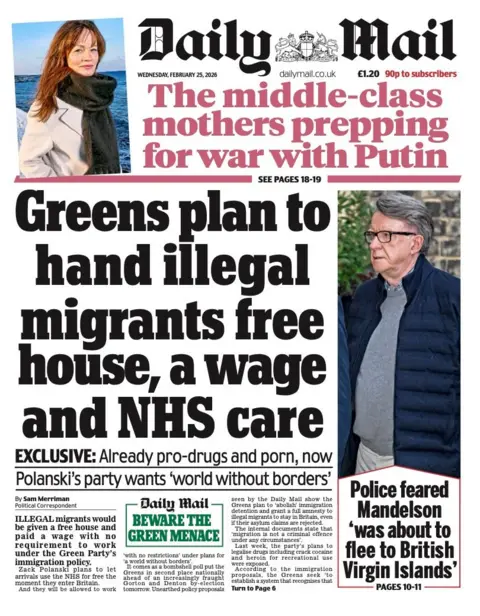
The Mail dedicated its front page to a political piece examining the Green Party’s immigration policy, sounding an alarm with the headline "Beware the green menace." The paper detailed a proposed policy framework that, it claims, would offer "illegal migrants" a "free house, a wage and NHS care," notably "with no requirement to work." This portrayal has ignited considerable debate, positioning the Green Party’s approach as radically divergent from mainstream immigration policies.
Proponents of such policies often argue for humanitarian considerations, emphasizing the dignity and basic rights of all individuals, regardless of legal status, and the potential for integration benefits in the long term. They might frame these provisions as essential for public health and safety, preventing destitution and exploitation. Critics, as highlighted by the Mail’s stark warning, typically raise concerns about the financial implications, the potential for creating "pull factors" that could encourage further irregular migration, and questions of national sovereignty and resource allocation. The debate underscores the deep polarization surrounding immigration, touching on issues of national identity, economic impact, and moral obligations.
Gordon Brown’s Warning on Reform UK: An Electoral Battleground
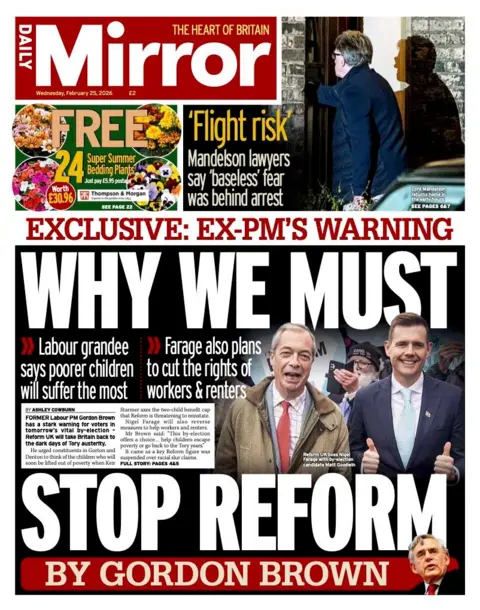
In the Mirror, former Labour Prime Minister Gordon Brown penned a forceful op-ed, urging voters to "stop reform" and warning of the "dark days of Tory austerity" under the influence of Reform UK. His intervention comes ahead of a crucial by-election in Gordon and Denton, highlighting the increasing political significance of Reform UK as a disruptive force.
Brown’s critique focused on the potential socio-economic consequences of Reform UK’s policies, specifically asserting that "poorer children will suffer the most" and that the party plans to "cut the rights of workers and renters." This rhetoric suggests that Reform UK advocates for a platform of fiscal conservatism, deregulation, and potentially a rollback of social protections, reminiscent of austerity measures. The former Prime Minister’s decision to engage directly in a by-election signifies the perceived threat Reform UK poses to established parties, particularly Labour, by potentially siphoning votes and shifting the political discourse. By-elections are often viewed as barometers of national sentiment, and Brown’s intervention indicates a high-stakes contest where economic policy and social welfare are central to the electoral narrative.
Tougher Pornography Laws: Safeguarding Women and Girls
The Metro reported on a "tough porn crackdown to tackle abuse," detailing new legislative changes aimed at making it illegal to create or possess pornographic content depicting incest or "twisted family sex." These changes are being introduced as an amendment to last year’s Crime and Policing Bill, with the explicit aim of protecting women and girls.
This legislative move reflects an evolving societal understanding of harmful content and the need for stronger legal frameworks to combat exploitation and abuse. While the specifics of "twisted family sex" will require careful legal definition to ensure clarity and avoid overreach, the intent is clear: to address content deemed to be profoundly harmful and exploitative. Such laws often spark debates between advocates for protection, who prioritize the safety of vulnerable individuals, and civil liberties groups, who raise concerns about censorship, privacy, and the potential for broad definitions to impact legitimate artistic expression or consensual adult content. The amendment underscores a governmental push to update criminal law in response to the proliferation of online content and its potential for harm.
Healthcare Access Crisis: Millions Underserved
Finally, the Express highlighted a pressing national health crisis, leading with new research indicating that "millions" of people across the UK did not receive the healthcare they needed last year. The headline "Half of adults to avoid going to GP for help" starkly illustrates the scale of the problem.
This research points to systemic strains within the National Health Service (NHS), which has long grappled with issues of funding, staffing shortages, and mounting waiting lists. The reasons for individuals avoiding GP appointments are multifaceted, ranging from difficulties securing appointments and long wait times to a reluctance to burden an already stretched system, and in some cases, perceived cost barriers or a lack of trust. The consequences of delayed or foregone healthcare are severe, potentially leading to the exacerbation of preventable conditions, increased emergency admissions, and long-term public health detriments. This issue underscores the urgent need for comprehensive reforms and increased investment in the NHS to ensure equitable and timely access to medical care for all citizens.
Collectively, these diverse headlines paint a picture of a world grappling with significant challenges, from the shifting sands of international alliances and ongoing conflicts to complex domestic issues of political accountability, social welfare, and public health. The discourse across various media outlets highlights the urgency and multifaceted nature of these contemporary concerns, demanding thoughtful analysis and decisive action from leaders.


 Aura Kasih
 Safa Marwah
 Ayu Aulia