Lisa Mariana
As the protracted conflict in Ukraine approaches its fourth anniversary of full-scale escalation, an intricate tapestry of territorial shifts, persistent aerial bombardments, and complex geopolitical maneuvering continues to define the landscape. Recent assessments indicate a discernible, albeit gradual, expansion of Russian-controlled zones, predominantly concentrated in the eastern Ukrainian territories, juxtaposed with an unwavering campaign of missile and drone attacks targeting civilian infrastructure and urban centers, including the capital, Kyiv. This ongoing struggle, marked by immense human cost and strategic stalemates, necessitates a comprehensive review of the current ground realities and the broader implications for regional stability.
The human toll of this conflict remains staggering, with official figures offering only a partial glimpse into the devastating reality. Ukrainian President Volodymyr Zelensky has publicly acknowledged approximately 55,000 Ukrainian military fatalities. On the Russian side, independent verification efforts, such as those conducted by the BBC, have meticulously documented the identities of nearly 160,000 fallen combatants, a testament to the brutal intensity of the fighting. These figures, while inherently difficult to fully ascertain amidst active hostilities, underscore the profound and tragic sacrifices made by both nations. With the grim milestone of Russia’s full-scale invasion looming, a detailed examination of the operational picture across Ukraine provides critical insight into the conflict’s trajectory.
Russia’s Incremental Advance in the East
The eastern Ukrainian regions have long been the focal point of Russia’s ground offensive, a strategy rooted in historical claims and strategic objectives. Analysts from the US-based Institute for the Study of War (ISW) report that Russian forces secured an estimated 4,700 square kilometers (approximately 1,800 square miles) of additional territory in 2025 alone. This area, roughly equivalent to twice the size of Moscow, contrasts with Russia’s own claim of having captured 6,000 square kilometers, highlighting the inherent discrepancies and propaganda narratives surrounding battlefield gains.
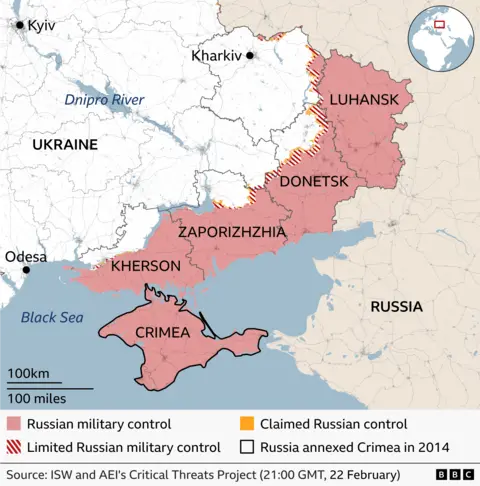
Within the expansive plains of the Luhansk and Donetsk regions, collectively known as the Donbas, Moscow’s military apparatus has engaged in a relentless war of attrition. This methodical advance has seen Russian units slowly but consistently push forward, encircling and eventually overwhelming numerous villages and towns. The overarching objective in this sector appears to be the consolidation of full control over the Donbas, alongside substantial portions of the neighboring Zaporizhzhia and Kherson regions to the west. Following the initial full-scale invasion, Russia conducted internationally condemned referendums in these areas, mirroring its 2014 annexation of Crimea, in an attempt to legitimize its occupation. However, these territories have never been fully under Moscow’s command, and Ukrainian resistance persists within pockets of these claimed areas.
A notable development impacting battlefield dynamics has been the reported denial of access to the Starlink satellite internet service for Russian forces, a decision attributed to Elon Musk at the beginning of February. This move, prompted by growing evidence that Starlink was facilitating increasingly precise Russian attacks, particularly through real-time video links for drone operators guiding munitions, is believed to have afforded Ukraine a tactical advantage. The disruption to Russian command, control, and reconnaissance capabilities, especially for weaponized drones, could significantly impede their ability to mount coordinated assaults. Conversely, in specific segments of the extensive front line, particularly east of the city of Zaporizhzhia, Russian units have reportedly been compelled to execute tactical withdrawals, suggesting a fluid and contested operational environment.
Ukraine’s strategic calculus involves leveraging any territorial gains, or preventing further losses, to strengthen its negotiating position should future peace talks materialize. This stance stands in stark contrast to a US-backed peace proposal reportedly floated in November, which suggested Ukraine might cede control of all of Luhansk, Donetsk, and Crimea, along with the Russian-occupied segments of Zaporizhzhia and Kherson, to Moscow. Such a plan would also entail a Ukrainian withdrawal from remaining parts of Donetsk, transforming them into a demilitarized zone under de facto Russian control, while Russian forces would retreat from minor occupied areas outside these designated regions. President Zelensky has consistently and unequivocally rejected any propositions involving the surrender of the Donbas, arguing that such concessions could merely serve as a strategic springboard for future Russian aggression.
The Contested "Fortress Belt" and Key Urban Targets
A recent analysis by the ISW highlights the existence of a formidable "fortress belt" stretching approximately 50 kilometers (31 miles) across western Donetsk. This defensive line represents over a decade of Ukrainian investment in reinforcing strategic infrastructure, establishing robust defensive positions, and developing indigenous defense industrial capabilities. The presence of this fortified zone underscores Ukraine’s long-term commitment to safeguarding its territorial integrity, particularly in areas perceived as critical to national security.
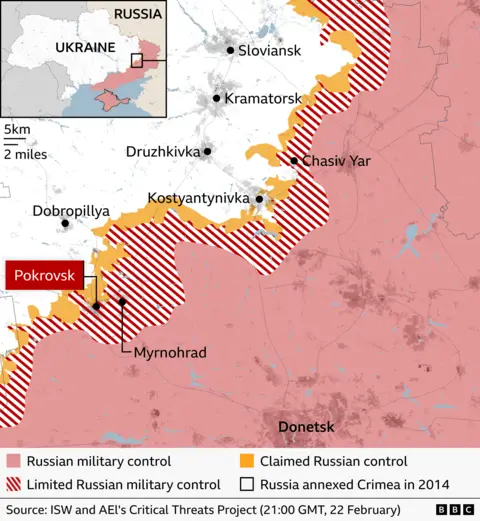
Despite these defenses, a Russian summer offensive near the eastern town of Pokrovsk made significant, albeit localized, advances just north of the urban center. More recently, Russian forces have reported gains within Pokrovsk itself and to the east of the nearby town of Kostyantynivka. Pokrovsk, once a vital logistical nexus for the Ukrainian military, serving as a key road and railway junction connecting the northern Donetsk region with major western cities like Dnipro, has been reduced to ruins by incessant shelling.
While Russian officials have previously claimed to have captured Pokrovsk (known as Krasnoarmeysk in Russian), Ukraine maintains control over the northern sections of the town. The complete fall of Pokrovsk would represent Russia’s most substantial battlefield success since its capture of Avdiivka, approximately 40 kilometers (25 miles) to the east, in early 2024. Such an outcome could provide Moscow with a critical staging ground to push northward toward Kramatorsk and Sloviansk, the two largest remaining Ukrainian-controlled cities in the Donetsk region. However, the ISW cautions that despite current Russian advances, seizing Pokrovsk – a town spanning roughly 23 square kilometers – has taken nearly two years. Given that the cities within the "fortress belt" are considerably larger and more heavily defended, the ISW projects that capturing the remainder of the Donetsk region could take Russian forces another two years, incurring immense costs in personnel and materiel.
Northern Incursions and the Buffer Zone Imperative
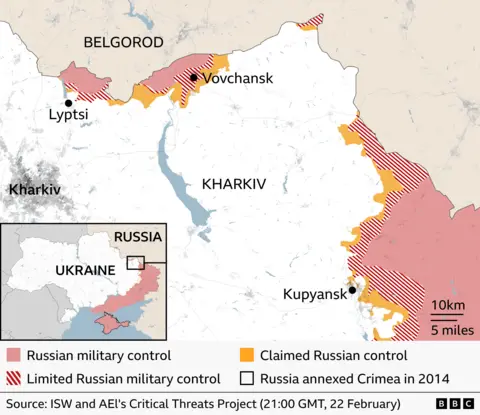
Further north along the primary front line, Russian forces have intensified efforts to advance on the city of Kupyansk. Analysts suggest that a successful capture of Kupyansk could enable Russian forces to encircle the northern Donetsk region, thereby severing crucial supply lines and consolidating their strategic position. Concurrently, Russia has sought to push Ukrainian forces back from its own border with the Belgorod region, a move aimed at enhancing the security of its frontier territories.
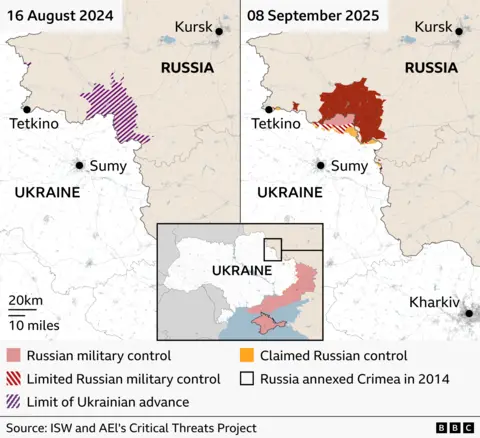
According to ISW analysts, Russia’s strategic objective in this northern sector is to establish a buffer zone within Ukraine’s northern borders and bring its artillery within effective range of Kharkiv, Ukraine’s second-largest city. Recent Russian gains, including limited control over a salient of land south of Vovchansk, would incrementally advance them closer to achieving this artillery-range objective. Russian President Vladimir Putin has explicitly stated that this buffer zone is intended to protect Russian territory, referencing a Ukrainian incursion into Russia’s Kursk region in the summer of 2024, which Russian forces, reportedly aided by North Korean troops, eventually repelled.
Recent reports confirm a series of coordinated Ukrainian drone attacks deep within Russian territory. On February 22, an overnight Russian attack targeted Kyiv and its surrounding areas, with dozens of strikes aimed at energy infrastructure, causing widespread damage and power outages. This followed a significant Ukrainian drone attack on Volzhsky in Russia’s Volgograd region on February 11. These retaliatory strikes by Ukraine aim to disrupt Russian military logistics and infrastructure, as well as to demonstrate Ukraine’s capacity to project power beyond the immediate front lines.
Conversely, Russia has maintained a relentless campaign of strikes against Ukrainian infrastructure, specifically targeting energy facilities such as electricity substations and power plants. These attacks have tragically claimed civilian lives and plunged tens of thousands of Ukrainians into severe power cuts, often leaving them without running water or heating during the harshest winter months, exacerbating an already dire humanitarian situation.
Elusive Ceasefire and Diplomatic Deadlock
A brief pause in these infrastructure attacks was observed following a request from former US President Donald Trump to President Putin, highlighting the complex interplay of international diplomacy and military operations. Trump has been a vocal proponent of negotiating an end to the conflict, and President Zelensky indicated earlier this month that the United States desired a resolution by June.
However, the most recent round of trilateral talks involving Russia, Ukraine, and the United States, held in Geneva, Switzerland, on February 18, concluded without a significant breakthrough. While a Ukrainian diplomatic source reported some progress on "military issues," including discussions on front line demarcation and ceasefire monitoring mechanisms, the core issue of territorial integrity remains a formidable obstacle. White House spokeswoman Karoline Leavitt later affirmed that "meaningful progress" was made by both sides, and an agreement to "continue to work towards a peace deal together" was reached. Nevertheless, the fundamental disagreement over territory—a prerequisite for any viable ceasefire—persists, with Moscow and Kyiv’s positions remaining diametrically opposed. Ukraine insists on the restoration of its 1991 borders, while Russia seeks to legitimize its annexations.
Three Years of Conflict: A Retrospective
Russia’s full-scale invasion commenced with a coordinated barrage of missile strikes across numerous Ukrainian cities before dawn on February 24, 2022. Russian ground forces rapidly advanced, securing vast swathes of Ukrainian territory within weeks and reaching the outskirts of Kyiv. Kharkiv came under intense bombardment, and Russian forces established control over significant areas in the east and south, extending to Kherson and besieging the strategic port city of Mariupol.
However, the initial Russian offensive encountered unexpectedly fierce Ukrainian resistance, compounded by significant logistical challenges. Reports indicated poorly motivated Russian troops suffered from shortages of food, water, and ammunition, severely hampering their operational effectiveness. Ukrainian forces, adeptly deploying Western-supplied anti-tank systems like the NLAW, proved highly effective in blunting the Russian advance.
By October 2022, the strategic landscape had dramatically shifted. Having failed in its objective to capture Kyiv, Russia executed a complete withdrawal from northern Ukraine. The following month, Ukrainian forces achieved a significant victory by recapturing the southern city of Kherson. Since then, the conflict has largely concentrated in eastern Ukraine, characterized by a grinding war of attrition where Russian forces have incrementally gained ground over many months, albeit at a high cost.
Accurate casualty figures remain a highly sensitive and frequently contested aspect of the conflict. Both Kyiv and Moscow regularly publish inflated estimates of adversary losses while remaining reticent about their own. As of six months prior, Ukraine’s interior ministry reported over 70,000 individuals, both soldiers and civilians, as officially missing, though a detailed breakdown has not been provided, and the actual number could be higher. President Zelensky’s statement in early February regarding 55,000 military fatalities offers a rare, albeit partial, glimpse into Ukraine’s acknowledged losses. The opacity surrounding these figures underscores the immense and often unquantifiable human suffering inflicted by this devastating conflict.
The dynamic nature of the situation in Ukraine implies that territorial control can shift rapidly. While every effort is made to provide accurate and timely assessments, it is important to acknowledge that real-time changes on the ground may not always be immediately reflected in static analyses or cartographic representations.



 Aura Kasih
 Safa Marwah
 Ayu Aulia