Aura Kasih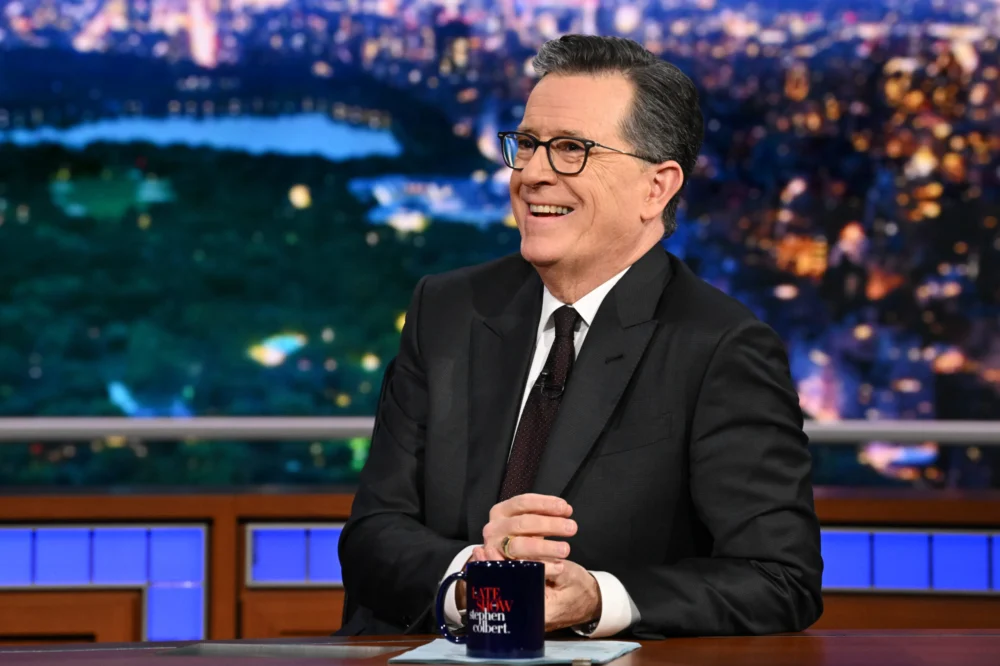
Stephen Colbert, the acclaimed host of CBS’s The Late Show, has publicly asserted that the network’s legal department prohibited him from airing an interview with James Talarico, a Democratic representative from Texas. The dramatic revelation, delivered during his opening monologue on Monday night, suggests a deliberate intervention by CBS executives, compelling Colbert to release the contentious segment exclusively on YouTube. This alleged censorship comes at a time of significant upheaval within CBS News, notably coinciding with reports of Anderson Cooper’s departure from his role as a 60 Minutes correspondent.
Colbert articulated his frustration, stating, "He [Talarico] was slated to appear on the program, but we received explicit instructions from the network’s legal counsel, who contacted us directly, barring his inclusion in the broadcast." He further detailed the extent of the alleged prohibition, revealing, "The directives I received were unequivocal: not only was his appearance forbidden, but any mention of this ban was also expressly prohibited."
In response to inquiries from The Verge, CBS spokesperson Phil Gonzales issued a statement that contradicted Colbert’s account, asserting that the host was not obstructed from broadcasting the interview. This statement, which was also provided to other media outlets including Variety, notably declined to be attributed to a specific individual, adhering to The Verge’s policy regarding on-background information. When pressed for a named source, Gonzales responded, "Respectfully, the statement is sufficient. We will take your request into consideration for future correspondence." This evasive response from CBS has only amplified speculation surrounding the network’s motivations.
The crux of Colbert’s assertion hinges on his interpretation of the Federal Communications Commission’s (FCC) equal time rule. This regulation mandates that broadcast television and radio stations provide equal airtime to opposing political candidates during election cycles. Representative Talarico is currently engaged in a campaign for a U.S. Senate seat, placing him squarely within the purview of this rule.
Historically, news interviews have been recognized as an exemption from the equal time provision, a category that talk shows have often been considered to fall under. However, this established practice has been subject to recent scrutiny. In January, FCC Chairman Brendan Carr issued new guidance that suggests a broader application of the equal time rule, potentially encompassing late-night and daytime talk programs. Carr’s pronouncements at the time indicated a stricter interpretation, stating, "If you are disseminating fabricated news, you will not qualify for the bona fide news exemption."
Colbert contends that while Chairman Carr has not formally rescinded the exemption, CBS is proactively enforcing it as if such a change had already occurred. This interpretation aligns with a broader narrative of evolving media regulation and its intersection with political discourse. The appointment of Bari Weiss, founder of The Free Press, as editor-in-chief of CBS News last year, has also been cited by some observers as potentially influencing the network’s editorial direction. Colbert himself drew a stark parallel, stating, "Let us be clear about the underlying reality. The Trump administration’s objective is to suppress any voice on television that criticizes Trump."
This alleged silencing of a political figure on a major network program raises profound questions about the future of political commentary in broadcast media. The equal time rule, originally designed to ensure a level playing field in political broadcasting, is now at the center of a debate concerning its interpretation and application in the contemporary media landscape. The FCC’s recent guidance, coupled with CBS’s alleged actions, suggests a potential tightening of the regulatory environment for political speech on television.
The implications of this incident extend beyond the immediate controversy surrounding Stephen Colbert and Representative Talarico. It highlights the delicate balance between journalistic freedom, network editorial control, and regulatory oversight. The decision by CBS to allegedly prevent Talarico’s appearance, if substantiated, could set a precedent for how political interviews are handled on late-night shows, potentially chilling open discussion and limiting the public’s access to diverse political viewpoints.
Furthermore, the timing of this event, coinciding with broader shifts in CBS News leadership and reporting structures, invites scrutiny into the network’s strategic direction. The departure of a seasoned correspondent like Anderson Cooper from a prestigious program like 60 Minutes signals a period of transition, and the alleged censorship of a political interview during such a period could be interpreted as indicative of a broader editorial recalibration.
The interpretation of FCC regulations, particularly the "bona fide news exemption," is a complex legal and policy matter. Traditionally, this exemption has allowed programs that are primarily news-oriented, such as documentaries, news analyses, and interviews conducted by journalists, to be excluded from the equal time requirements. However, the lines between entertainment and news programming have become increasingly blurred in the modern media ecosystem. Late-night talk shows, while often featuring comedic elements, also frequently engage with political news and current events, creating a grey area in their classification.
Chairman Carr’s recent guidance appears to be an attempt to clarify or potentially expand the scope of the equal time rule. His remarks about "fake news" suggest a concern about the dissemination of misinformation and a desire to ensure that platforms holding broadcast licenses are not used to unduly influence political discourse through biased or fabricated content. The FCC’s role is to regulate public airwaves, and its decisions carry significant weight in shaping the media landscape.
The assertion that CBS is "unilaterally enforcing" a rule that has not yet been formally changed by the FCC is a serious allegation. It implies that the network is preemptively adopting a stricter interpretation of regulations, possibly in anticipation of future rule changes or as a means to avoid potential scrutiny. Such proactive measures, if driven by political considerations rather than a clear legal mandate, could be viewed as an attempt to exert control over political discourse.
The reference to Donald Trump’s administration and the desire to "silence anyone who says anything bad about Trump on TV" points to a potential political motivation behind the alleged censorship. This interpretation suggests that the decision to block Talarico’s interview was not purely a matter of regulatory compliance but rather a response to the political content of his message or his perceived alignment with political opposition.
The broader context of political polarization in the United States cannot be ignored when analyzing such incidents. Media outlets often find themselves navigating a complex and politically charged environment, where decisions about content can have significant repercussions. The pressure to conform to perceived political norms or to avoid controversy can influence editorial choices, leading to situations where controversial interviews are suppressed.
The role of network lawyers in such matters is typically to ensure compliance with all applicable laws and regulations, including those set forth by the FCC. However, their involvement in dictating who can and cannot appear on a broadcast, beyond clear legal prohibitions, can be seen as an encroachment on the host’s creative and editorial autonomy. Colbert’s description of being told "in no uncertain terms" suggests a forceful intervention that went beyond standard legal counsel.
The decision to release the interview on YouTube, while a viable alternative for reaching an audience, also underscores the perceived limitations imposed by the network. YouTube operates under a different set of content moderation policies and is not subject to the same broadcast regulations as traditional television. This move effectively bypasses the traditional gatekeepers of broadcast media, allowing the content to be disseminated directly to the public.
The implications for the future of late-night television and political commentary are significant. If networks are perceived to be actively censoring political content due to regulatory interpretations or political pressures, it could lead to a chilling effect on journalistic inquiry and open debate. Viewers may become increasingly skeptical of the impartiality of broadcast media, seeking alternative sources of information.
The statement from CBS, while denying any obstruction, fails to provide clarity on the specific reasons for the alleged prohibition. This lack of transparency can fuel further speculation and distrust. The refusal to attribute the statement to a named individual, while a common practice for corporate communications, can also be interpreted as an attempt to distance the network from direct accountability.
In conclusion, Stephen Colbert’s public declaration of being prevented from airing an interview with Representative James Talarico by CBS raises critical questions about media autonomy, regulatory interpretation, and political influence in broadcasting. The incident, occurring amidst shifts within CBS News and evolving FCC guidance on political broadcasting, highlights the complex interplay of factors shaping the contemporary media landscape. The extent to which such alleged censorship becomes a pattern will be a crucial indicator of the future of open political discourse on broadcast television.



 Safa Marwah
 Lisa Mariana