Lisa Mariana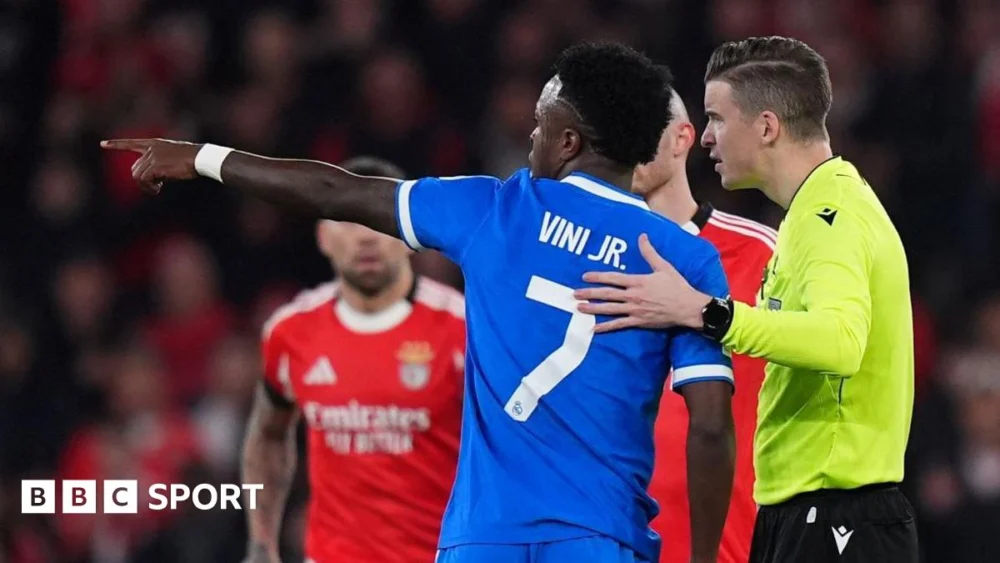
A pivotal UEFA Champions League knockout stage encounter between Real Madrid and Benfica was temporarily suspended for a ten-minute period after Brazilian forward Vinicius Junior reported experiencing alleged racist abuse, leading to an unprecedented on-field protest by him and his Real Madrid teammates. This high-stakes fixture, held at the historic Estadio da Luz, saw an unsettling turn of events that underscored the persistent challenge of discriminatory behavior within professional football. The incident unfolded during the second half of the match, casting a shadow over the competitive spectacle and reigniting urgent discussions about player protection and accountability for fan conduct.
The catalyst for the dramatic pause occurred shortly after Vinicius Junior had delivered a masterful performance, breaking the deadlock with a stunning goal in the 50th minute that put the Spanish giants 1-0 ahead. His celebration, which involved a characteristic dance by the corner flag, was met with a barrage of objects thrown from sections of the home crowd, immediately signaling a hostile environment. This initial reaction quickly escalated, culminating in an interaction that caught the attention of the match officials. Following the celebration, Vinicius was issued a yellow card for what the referee deemed an excessive display. Moments later, a heated exchange between Vinicius and Benfica’s Gianluca Prestianni intensified the on-field tension. It was at this juncture that Vinicius, visibly distressed, made a direct appeal to the French referee, François Letexier, gesturing emphatically towards the stands and then towards Prestianni, indicating a severe transgression.
Referee Letexier, after a brief but serious conversation with the Real Madrid star, responded by performing the widely recognized "crossed arms" gesture, an official signal deployed to denote a report of racist abuse or other discriminatory behavior. This immediate acknowledgment from the match official validated the severity of Vinicius’s claim and triggered a sequence of events that saw the player, without hesitation, walk off the pitch. His teammates, in a powerful show of solidarity and collective protest against the alleged abuse, swiftly followed suit, leaving the field vacant and bringing the prestigious European fixture to an abrupt halt. The scene was one of profound disruption, with club staff from both sides becoming involved in discussions, including an interaction between Vinicius and Benfica manager Jose Mourinho near the touchline, as the gravity of the situation permeated the stadium.
This incident is not an isolated occurrence for Vinicius Junior, whose career has, unfortunately, been repeatedly marred by racist taunts and gestures from opposing fans. The gifted winger has become a symbol of the fight against racism in football, often speaking out passionately about the psychological toll such abuse takes. His previous experiences, particularly in Spanish domestic league matches, have drawn widespread condemnation from international football bodies, fellow players, and anti-racism organizations. Despite numerous official complaints, investigations, and public awareness campaigns, the frequency of these incidents involving Vinicius highlights a systemic failure to adequately protect players and eradicate discriminatory behavior from the sport. The recurrence of such events underscores the urgent need for more stringent penalties and proactive measures from clubs, national associations, and continental governing bodies like UEFA.
The "three-step protocol" for dealing with racist incidents, developed by UEFA and FIFA, outlines a procedure for referees to follow: first, a pause in play and an announcement over the public address system; second, a temporary suspension of the match; and third, if the abuse continues, abandonment of the game. In this instance, Referee Letexier’s actions aligned with the initial stages of this protocol, demonstrating a commitment to addressing the reported abuse. The decision to lead the team off the pitch, however, represented a more direct and impactful form of protest initiated by the players themselves, arguably exerting greater immediate pressure than a solely referee-led action. The return to play after a ten-minute interval suggests that either the alleged abuse ceased, or that the officials and teams decided against the drastic step of full abandonment, likely due to the high stakes of a Champions League knockout tie and the potential for severe repercussions on the competition’s integrity.
The broader context of racism in European football reveals a persistent and deeply entrenched issue. Despite decades of campaigns, educational initiatives, and the imposition of fines, discriminatory behavior continues to surface, particularly targeting Black players and those from ethnic minority backgrounds. The anonymity afforded by large crowds often emboldens individuals to engage in hateful conduct, which then reverberates through social media and broader public discourse. This ongoing challenge calls into question the effectiveness of current deterrents and the commitment of all stakeholders to enforce zero-tolerance policies. The psychological impact on players like Vinicius Junior is immense, transforming moments of sporting achievement into experiences of profound dehumanization and distress. It not only affects their performance but also their mental well-being and overall experience of the game they love.
Following such an incident, an immediate and thorough investigation by UEFA is imperative. This typically involves reviewing match delegate reports, referee reports, video footage from multiple angles, and potentially interviewing players, officials, and stadium security personnel. Benfica, as the home club, bears significant responsibility for the conduct of its supporters and the security within its stadium. Depending on the findings, the club could face severe sanctions, ranging from substantial fines to partial or full stadium closures, or even deduction of points in extreme cases. Identifying the individual perpetrators is also crucial, as modern stadium surveillance systems, combined with cooperation from local law enforcement, can lead to bans from attending future matches and even criminal charges in some jurisdictions.
The incident at the Estadio da Luz serves as a stark reminder that punitive measures alone are insufficient. A multi-faceted approach is required, encompassing stronger educational programs for fans, enhanced training for stewards and security personnel to identify and intervene in discriminatory incidents, and the promotion of diversity and inclusion at all levels of football. Furthermore, empowering players to speak out and ensuring they receive unequivocal support from their clubs and governing bodies is vital. The collective walk-off by Real Madrid players sends a powerful message that players will no longer tolerate such abuse passively. This form of player agency, while disruptive, can be a potent catalyst for change, forcing football authorities to confront these issues more decisively.
The future outlook for tackling racism in football demands a sustained, unified effort. Technology, such as advanced facial recognition and improved CCTV systems, can aid in identifying perpetrators. Stricter liability rules for clubs, where negligence in preventing or addressing racist incidents carries severe sporting consequences, could also act as a stronger deterrent. Beyond penalties, fostering a culture of respect and inclusivity through community outreach programs and engagement with fan groups is essential. The global reach and influence of football mean that its stance on racism has significant societal implications; by truly eradicating it from the stadiums, the sport can set a powerful example for the wider world.
In conclusion, the temporary suspension of the Champions League tie between Benfica and Real Madrid due to alleged racist abuse targeting Vinicius Junior represents a critical moment in football’s ongoing battle against discrimination. It highlights the persistent nature of the problem, the immense pressure on players, and the urgent need for more robust and effective responses from governing bodies and clubs. While the match eventually resumed, the incident’s resonance extends far beyond the final score, serving as a powerful call to action for all stakeholders to redouble their efforts in creating an inclusive environment where talent, not race, defines the beautiful game. The incident underscores that until every player can perform without fear of racist abuse, the integrity and spirit of football remain compromised.


 Aura Kasih
 Safa Marwah
 Ayu Aulia