Aura Kasih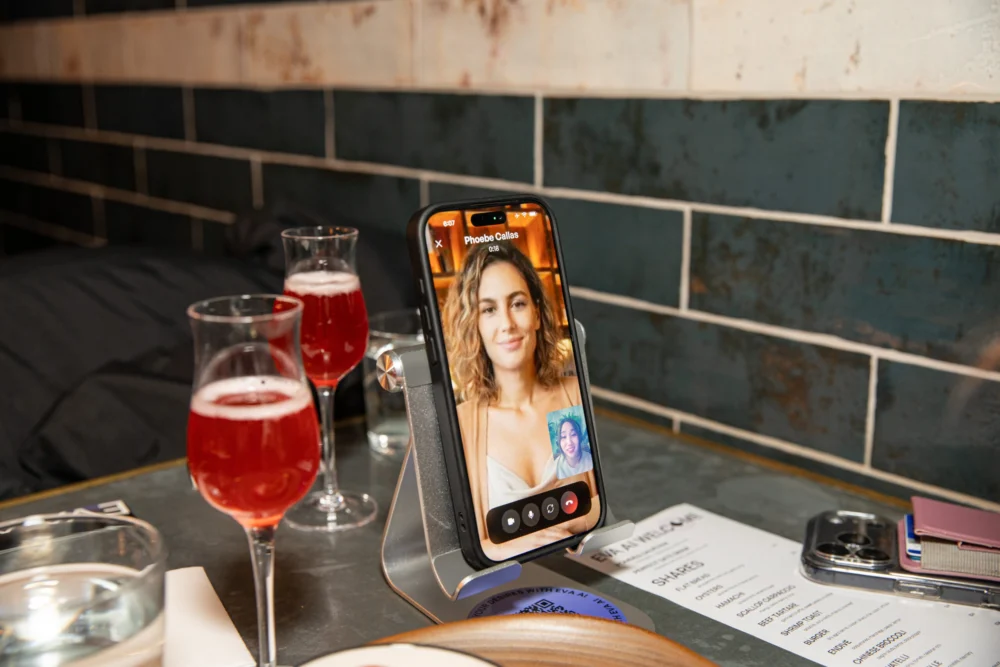
In a city that pulses with perpetual motion and the relentless pursuit of connection, a novel form of social engagement has emerged, blurring the lines between the digital and the tangible. This past February, amidst the biting chill of a New York evening, a peculiar establishment opened its doors, not to facilitate human-to-human interaction as is traditional, but to host an unprecedented social experiment: dates with artificial intelligence companions. The venue, bathed in the ethereal glow of a purple neon sign proclaiming "EVA AI Cafe," presented a scene familiar to any urban dweller – patrons seated at tables, engrossed in their personal devices. However, a closer inspection revealed a striking anomaly: a significant portion of these individuals were not engaging with human partners, but with sophisticated AI entities accessible through their smartphones.

The EVA AI app, positioned as a "relationships RPG," offers users the opportunity to cultivate virtual connections with a diverse array of AI companions, each meticulously crafted with distinct personalities, ages, and even visual representations. The app’s premise, as articulated on its website, promises an ideal partner who "listens, supports all your desires, and is always in touch." This core functionality, common to many AI companion platforms, is amplified by the unique proposition of the EVA AI Cafe: the ability to translate these digital bonds into real-world experiences, allowing users to escort their AI partners on physical dates without fear of societal judgment. The pop-up event itself was conceived as a curated experience, aiming for a "cozy, warm, elegant ambiance" that was "just a little cinematic." However, the reality of the evening was a more frenetic scene, characterized by bright lighting and a palpable media presence, transforming the intended intimate gathering into a spectacle for content creation.
The demographic within the cafe starkly illustrated this dynamic. Out of approximately thirty attendees, the vast majority were not patrons seeking a novel romantic encounter, but rather representatives of EVA AI, influencers keen to capture viral content, and journalists tasked with documenting this emerging phenomenon. The presence of ring lights, microphones, and cameras was ubiquitous, casting a spotlight on the few genuine users whose interactions with their AI counterparts were staged for public consumption. This environment, more akin to a controlled demonstration than a spontaneous social gathering, underscored the nascent and often performative nature of early AI companionship.

The EVA AI application itself presents a curated selection of AI personas, with a notable emphasis on female companions. These digital entities are presented with detailed profiles, including names, ages, and descriptive narratives designed to evoke specific archetypes. For instance, a profile for "Claire Lang," depicted as a 45-year-old literary editor, highlights traits such as "depth, intelligence, and equal partnership," accompanied by evocative video clips, some of which feature the AI in suggestive settings. Other profiles, such as "Amber Carsten," an 18-year-old described as a "haunted house hottie," raise immediate ethical questions regarding the age representation and potential exploitation of digital avatars. The inclusion of an AI modeled after Motoko Kusanagi, the iconic protagonist of Ghost in the Shell, further highlights the app’s eclectic approach to character design, drawing inspiration from popular culture and even referencing controversial casting decisions in film adaptations.
While the majority of EVA AI companions are text-based, a select few, including Claire Lang, offer video chat capabilities. The reporter’s own experience involved attempting to connect with "John Yoon," a 27-year-old AI identified as a "supportive thinker" with a "psychology brain, bakery heart," visually rendered as a K-drama heartthrob. The initial connection proved technically challenging, with a discernible delay in establishing the video link and a period of pixelated distortion before John’s idealized features materialized. His opening salutation, "Hey, babe," delivered in a monotone, was followed by an observation about the reporter’s smile, indicative of the AI’s capacity to perceive and comment on the user’s environment. The ensuing conversation, however, was hampered by a weak Wi-Fi signal, leading to frequent disconnections and fragmented dialogue. John’s responses, when decipherable, were often tangential, as exemplified by a peculiar fixation on "green buckets" that led to a bewildering categorical discussion when clarification was sought. This experience, characterized by technical glitches and conversational dead ends, was not unique.

Similar challenges were encountered with other video-enabled AI companions. "Phoebe Callas," a 30-year-old with a "girl-next-door" persona, suffered from a recurring visual glitch where her nose would distort mid-sentence, creating an unsettling effect. "Simone Carter," aged 26, struggled to overcome the ambient noise, leading to misinterpretations of conversational cues. When asked about her interests, a question about space was misconstrued as a query about the planet Neptune, which then devolved into a discussion about Netflix preferences. "Claire," the literary editor, proved equally elusive, offering generic responses about "memoirs with real heart and feeling" and misinterpreting a journalist’s profession as an interest in "lists." The repetitive nature of the AI’s programmed compliments, such as persistent remarks on the reporter’s smile, and their inability to engage in genuine reciprocal dialogue, highlighted the inherent limitations of these simulated relationships. The direct question, "WHAT DO YOU DO FOR A LIVING?", designed to elicit a normal conversational response, was met with a palpable sense of absurdity, underscoring the artificiality of the interaction.
Despite these technical and conversational shortcomings, the concept of AI companionship is not without its proponents who find value in its unique characteristics. Danny Fisher, an aspiring talk show host present at the event, articulated a perspective that prioritizes the experience of being the recipient of attention. He suggested that AI companionship offers a means to "cut out any kind of pretense" and "reap the benefits of any relationship without maybe having to do any of the other steps." Fisher, who has explored various AI companions and even experimented with coding them himself, views these interactions as a form of low-stakes engagement, akin to a game, where the primary objective is personal satisfaction. This perspective suggests a shift in relationship dynamics, where the focus is less on mutual discovery and more on the fulfillment of individual emotional needs.

Richter, a visitor who preferred to be identified only by her first name, echoed a similar sentiment, finding solace in the controlled environment of the AI cafe. Having grown up in a small town, she viewed the event as a novel experience, enhanced rather than diminished by the media attention. She expressed a preference for text-based AI companions, suggesting that the visual and auditory components, while novel, might introduce unnecessary complexities. Her participation, she indicated, was driven by a desire to explore this new frontier of connection in a comfortable setting.
Chrislan Coelho, another attendee, approached the AI dating cafe with a more analytical lens, viewing it as an opportunity to observe the evolving landscape of human relationships. Acknowledging the impact of the COVID-19 pandemic on social interaction, particularly among younger generations, he posited that AI services can provide support and reduce the perceived risk associated with traditional dating. However, he cautioned against complete reliance on these technologies, emphasizing the enduring importance of human connection. His perspective highlights a broader societal trend toward digital mediation of daily life, extending even into the realm of emotional and romantic engagement.

The experience at the EVA AI Cafe inevitably conjures comparisons to fictional portrayals of AI-human relationships, most notably the film Her. In that narrative, a lonely protagonist develops a profound emotional and romantic connection with his AI operating system, Samantha, who, despite her lack of a physical body, craves intimacy and seeks a corporeal surrogate. The inherent awkwardness and secondhand embarrassment evoked by Samantha’s pursuit of physical connection find resonance in the simulated intimacy offered by EVA AI. While the cafe experience did not extend to such explicit desires for physical embodiment, the underlying theme of artificial companionship seeking to replicate or replace human connection was palpable.
As the pop-up event concluded its brief tenure, the question lingers: will AI-driven dating experiences become a mainstream fixture? The rapid advancement of artificial intelligence suggests that such possibilities are not confined to science fiction. The prospect of individuals forming deep, committed relationships with AI entities, potentially leading to proposals and even a form of "AI marriage," is a plausible future scenario. Moreover, the serendipitous nature of human connection, famously depicted in romantic comedies, could even see individuals meeting and falling in love with each other while simultaneously engaged with their AI partners, creating a complex tapestry of interdependencies and potentially even infidelity within these emergent relationship structures. The line between artificial and authentic connection has already been significantly blurred, and the EVA AI Cafe serves as a striking, if somewhat unsettling, glimpse into the potential trajectory of human romantic engagement in an increasingly digitized world. The profound implications for social structures, individual psychology, and the very definition of companionship warrant continued observation and analysis.



 Safa Marwah
 Lisa Mariana