Lisa Mariana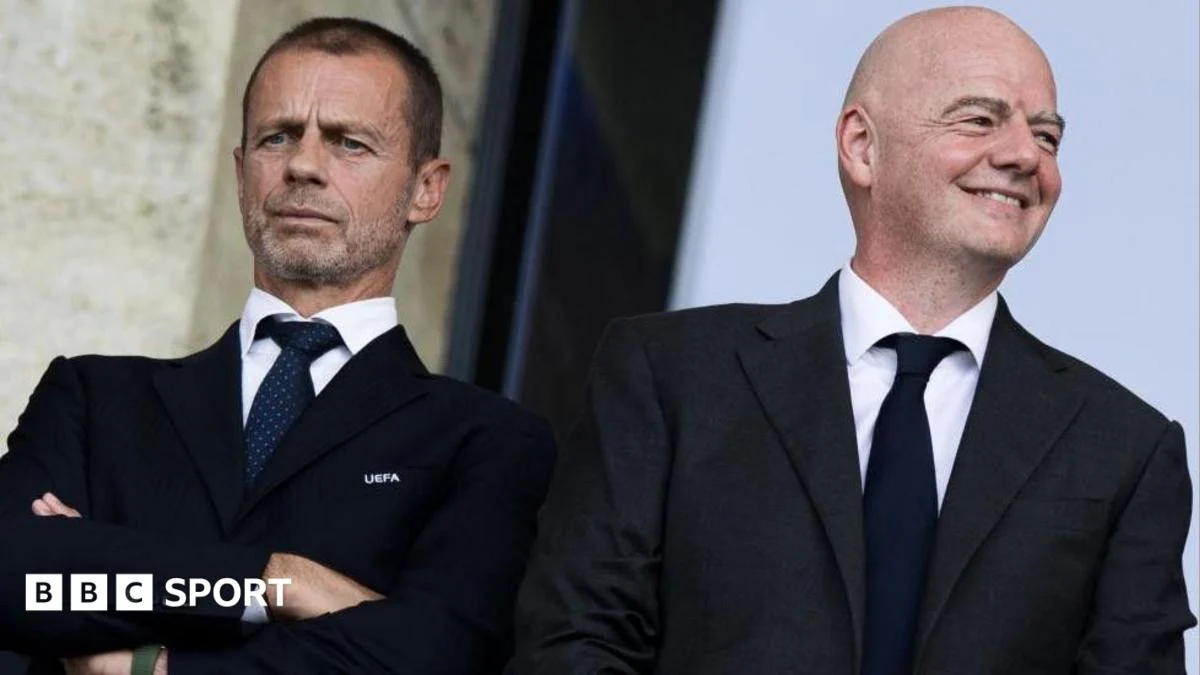
A monumental power struggle has erupted within the upper echelons of global football governance, as European football’s preeminent body, UEFA, issued an unprecedented and unequivocal threat to boycott FIFA competitions. This dramatic declaration represents a direct challenge to FIFA President Gianni Infantino’s controversial proposal to commercialize a substantial stake in the world governing body’s flagship tournaments, casting a profound shadow over his leadership and the very architecture of the sport’s future.
The catalyst for this profound schism materialized on a Thursday afternoon, specifically at 16:00 BST on July 30th, when UEFA released a statement of unparalleled impact. Its terse, yet devastating, declaration – "Uefa and its national associations will not participate in Fifa competitions" – reverberated instantly across the footballing world. This eleven-word ultimatum served as the definitive response to President Infantino’s ambitious, and ultimately divisive, strategy: the proposed sale of a 20% equity stake in a newly established subsidiary entity. This company, designed to oversee FIFA’s array of prestigious competitions, including the iconic World Cup, was intended to operate under FIFA’s ultimate control but with significant financial backing from private investors. Among the named private backers was Joshua Kushner, a figure notable for his familial connection to the US presidential administration, further adding a layer of scrutiny to the deal’s transparency and appropriateness.
Infantino’s vision, as outlined in the contentious proposal, aimed to inject substantial capital into FIFA’s operations and potentially unlock new revenue streams by leveraging external investment. The financial blueprint presented to national associations suggested an opportunity for them to receive an immediate payment of $20 million (approximately £15 million) by January 1st, contingent on accepting the deal by a September 19th deadline. This financial incentive was clearly designed to garner widespread support from the 211 member associations, particularly those with more modest resources, effectively creating a direct financial inducement to align with the President’s plan.
However, the European response, spearheaded by UEFA, indicates a fundamental disagreement not only with the commercial terms but also, crucially, with the underlying governance principles. The prevailing sentiment among UEFA members, as articulated by senior sources, suggests that the intricate details and long-term ramifications of Infantino’s policy were not adequately considered, or perhaps even understood, before the overall strategy was presented. This perceived lack of proper consultation and transparent dialogue has ignited a deep vein of anger and mistrust, extending beyond the mere financial aspects of the deal.
The immediate operational implications of UEFA’s boycott threat are stark and deeply unsettling for the global football calendar. Should Infantino’s funding agreement proceed, the threat would activate, potentially causing unprecedented disruption to upcoming international tournaments. For instance, the U20 Women’s World Cup, scheduled to commence on September 5th in Poland, features a significant contingent of European nations. The hypothetical scenario of European teams withdrawing mid-tournament, perhaps even during the quarter-final stages, due to the activation of the boycott, presents a logistical and sporting nightmare. Beyond this, the Women’s World Cup play-offs in October, involving prominent European national teams such as England, Scotland, Wales, and Northern Ireland, would also be directly impacted. Laura McAllister, a UEFA vice-president and former Welsh international, underscored the gravity of the situation, stating that the thought of nations being excluded from such pivotal qualification matches for their first World Cup appearance was "unthinkable." She vehemently asserted, however, that this crisis was "not a problem of Uefa’s making," placing the onus squarely on FIFA for creating a situation that pushes European football into an untenable position, ultimately threatening the aspirations of players and nations.
The unified opposition to Infantino’s plan extends beyond the European continent. Following UEFA’s decisive statement, Concacaf, the governing body for football in North and Central America and the Caribbean, which notably co-hosted the previous World Cup, also issued a communiqué rejecting the proposals. This collective stance from two of football’s most influential confederations signifies a formidable challenge to Infantino’s authority. The dissent is not limited to confederations; prominent national associations, including the English Football Association (FA) and the Scottish Football Association (SFA), have publicly aligned themselves with UEFA’s position. Debbie Hewitt, chair of the FA and a FIFA vice-president, explicitly spoke out against the plan during UEFA’s emergency meeting, with the FA subsequently affirming its solidarity with its "European colleagues." Similarly, Mike Mulraney, president of the Scottish FA and chair of FIFA’s finance committee, declared his organization’s "unequivocal" agreement with UEFA, illustrating a significant fracture within FIFA’s own governance structures, even among its vice-presidents and committee chairs.
The pervasive sentiment among those who have voiced opposition is one of profound frustration and anger over the perceived lack of proper consultation and open dialogue from President Infantino. Sources close to the discussions describe the prevailing mood at UEFA’s emergency meeting as one of "anger." This suggests that the crisis is as much about governance and the manner in which decisions are made within FIFA as it is about the substance of the commercial deal itself. The repeated insistence on a transparent, consultative approach highlights a fundamental expectation from member associations that has, in their view, been disregarded.
Gianni Infantino, who assumed the FIFA presidency in 2016 after defeating Asian Football Confederation president Sheikh Salman al-Khalifa, is scheduled to seek a fourth term in March. Prior to this week’s developments, it was widely anticipated that his re-election would proceed unopposed, with numerous FAs globally, including some within Europe, having already pledged their support. However, the current crisis has dramatically altered this landscape. Sources indicate that a significant majority of Concacaf members, in addition to their rejection of the funding deal, are either losing confidence in Infantino’s capacity to effectively govern the sport or have entirely withdrawn their trust. This erosion of support has now spurred discussions about identifying and backing a credible candidate to challenge his re-election, a move that would break a long-standing tradition of sitting FIFA presidents typically not facing electoral opposition. The last instance of an incumbent president losing an election was in 1974 when Sir Stanley Rous was unseated by Brazil’s Joao Havelange.
The name of Nasser Al-Khelaifi has emerged in these discussions as a potential challenger, a proposition that is understandable given his immense influence within global football. As president of Paris Saint-Germain, a club that has achieved consecutive Champions League victories, and more critically, as chairman of European Football Clubs (formerly the European Clubs’ Association), Al-Khelaifi commands significant power. His leadership of the European clubs’ body, particularly in the aftermath of the ill-fated European Super League attempt in 2021, which he navigated by expanding its membership to over 800 clubs (with only Real Madrid remaining outside), has solidified his standing. Theoretically, his profile makes him an ideal candidate to challenge Infantino. However, sources close to the 52-year-old Qatari indicate a profound disinterest in the FIFA presidency, asserting that he "genuinely, genuinely, genuinely doesn’t want the job." This reluctance complicates the search for a viable alternative, highlighting the inherent difficulty in finding a figure with both the stature and willingness to contest the incumbent.
The future of Infantino’s tenure remains highly uncertain. As Laura McAllister candidly admitted, "I don’t know, in all honesty," when asked about his job security. David Bernstein, former chairman of the English FA, offered a pointed assessment: "In a normal organisation, if he has to back down due to something of this magnitude he’d probably be shown the door. But Fifa is not a normal organisation. If he has the support of enough of the national associations, he will continue." This underscores the unique political dynamics within FIFA, where the aggregate support of numerous smaller national associations can sometimes outweigh the influence of the most powerful confederations.
Despite UEFA representing only 55 of FIFA’s 211 national associations, its influence in pure footballing terms is unparalleled. In FIFA’s most prestigious competitions – the men’s World Cup, the Women’s World Cup, and the Club World Cup – UEFA nations consistently dominate, routinely supplying three of the four semi-finalists. The absence of European involvement in FIFA competitions would trigger an unprecedented commercial catastrophe. The financial figures Infantino has touted in his communications to national associations, including a projected $40 billion (approximately £30 billion) valuation for the "product," would become entirely unattainable. The loss of European teams would render the events commercially unviable, deterring major sponsors, broadcasters, and ultimately eroding the global appeal and financial foundation of FIFA’s tournaments.
David Bernstein articulated the prevailing view that a resolution is not merely desirable but essential. "I can’t believe in the long term that there will be a schism because it would be a lose-lose for everybody," he stated. The symbiotic relationship between FIFA and European football is undeniable: FIFA cannot afford to exclude European nations, and Europe, despite its considerable power, cannot afford to be entirely isolated from the global stage of FIFA competitions. Bernstein’s analysis suggests that Infantino will ultimately be compelled to retract the controversial deal. He characterized the proposal as a "friends deal," implying a lack of competitive bidding or transparent market-based valuation, and asserted that "it’s not right. If they want to raise capital, there’s other, better ways of doing it."
The current crisis represents a critical juncture for FIFA and its President. It highlights deep-seated tensions over governance, transparency, and the strategic direction of global football. The collective stand by UEFA and other prominent confederations and national associations signals a strong demand for a more consultative and inclusive leadership model. The coming weeks will determine whether Gianni Infantino can navigate this profound challenge, either by making significant concessions or by mobilizing sufficient support to withstand the formidable opposition, thereby shaping not only his own future but also the very structure and integrity of the world’s most popular sport.


 Aura Kasih
 Safa Marwah