Safa Marwah
Meta Platforms’ Instagram division has addressed recent speculation regarding a significant data leak affecting millions of user accounts, simultaneously confirming the rectification of a bug that permitted the mass initiation of password reset requests. The social media giant maintains that its systems were not breached and that user accounts remain secure, urging individuals to disregard any unsolicited password reset communications. This development unfolds against a backdrop of claims circulating on cybercrime forums regarding the availability of data pertaining to over 17 million Instagram profiles, sparking widespread concern within the cybersecurity community and among the platform’s vast user base.
The digital landscape is frequently punctuated by reports of data compromise, ranging from sophisticated system intrusions to more subtle data exfiltration techniques. In the current instance, the controversy centers on two distinct but related issues: an alleged large-scale data leak and a confirmed technical vulnerability. Instagram, through a Meta spokesperson, confirmed to security researchers that it had "fixed an issue that allowed an external party to request password reset emails for some Instagram users." The company emphasized, "We want to reassure everyone there was no breach of our systems and people’s Instagram accounts remain secure. People can disregard these emails and we apologize for any confusion this may have caused." This statement underscores a critical distinction in cybersecurity terminology: a "breach" typically implies unauthorized access to a system’s core infrastructure, while a "leak" or "scraping" might refer to data exposed or extracted through legitimate, albeit abused, means or compiled from disparate sources.
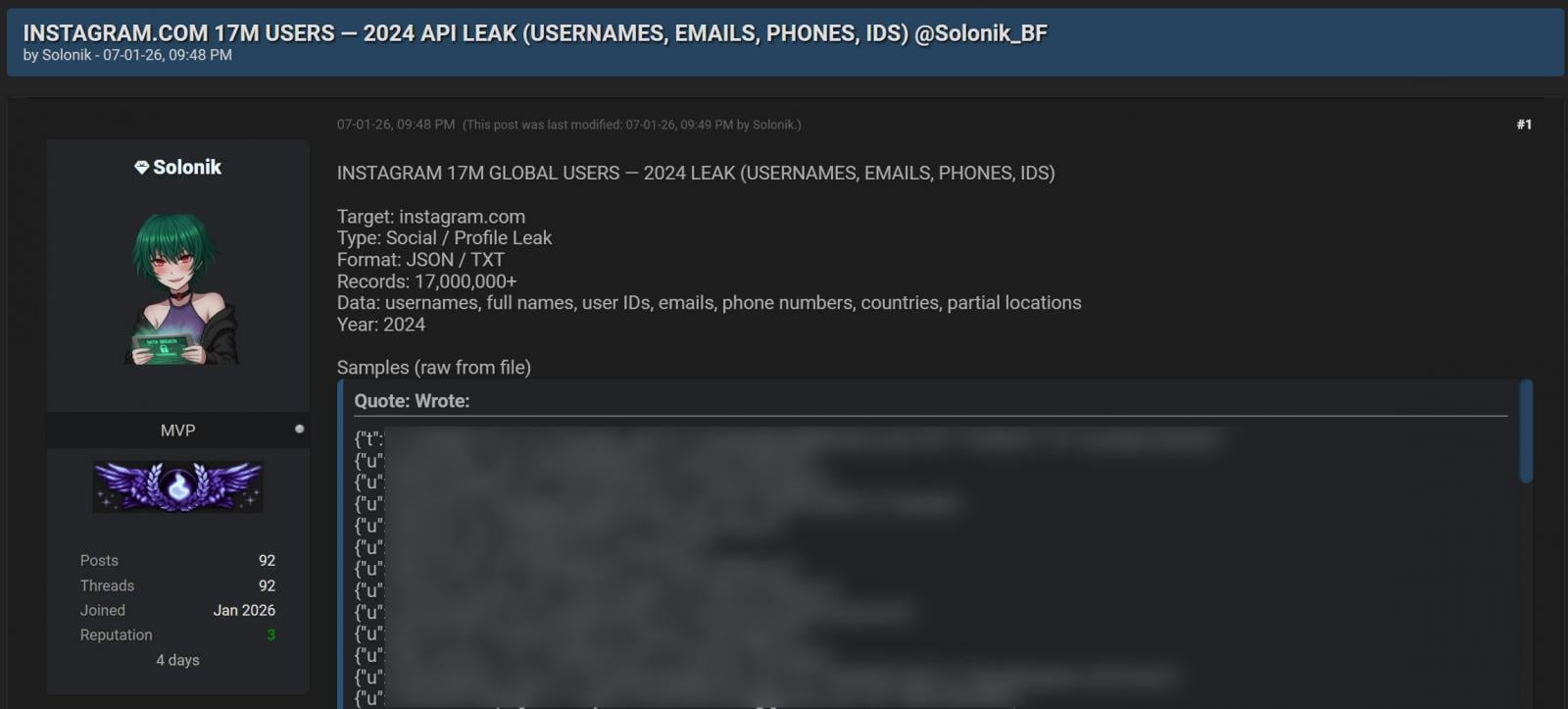
The genesis of the public alarm can be traced to warnings issued by cybersecurity firms and subsequent discussions across various digital platforms. Malwarebytes, for example, reportedly alerted its clientele to claims that cybercriminals had acquired and disseminated data from approximately 17.5 million Instagram accounts. This alleged dataset subsequently appeared on numerous hacking forums, where the individual responsible for its release purported it to be the outcome of an "unconfirmed 2024 Instagram API leak." The public availability of such a substantial volume of personal information, regardless of its origin, invariably triggers an immediate and urgent response from both the affected platform and the broader cybersecurity defense ecosystem.
An examination of the purportedly leaked dataset reveals a comprehensive collection of user attributes, although the completeness varies per record. In total, the collection is said to encompass 17,017,213 Instagram account profiles. The types of information reportedly contained within this dataset include, but are not limited to, phone numbers, usernames, full names, physical addresses, email addresses, and Instagram unique identifiers. While not every piece of information is present for each entry – with some records containing as little as an Instagram ID and a username – the sheer volume and variety of data points raise significant concerns regarding privacy and security. The dataset’s reported composition includes a significant number of unique entries across these categories, illustrating the potential breadth of exposure.
The precise provenance of this data remains a subject of considerable debate and unconfirmed speculation. While the forum poster claimed a 2024 API leak as the source, several cybersecurity researchers active on platforms like X (formerly Twitter) have posited that the scraped data may originate from a previously documented API scraping incident in 2022. However, these assertions have yet to be substantiated with concrete, verifiable evidence. Adding to the ambiguity, Meta has explicitly stated that it is unaware of any API incidents, whether in 2022 or 2024, that would account for such a data leak. This conflicting information complicates efforts to definitively ascertain the timeline and method of data acquisition, leaving both users and analysts to sift through various possibilities.

Instagram’s history is not without prior instances of data-related challenges. A notable event occurred in 2017 when a bug was exploited to scrape and subsequently sell the personal information of an estimated 6 million accounts, many belonging to high-profile individuals. This earlier incident, also involving API vulnerabilities, serves as a precedent for the current allegations and underscores the persistent attractiveness of large social media platforms as targets for data exfiltration. The question now arises whether the newly surfaced data represents a fresh, independent compromise, a compilation of information from the 2017 leak augmented with more recent details, or an entirely different aggregation of publicly accessible or previously compromised data. Attempts to contact the individual responsible for leaking the Instagram information to clarify its origins have reportedly not yielded a response, further obscuring the full picture.
The Nature of the Alleged Data and Its Implications
The information reported to be within the leaked dataset—usernames, full names, email addresses, phone numbers, and physical addresses—represents a potent arsenal for malicious actors. While the absence of passwords is a crucial mitigating factor, as it means direct account compromise is not immediately possible through this data alone, the other personal identifiers are invaluable for various forms of cybercrime. This data enables highly targeted phishing campaigns, where attackers craft believable messages tailored to individual users, leveraging their real names, contact details, and even geographical information to appear legitimate. Such sophisticated attacks, known as spear-phishing or smishing (via SMS), significantly increase the likelihood of victims divulging sensitive information, including their passwords, financial details, or other confidential data.
Beyond phishing, the consolidation of such personal information facilitates identity theft. While a full identity theft typically requires more extensive data, the leaked details can serve as foundational elements for fraudsters to build more comprehensive profiles. This could involve combining the Instagram data with information obtained from other leaks or public sources, slowly piecing together a complete picture of an individual. Furthermore, the presence of physical addresses raises concerns about potential real-world threats, ranging from unsolicited mail to more sinister forms of harassment or even physical targeting, particularly for individuals with public profiles.
Instagram’s Official Stance and Technical Explanation
Instagram’s firm denial of a "breach" is a calculated statement designed to reassure users and potentially mitigate regulatory consequences. From a technical standpoint, a breach implies unauthorized access to the platform’s internal servers, databases, or privileged systems. In contrast, data scraping often involves using automated tools to extract publicly available information or abusing legitimate API functionalities to gather data that might not be directly exposed on a user’s profile but is accessible through the platform’s design. If the data was indeed obtained through API scraping, Instagram could argue that its core systems were not "breached," even if a significant volume of user data was exfiltrated.
The acknowledged fix for a bug allowing "mass-request password reset emails" is a separate, yet related, security concern. While Instagram states this bug did not lead to a data breach, its existence highlights a vulnerability that could be exploited in other ways. An attacker could flood a user’s inbox with password reset emails, potentially leading to confusion, disruption, or even social engineering attempts where a user might be tricked into clicking a malicious link disguised as a legitimate reset. While Instagram clarifies that this bug did not compromise accounts directly, its prompt remediation demonstrates the company’s awareness of its potential for abuse.
Historical Context and Evolving Threats
The recurring nature of data incidents involving social media platforms underscores the persistent challenges in securing vast, interconnected digital ecosystems. Instagram, like its parent company Meta, operates on an immense scale, processing and storing information for billions of users. This scale inherently presents a massive attack surface for cybercriminals. The evolution of threats from direct hacking attempts to sophisticated social engineering, API abuse, and data scraping necessitates a dynamic and proactive security posture. The 2017 Instagram incident, where an API flaw allowed for the extraction of celebrity contact details, serves as a stark reminder that even seemingly minor vulnerabilities can have significant repercussions when exploited at scale. The current situation, regardless of its ultimate origin, fits into a pattern of threat actors continuously probing and exploiting any weaknesses in large online platforms to monetize user data.
Mitigation Strategies and Future Outlook
For users, the most immediate and effective mitigation strategies involve heightened vigilance and the adoption of robust security practices. Given that the leaked data reportedly does not contain passwords, there is no urgent need for users to change their Instagram credentials unless they suspect a separate, unrelated compromise. However, the presence of other personal identifiers necessitates extreme caution against targeted phishing, smishing, and social engineering attacks. Users should be highly skeptical of any unsolicited communications—emails, text messages, or direct messages—that purport to be from Instagram or related entities, especially those requesting personal information or prompting clicks on suspicious links.
Crucially, enabling two-factor authentication (2FA) on Instagram accounts is a paramount security measure. 2FA adds an essential layer of security by requiring a second form of verification, such as a code sent to a mobile device, in addition to a password. This significantly hampers an attacker’s ability to gain unauthorized access, even if they manage to obtain a user’s password through other means. Regularly reviewing privacy settings and being mindful of the information shared publicly on social media platforms also contributes to reducing one’s digital footprint and potential exposure.
For Instagram and Meta, this incident, irrespective of whether it constitutes a "breach" or a "leak," carries significant reputational and potentially regulatory implications. Even if systems were not directly compromised, the perception of lax data security can erode user trust and invite scrutiny from data protection authorities worldwide, such as those enforcing GDPR in Europe or CCPA in California. These regulations impose stringent requirements on data handling and notification, and any perceived failure to adequately protect user data can result in substantial fines and legal challenges. The company’s ongoing commitment to identifying and patching vulnerabilities, enhancing API security, and transparently communicating with its user base will be critical in navigating these challenges.
The broader cybersecurity landscape continues to evolve, with data scraping and the exploitation of API vulnerabilities remaining persistent threats. As platforms like Instagram become increasingly integrated into daily life, the responsibility to safeguard vast repositories of personal data becomes ever more critical. The ongoing dialogue between platforms, security researchers, and regulatory bodies is essential to fostering a more secure digital environment. Ultimately, the Instagram incident serves as a salient reminder of the continuous arms race between digital innovation and cyber threats, emphasizing the need for both platforms and individual users to remain perpetually proactive in protecting their digital identities.



 Lisa Mariana
 Aura Kasih
 Ayu Aulia