 Ayu Aulia
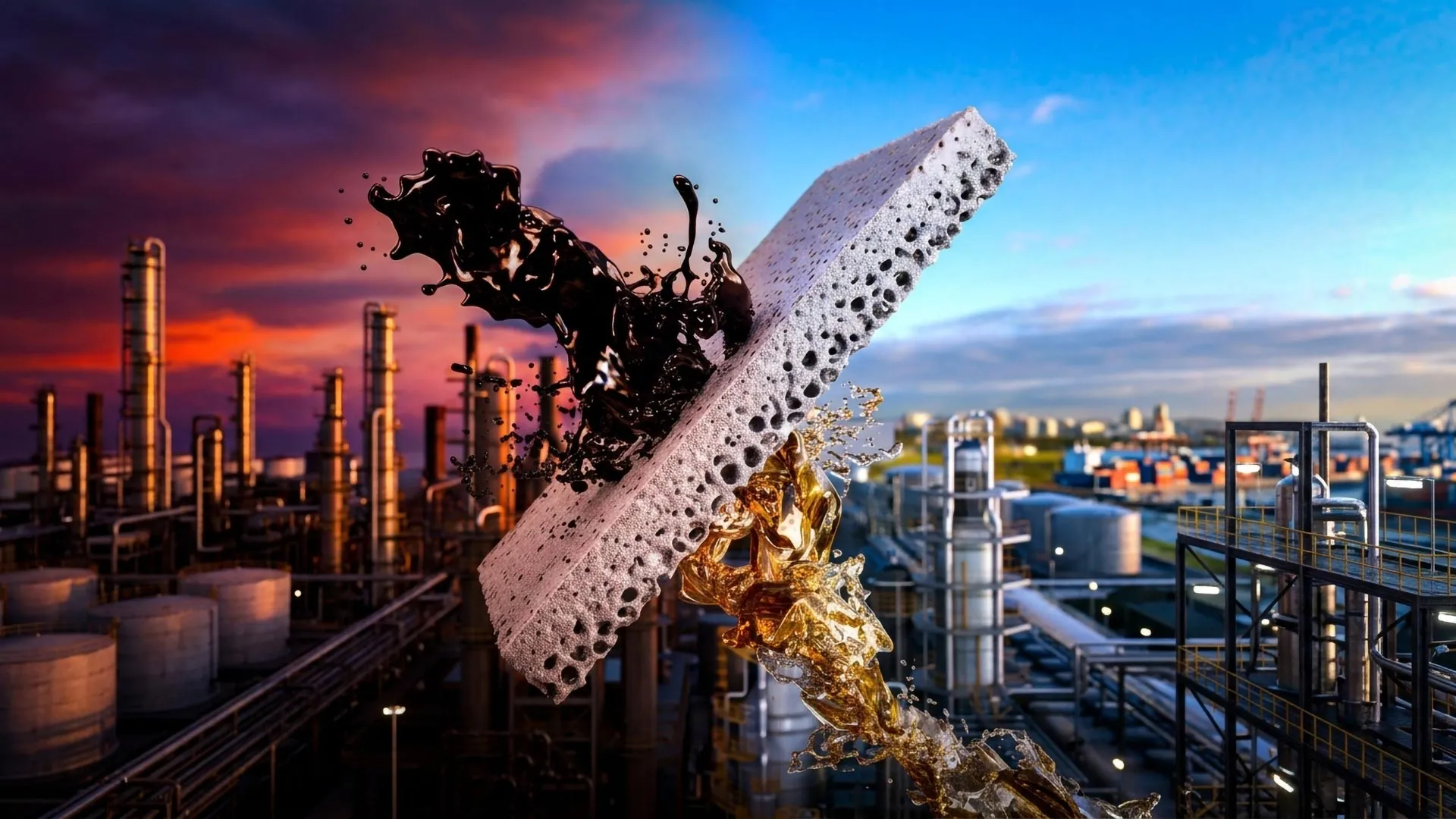
An innovative membrane system, developed through international collaboration, promises to fundamentally alter crude oil processing by enabling efficient separation without the immense thermal energy typically required for distillation. This breakthrough, which leverages a counter-intuitive principle where crude oil itself helps form the microscopic separation channels, could usher in a new era of energy-efficient refining, substantially reducing operational costs, greenhouse gas emissions, and water consumption across the petrochemical industry.
The Energy Imperative: Rethinking Conventional Distillation
For over a century, the global oil refining industry has been anchored to thermal distillation as its primary method for separating crude oil into various useful fractions. This foundational process involves heating crude oil to temperatures exceeding 350 degrees Celsius, vaporizing its components, and then condensing them at different temperature gradients to isolate products such as naphtha, gasoline, kerosene, diesel, and heavier fuel oils, alongside feedstocks for plastics and other chemicals. While effective, this reliance on extreme heat positions distillation as one of the most energy-intensive industrial operations worldwide. Estimates indicate that crude oil distillation consumes approximately 1,100 terawatt-hours (TWh) annually. To put this into perspective, this energy expenditure is roughly equivalent to the combined yearly output of 130 continuously operating gigawatt-capacity nuclear power plants.
This colossal energy demand carries significant economic and environmental burdens. Economically, the cost of heating and cooling large volumes of crude oil represents a substantial portion of refinery operating expenses, directly influencing the final prices of countless consumer and industrial products derived from petroleum. Environmentally, the combustion of fossil fuels to generate this heat contributes massively to global greenhouse gas emissions, particularly carbon dioxide. As industries face increasing pressure to decarbonize and operate more sustainably, the search for alternative, less energy-intensive separation technologies has intensified. The imperative is not merely to optimize existing processes but to discover fundamentally different approaches that can achieve the same, or superior, separation outcomes with a dramatically reduced energy footprint.
The Promise and Pitfalls of Membrane Separation
Membrane technology has long been identified as a highly promising alternative to thermal separation processes. Unlike distillation, which requires a phase change (liquid to vapor and back), membranes achieve separation by selectively allowing certain molecules to pass through microscopic pores while retaining others. This eliminates the need for high temperatures and pressures, offering the potential for significant energy savings. However, despite decades of research, the widespread industrial adoption of membrane systems for crude oil refining has been hindered by several formidable challenges.
Traditional membrane designs for precise molecular separation typically rely on highly specialized, ultrathin coatings applied to a porous support structure. These coatings, often composed of advanced polymers or inorganic materials, are engineered to possess specific pore sizes and surface chemistries that enable selective permeation. While theoretically capable of achieving the necessary separation precision, their practical implementation at an industrial scale has been fraught with difficulties. The manufacturing of these highly precise coatings is inherently expensive, making the membranes cost-prohibitive for high-volume applications like crude oil refining. Furthermore, scaling up production often leads to the introduction of defects in the delicate coating layers, compromising separation efficiency and membrane integrity. Perhaps the most persistent challenge has been "fouling," where unwanted substances accumulate on or within the membrane pores, reducing flux, increasing pressure drop, and ultimately necessitating frequent cleaning or replacement. For highly complex and contaminant-rich mixtures like crude oil, fouling has been a critical barrier, often negating the theoretical advantages of membrane separation.
A Serendipitous Discovery: Repurposing the Problem of Fouling
The recent breakthrough, spearheaded by Professor Dong-Yeun Koh’s team at the Korea Advanced Institute of Science and Technology (KAIST) in collaboration with Professor Ryan Lively’s research group at Georgia Tech, represents a radical departure from conventional membrane design philosophy. Instead of meticulously engineering a pristine, specialized coating, the researchers opted for a remarkably simpler approach: a bare, porous membrane fabricated from polyacrylonitrile (PAN). PAN is an inexpensive, chemically robust polymer widely utilized as a support layer in existing industrial filtration systems, not typically for active separation.
The pivotal insight emerged from observing an unexpected phenomenon when crude oil was passed through this seemingly unsophisticated PAN membrane. Rather than requiring a pre-defined, ultrathin selective layer, the crude oil itself facilitated the creation of the necessary separation architecture. As the complex mixture of hydrocarbons flowed through the macroscopic pores of the PAN membrane, heavier, larger hydrocarbon molecules began to accumulate and adsorb along the inner walls of these pores. This gradual, self-assembly process led to a progressive constriction of the pore openings, effectively reducing their size to extremely narrow channels, measuring less than two nanometers across.
In essence, the very components of crude oil acted as architects, dynamically shaping the membrane’s internal structure to facilitate its own separation. These self-formed, nanoscale pathways exhibited remarkable selectivity: lighter oil fractions, such as naphtha, gasoline, and kerosene, could efficiently navigate and pass through these constricted channels, while the bulkier, heavier substances were preferentially retained or slowed significantly. This process directly enabled the separation of crude oil into its valuable constituents at ambient temperatures.
This discovery is particularly astonishing because the accumulation of material within membrane pores, traditionally known as fouling, has always been regarded as a severe operational impediment. Fouling typically degrades performance, shortens membrane lifespan, and necessitates costly maintenance. The KAIST and Georgia Tech teams, however, have ingeniously transformed this long-standing problem into a fundamental advantage. By embracing and understanding the mechanism of "self-fouling" or "self-constriction," they have unlocked a new paradigm for membrane design.
The performance metrics of this innovative uncoated PAN membrane are compelling. It demonstrated crude oil permeation rates approximately 23 times higher than those reported for previous leading crude oil separation membranes. Crucially, the membrane maintained stable operational performance for 28 consecutive days, a significant indicator of its potential robustness. Professor Ryan Lively of Georgia Tech highlighted the practical implications, stating, "One of the key challenges facing membrane systems for crude oil separation was the low productivities of the membrane units – the PAN membranes with their surprising separation mechanism – dramatically increase the productivity of the membrane unit, to the point where industry should seriously consider adopting the technology." This assessment underscores the shift from laboratory curiosity to a viable industrial solution.
Transformative Potential for Existing Refinery Infrastructure
A key advantage of this new membrane technology lies in its potential for seamless integration into existing refinery operations, circumventing the need for complete overhauls of capital-intensive infrastructure. Rather than replacing conventional distillation columns, the membrane system could be deployed as a modular pre-treatment unit. This would involve processing crude oil through the membrane filtration system before it enters the traditional distillation equipment.
This modular approach offers a strategic pathway for immediate impact. By pre-separating a significant portion of the lighter fractions at room temperature, the downstream distillation units would receive a partially refined feedstock, requiring less heat input and processing capacity. Computer simulations provide a compelling vision of the potential benefits: integrating this membrane technology could lead to a substantial 31.6% reduction in overall energy consumption for the refining process. This energy saving translates directly into a projected 37.6% decrease in carbon dioxide emissions, a critical step towards decarbonizing a notoriously difficult-to-abate industrial sector. Furthermore, the simulations project a 20.7% reduction in cooling water consumption, addressing another significant environmental concern, and a substantial 36% decrease in overall operating costs.
The societal and environmental implications, if widely adopted, are profound. Researchers estimate that implementing this system across Korea’s refining and petrochemical industries alone could prevent approximately 10 million tonnes of greenhouse gas emissions annually. This is roughly equivalent to removing four million internal combustion engine vehicles from the roads each year. While these figures are based on sophisticated process simulations rather than operational refinery data, they provide a powerful indication of the technology’s capacity to drive both economic competitiveness and environmental sustainability within the global energy sector. The ability to enhance the efficiency of existing facilities, rather than necessitating entirely new construction, makes this a highly attractive proposition for an industry seeking to modernize and reduce its environmental footprint without prohibitive capital expenditure.
Beyond Crude Oil: A Versatile Platform for Complex Mixtures
While the initial focus of the research was firmly on crude oil separation, the underlying scientific principle – using a complex liquid mixture to dynamically form its own selective separation channels – holds immense promise for a broader spectrum of industrial applications. This innovative approach could offer a more affordable and versatile alternative to conventional membranes that rely on precisely engineered and expensive surface coatings.
One immediate potential application identified is the treatment of pyrolysis oil, a liquid product derived from the thermal decomposition of waste plastics during chemical recycling processes. Separating and purifying pyrolysis oil is a crucial step in transforming plastic waste back into valuable feedstocks, and a low-energy membrane solution could significantly improve the economic viability and environmental profile of plastic recycling. Other promising areas include the recovery and purification of solvents used in the manufacturing of advanced batteries, a rapidly expanding industry with stringent requirements for material purity and process efficiency. The technology could also find utility in purifying pharmaceutical compounds, where precise separation is paramount, and in enhancing the production of biofuels, supporting the transition towards renewable energy sources.
Professor Dong-Yeun Koh of KAIST emphasized the fundamental nature of the discovery: "This study reveals a new scientific principle in which a membrane interacts with a complex mixture and spontaneously forms its own separation channels." The research team’s commitment to industrial relevance was further underscored by their collaboration with HD Hyundai Oilbank, which supplied actual crude oil for testing. This ensured that the performance validation was conducted under conditions representative of real-world industrial operations, addressing the inherent complexity of industrial feedstocks.
Looking ahead, the research team is focused on critical next steps to transition this laboratory breakthrough into widespread industrial deployment. These include scaling up membrane production to meet large-area requirements and rigorously establishing the long-term operational reliability of the system under continuous industrial conditions. Professor Jae W. Lee of KAIST, a co-corresponding author, articulated this vision: "By advancing large-area membrane modularization and long-term operational reliability, we hope to broaden the adoption of membrane-based processes throughout the refining and petrochemical industries." Dr. Jihoon Choi and Dr. Hyeokjun Seo, co-first authors, further elaborated on their ambition to precisely control this spontaneous pore-constriction phenomenon, developing it into a versatile membrane platform applicable across the entire refining process and extending its reach to vital sustainable chemical processes supporting global carbon neutrality goals, such as plastic recycling and biofuel purification.
This innovative research, supported by Korea’s Ministry of Science and ICT, represents more than just a technological improvement; it signifies a paradigm shift in how engineers and scientists might approach separation challenges. By transforming a long-standing operational hindrance into a core mechanism of efficiency, this self-forming nanopore technology opens new avenues for sustainable industrial practices, promising substantial benefits for both the global economy and the environment.



 Aura Kasih

 Lisa Mariana