Lisa Mariana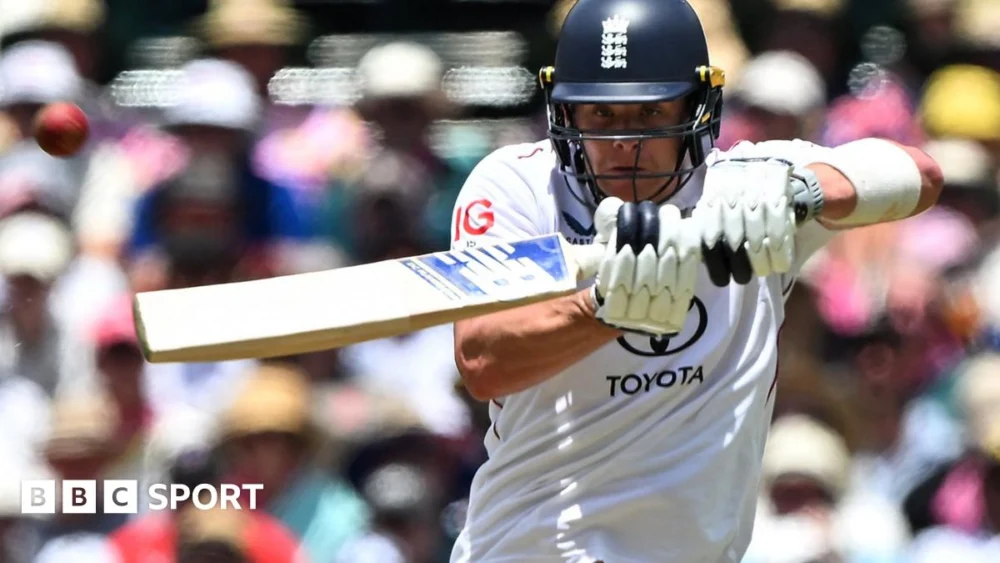
Jamie Smith’s dismissal during England’s fifth Test against Australia in the 2025-26 Ashes series in Sydney has drawn widespread condemnation, serving as a stark encapsulation of England’s challenging campaign and prompting significant debate regarding strategic judgment and player discipline at the highest level of Test cricket.
The incident unfolded on the second morning of the final Test, a session critical for England as they sought to consolidate their innings and build a substantial total. The visitors, having endured a series marred by inconsistent performances, were in a precarious position, relying heavily on a burgeoning partnership between the steadfast Joe Root, who was compiling a masterful century, and the younger Smith. With lunch approaching, the Australian captain, in a tactical manoeuvre to accelerate the arrival of the second new ball, introduced Marnus Labuschagne into the attack. Labuschagne, primarily known for his wrist-spin, was instructed to bowl occasional medium-pace bouncers, a deviation from his usual repertoire, designed to test the patience and temperament of the English batsmen.
This strategic gambit was accompanied by an unorthodox field setting. Seven Australian fielders were positioned deep on the boundary, explicitly indicating an invitation for the batsman to take on the short ball. This arrangement was immediately identified by seasoned cricket commentators as a conspicuous trap, almost daring the batsman to engage. Jonathan Agnew, a veteran voice in cricket commentary, highlighted the peculiarity of the situation, remarking on the sheer improbability of a Test batsman falling victim to such an overt ploy from a part-time bowler. Labuschagne, whose prior Test wickets were exclusively secured through his spin, had laid a transparent snare, making Smith’s subsequent actions all the more perplexing.
Despite the transparent nature of the trap, Smith, who had reached a somewhat scratchy 46 and was contributing to a valuable 94-run stand with Root, elected to engage. From Labuschagne’s fourth delivery, a gentle bouncer, Smith stepped back and attempted a forceful, flat-batted swipe. The execution was flawed, leading to a miscue that flew directly to Scott Boland, the solitary fielder positioned in front of square on the off-side at cover. The immediate reaction from the commentary box and former players was one of utter disbelief and profound disappointment. Steven Finn, an Ashes winner himself, described the shot as "completely brainless," highlighting the apparent absence of reasoned decision-making in a high-stakes Test environment. Alex Hartley, a Women’s World Cup champion, minced no words, labelling the dismissal "filthy" and attributing it to a palpable "lack of discipline."
This dismissal did not occur in isolation but was, in many respects, the culmination of a broader pattern of vulnerability and a discernible struggle for consistency from Smith throughout his innings. Prior to Labuschagne’s introduction, Smith had ridden his luck on several occasions against the express pace of Cameron Green. Early in his innings, on 22, he was caught at cover, only for replays to confirm that Green had overstepped, granting Smith a reprieve. On the very next ball, Smith executed a risky slash that narrowly eluded the wicketkeeper Alex Carey and Beau Webster at first slip. Further instances of fortune followed: a top-edged shot over the slips when on 30 and a miscued pull that just evaded the mid-on fielder when he had reached 34. These incidents, occurring within a relatively short span, painted a picture of a batsman struggling to assert control, frequently resorting to risky strokes, and relying on fortuitous circumstances to prolong his stay at the crease. This pattern of play underscored a fundamental issue in shot selection and risk assessment, ultimately leading to the seemingly inevitable, albeit spectacularly poor, dismissal to Labuschagne.
The Sydney horror show was not merely an isolated incident but rather a microcosm of a profoundly disappointing Ashes series for Jamie Smith, extending a worrying dip in form that had commenced during the preceding home summer. His international career had begun with significant promise, highlighted by an astonishing innings of 184 in the second Test against India at Edgbaston in July. Following that stellar performance, his Test batting average stood impressively at almost 59. However, in the subsequent eight Test matches, this average plummeted to 42, a substantial decline indicative of his struggles to replicate early success.
His difficulties in Australia were multifaceted. In the opening Test in Perth, Smith reportedly struggled to adapt to the expansive boundaries and the notorious bounce characteristic of Australian pitches, eventually succumbing to a short-pitched delivery. The second Test in Brisbane, played with a pink ball under lights, presented a different set of challenges, where Smith, as wicketkeeper, missed two crucial chances behind the stumps, impacting the team’s fortunes. While he managed his highest score of the series, a 60 in the second innings of the third Test in Adelaide, even this innings ended in a manner that drew criticism. Just as he was offering England a glimmer of hope in an improbable run-chase, he holed out off the bowling of Mitchell Starc, a dismissal that epitomized a lack of composure at a critical juncture. The accumulation of these events, culminating in the Sydney dismissal, painted a concerning trajectory for a player once considered a rising star. Further illustrating the selectors’ concerns, Smith was conspicuously omitted from England’s white-ball squads for the upcoming tour of Sri Lanka and the subsequent T20 World Cup, a clear signal of his diminished standing across formats.
Despite this recent downturn, Smith’s career statistics still reveal a talent of considerable potential. He maintains the second-highest batting average for an England wicketkeeper who has featured in at least 20 Test matches, a testament to his earlier form and the quality of his batting when at his best. However, the dramatic collapse in his form, coupled with the nature of his recent dismissals, has undeniably cast a significant shadow over his future in the Test arena.
The discussion surrounding Smith’s dismissal inevitably extended to the broader cultural and tactical framework of the England Test team. Former England captain Michael Vaughan provided a particularly trenchant critique, suggesting that Smith’s dismissal was symptomatic of a wider systemic issue within the England setup. Vaughan argued that there might be an underlying team culture that, while ostensibly promoting aggressive, positive play, inadvertently condones ill-judged risk-taking. His observation that a player might "get a pat on the back for trying to take the game on" even after such a dismissal suggests a potential misinterpretation or misapplication of an aggressive batting philosophy. Vaughan’s assertion that "there are times to get on the front foot but when it is so close to lunch and Marnus Labuschagne is bowling bouncers. I cannot accept that. It sums up this England side," highlights the critical distinction between calculated aggression and reckless abandon. This perspective frames Smith’s actions not merely as an individual error but as a manifestation of a team ethos that, in this instance, failed to adapt to the specific match situation and the strategic nuances of Test cricket.
The implications of Smith’s performance and particularly his Sydney dismissal are far-reaching, both for the player himself and for the future direction of England Test cricket. For Jamie Smith, the immediate challenge is to rediscover the rhythm and discipline that characterized his earlier success. His position as England’s primary wicketkeeper-batsman, a role that demands both consistent performance with the bat and impeccable glovework, is now under intense scrutiny. The competition for this role is robust, and continued struggles could lead to his replacement, potentially jeopardizing a promising international career. The psychological impact of such a highly criticized dismissal, particularly when coupled with a broader run of poor form, cannot be underestimated. Rebuilding confidence and refining his decision-making process will be paramount for his resurgence.
For England Cricket, the incident prompts a deeper introspection into coaching philosophies, player development, and selection criteria. The Ashes series defeat, punctuated by moments of individual and collective strategic misjudgment, necessitates a thorough review. Is the team’s aggressive intent being channelled effectively, or is it occasionally leading to avoidable errors? The balance between encouraging positive, attacking cricket and instilling a deep understanding of match situations, opposition tactics, and judicious shot selection is a delicate one. Smith’s dismissal serves as a powerful case study in this ongoing debate, urging England to ensure that their celebrated attacking approach is underpinned by sound cricketing intelligence and situational awareness. The selectors will face critical decisions regarding player retention and the cultivation of a squad capable of adapting to diverse conditions and pressures.
In a broader cricketing context, Smith’s dismissal contributes to the ongoing discourse about the evolving nature of Test cricket tactics and the psychological demands placed upon modern players. The increasing use of part-time bowlers to create opportunities, even through seemingly innocuous deliveries, underscores the constant strategic chess match inherent in the long form of the game. It highlights how even a moment of perceived ease or relaxation can be ruthlessly exploited by an astute opposition. Ultimately, Jamie Smith’s dismal departure in Sydney will be remembered as a pivotal moment in the 2025-26 Ashes, not merely for its individual ignominy but for its profound reflection of England’s strategic vulnerabilities and the critical questions it raises about the path forward for their Test squad.




 Aura Kasih
 Safa Marwah
 Ayu Aulia