Lisa Mariana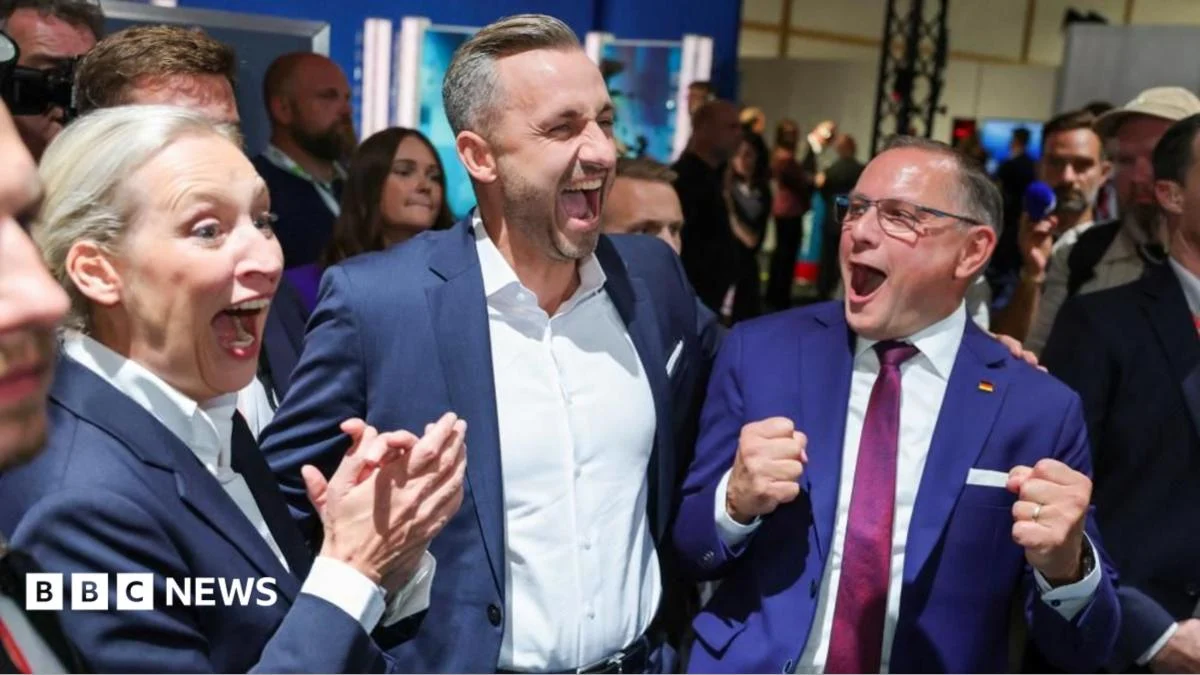
In an unprecedented political development, the Alternative for Germany (AfD), a party positioned on the far-right of the political spectrum, has achieved a commanding victory in the eastern German state of Saxony-Anhalt, according to initial electoral projections. This result places the AfD significantly ahead of established mainstream parties, signaling a profound reorientation of the regional political landscape and raising critical questions about the future trajectory of German democracy. While the precise configuration of the next state government remains subject to post-election negotiations, the AfD has swiftly declared a mandate to assume governmental responsibility, an assertion that, if realized, would mark a historic departure from Germany’s post-World War II political order.
Preliminary data indicates the AfD garnered an extraordinary 44% of the vote share, dwarfing the performance of the center-right Christian Democratic Union (CDU), which trailed with an estimated 17.8%. This outcome represents a substantial overperformance compared to pre-election opinion polling, which had already indicated strong support for the AfD but underestimated the scale of their eventual triumph. The state leader of the AfD, Ulrich Siegmund, hailed the result as "sensational," articulating an immediate desire to commence the process of governance. Such a prospect is historically charged; since the end of the Second World War, no party overtly identified with the far-right has successfully ascended to executive power within a German state. Assuming control at the state level would vest the AfD with significant authority over crucial public domains, including policing, local education policy, and cultural affairs.
Saxony-Anhalt, a state with a relatively modest population of 2.1 million residents, has long been recognized as a region where the AfD has cultivated a particularly robust base of support. The state’s chapter of the party is notably under scrutiny, having been formally classified by Germany’s domestic intelligence agency as "right-wing extremist," a designation that permits enhanced surveillance measures. This classification is vehemently rejected by Siegmund and other party officials, who characterize it as politically motivated. The widespread elation among AfD leadership, including national figures Alice Weidel and Tino Chrupalla, was palpable as the projections materialized, underscoring the perceived magnitude of this electoral breakthrough. Political analysts and opposing parties alike have underscored the outcome’s significance, describing it as a "watershed moment" that heralds a fundamental rupture with established political norms.
The path to forming a government, however, remains intricate. The AfD’s ability to secure a governing majority is contingent upon the performance of smaller parties and their success in surmounting the 5% electoral threshold required for parliamentary representation. A pivotal factor in this calculation is the Bündnis Sahra Wagenknecht (BSW), a populist left-wing party. Should the BSW fail to cross the 5% hurdle, the AfD’s prospects of attaining a parliamentary majority would significantly improve. Conversely, if the BSW secures representation, current projections suggest the AfD would command 39 seats within the 83-seat state parliament, necessitating coalition partners to form a stable administration.
The atmosphere at the AfD’s election night headquarters was described as euphoric, with supporters erupting in cheers as the projections appeared on screens, followed by an impromptu rendition of the German national anthem. Siegmund, addressing the jubilant crowd, declared that the party had "made history in this state." In contrast, Sven Schulze, the CDU’s lead candidate, swiftly conceded defeat, acknowledging the necessity for his party to grapple with the implications of the outcome, describing the preceding campaign as "extremely tough and intensive." Lars Klingbeil, a national leader of the center-left Social Democratic Party (SPD) – currently a partner in Germany’s national governing coalition – characterized the result as "truly dramatic." Klingbeil further emphasized the outcome as a "signal to Berlin," asserting that the message would be unequivocally received by the federal government.
The AfD, an acronym for Alternative für Deutschland, has distinguished itself through its openly pro-Russia stance and its staunch anti-migration platform. These positions have not only enabled the party to dominate the electoral discourse in Saxony-Anhalt but have also solidified its position as the dominant political force in the final vote count. Despite initial ambiguities regarding the ultimate governmental configuration, the party’s enthusiastic base views this result as definitive evidence of their growing national momentum. The election witnessed a notably high voter turnout, estimated at 78%, suggesting a high degree of political engagement among the electorate. AfD supporters in Magdeburg voiced strong approbation for Siegmund’s leadership and his perceived ability to connect with voters. One supporter, identified as Ollie, articulated a common sentiment, stating that Siegmund "gives us what no-one else can give," framing the AfD as "a party for the working people" and "the alternative for Germany" amidst perceived failures of traditional parties.
A significant impediment to the AfD’s governance aspirations remains the Brandmauer, or "firewall," a term used to describe the collective refusal of other mainstream political parties to enter into coalition agreements with the far-right. This consensus has historically served to isolate the AfD from executive power across Germany. However, the BSW has indicated a willingness to engage in cooperation with the AfD on specific policy issues, should it secure entry into the state parliament, potentially introducing a crack in this long-standing political barrier. Nationally, the AfD has recently ascended to leading positions in opinion polls, surpassing Chancellor Friedrich Merz’s conservative CDU and the SPD. Yet, its core strength and most significant electoral breakthroughs have consistently been concentrated in Germany’s eastern states, a region still grappling with the legacies of reunification. The party previously secured a victory in the 2024 state election in neighboring Thuringia but ultimately failed to amass sufficient seats to form a government.
Among the AfD’s most contentious policy proposals is its concept of "remigration." While the party asserts this refers specifically to the deportation of criminals and individuals residing in Germany illegally, the policy is widely interpreted by critics as a euphemism for the mass expulsion of migrants. Should the AfD assume leadership of a state government, it would lack the federal authority to implement such large-scale deportations. Nevertheless, a state-level administration would wield considerable influence over areas such as state policing, educational curricula, and cultural funding. The party has, for instance, been vocally critical of institutions like the Bauhaus school of design, drawing parallels to the Nazi regime’s suppression of the art movement after its ascent to power in 1933.
The news from Saxony-Anhalt has elicited profound concern from various segments of German society. Charlotte Knobloch, the venerable head of the Jewish community in Munich and Bavaria, a 93-year-old Holocaust survivor, expressed her deep apprehension, stating, "On days like this I find it hard to recognise my homeland any more." She issued an urgent plea to mainstream political forces not to remain passive in the face of what she perceives as a "decline." Furthermore, figures within the AfD’s Saxony-Anhalt leadership, such as Hans-Thomas Tillschneider, have faced criticism for their perceived pro-Russian sympathies. Tillschneider, when questioned about the presence of a Russian army mug in his office, dismissed it as a mere souvenir, asserting, "it’s not our war," a statement indicative of the party’s broader geopolitical stance.
The electoral success of the AfD in Saxony-Anhalt underscores a complex interplay of socio-economic factors, cultural grievances, and a growing disaffection with established political parties, particularly prevalent in Germany’s eastern regions. The legacy of reunification, characterized by economic restructuring, demographic shifts, and a perception of being overlooked by the federal government, has created fertile ground for populist narratives. The AfD’s rhetoric, which often taps into anxieties regarding immigration, national identity, and perceived elite failures, resonates strongly with a segment of the electorate that feels marginalized. This result serves not only as a localized political upset but also as a potent indicator of broader shifts within the German body politic, potentially challenging the fundamental tenets of its post-war democratic consensus and signaling a period of profound political realignment. The coming weeks will reveal whether the AfD can translate its electoral triumph into actual governance, a development that would undoubtedly have far-reaching implications for both Saxony-Anhalt and the wider German federal republic.




 Aura Kasih
 Safa Marwah
 Ayu Aulia