Safa Marwah
A significant cybersecurity incident at Covenant Health has been revealed to have compromised the personal and medical information of nearly half a million patients, a dramatic upward revision from the organization’s initial public disclosure. This extensive breach, attributed to the Qilin ransomware collective, underscores the persistent and evolving threats facing the healthcare sector and the complex challenges inherent in accurately assessing the full scope of such intrusions. The initial assessment of the incident dramatically underestimated its reach, highlighting the intricate and time-consuming nature of digital forensic investigations in uncovering the true scale of cyberattacks.
Covenant Health, a prominent Catholic healthcare provider based in Andover, Massachusetts, oversees a comprehensive network of hospitals, nursing and rehabilitation centers, assisted living residences, and elder care organizations spanning across New England and into parts of Pennsylvania. The breadth of its operations means that a data breach of this magnitude has widespread implications for patient privacy and security across multiple states. The revelation of the expanded impact has intensified scrutiny on the organization’s cybersecurity protocols and its capacity for rapid and accurate incident response.
The Unfolding of a Major Breach: From Initial Discovery to Revised Impact
The timeline of the Covenant Health breach reveals a common pattern in complex cyber incidents. The organization first detected unauthorized access to its systems on May 26, 2024, eight days after the initial intrusion by an attacker on May 18, 2024. This eight-day window between initial access and detection is a critical period during which malicious actors can exfiltrate substantial volumes of data and establish deeper footholds within a network.
Initially, in July, Covenant Health publicly disclosed that the data of 7,864 individuals had been exposed. This preliminary figure was based on the early stages of their investigation. However, as forensic specialists delved deeper into the compromised systems, the true extent of the breach began to materialize. After what Covenant Health described as completing "the bulk of its data analysis," the number of affected individuals surged to a staggering 478,188. This nearly 60-fold increase from the initial estimate underscores the formidable task of identifying every compromised record and assessing the full scope of exposure in the aftermath of a sophisticated cyberattack. The significant discrepancy between the initial and revised figures highlights the inherent difficulties in rapidly quantifying damage, often leading to iterative disclosures as investigations progress.
The Qilin Ransomware Group: A Force in Cyber Extortion
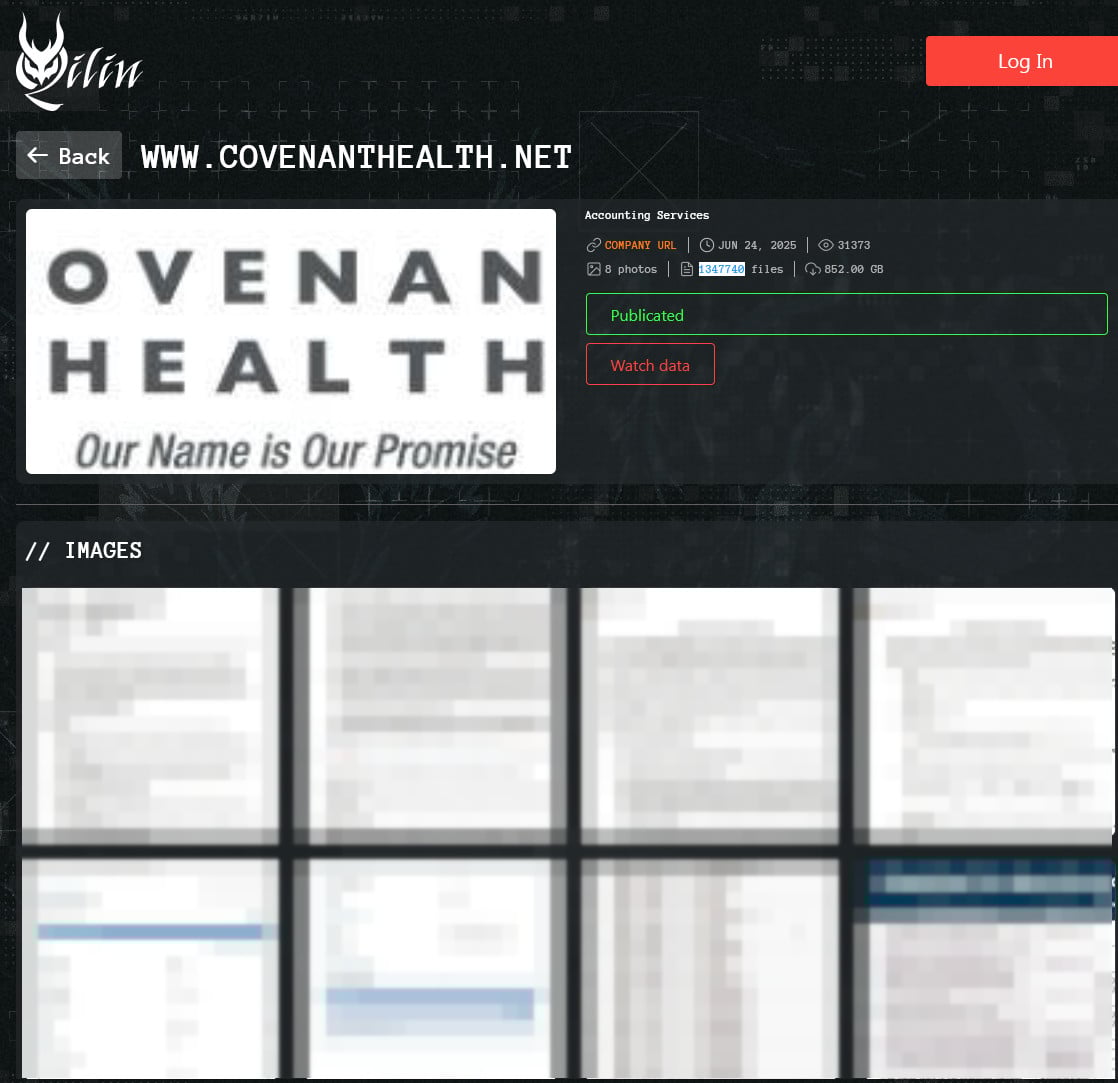
In late June, the notorious Qilin ransomware group publicly claimed responsibility for the attack, listing Covenant Health on its data leak site. The group asserted that it had successfully exfiltrated a massive 852 gigabytes of data, comprising approximately 1.35 million files. Qilin operates on a "double extortion" model, a common tactic among modern ransomware syndicates. This involves not only encrypting an organization’s data and demanding a ransom for decryption keys but also stealing sensitive data beforehand and threatening to publish it if the ransom is not paid. This dual pressure strategy significantly increases the leverage of the attackers and the potential harm to the victim organization and its constituents.

The Qilin group, like many of its contemporaries, functions as a Ransomware-as-a-Service (RaaS) operation, where developers create the ransomware tools and infrastructure, and affiliates carry out the actual attacks, sharing a percentage of the ransom payments. Their targets often include organizations rich in sensitive data, such as those in the healthcare sector, which are particularly vulnerable due to the critical nature of their services and the high value of patient information on illicit markets. The involvement of such a prominent ransomware collective points to a targeted and professionally executed attack rather than a random opportunistic exploit.
The Breadth of Compromised Patient Information
The types of information exposed in the Covenant Health breach are highly sensitive and carry significant risks for the affected individuals. The organization has confirmed that the compromised data may include:
- Personal Identifiable Information (PII): Names, addresses, and dates of birth.
- Medical Identifiable Information (MII): Medical record numbers, health insurance information, diagnoses, dates of treatment, and types of treatment received.
- Highly Sensitive Identifiable Information: Social Security numbers (SSNs).
The exposure of SSNs is particularly concerning, as it provides malicious actors with a key piece of information often used for comprehensive identity theft. Coupled with names, addresses, and dates of birth, this data can be used to open fraudulent accounts, obtain loans, file false tax returns, and commit various other forms of financial fraud. The inclusion of detailed medical information, such as diagnoses and treatment specifics, opens avenues for medical identity theft, where an individual’s stolen identity is used to obtain medical services or prescription drugs. This can lead to serious consequences, including erroneous information in medical records, which can endanger future legitimate medical care, and financial liabilities for services never received. The confluence of PII, MII, and SSNs creates a high-risk scenario for those impacted.
The Healthcare Sector: A Prime Target for Cyberattacks
The healthcare industry consistently ranks among the most targeted sectors for cyberattacks, a trend driven by several factors:
- High Value of Data: Patient health information (PHI) is exceptionally valuable on the black market, often fetching higher prices than credit card numbers due to its comprehensive nature and the difficulty in changing medical identifiers. This data can be exploited for identity theft, medical fraud, and even extortion.
- Critical Services: Healthcare organizations provide essential services, making them highly susceptible to disruption. Ransomware attacks that cripple hospital systems can lead to canceled appointments, delayed surgeries, and even diverted ambulances, increasing the pressure on institutions to pay ransoms quickly to restore operations.
- Complex and Legacy IT Infrastructures: Many healthcare systems operate with a mix of modern and legacy IT systems, some of which may be outdated, unpatched, and difficult to secure. The sheer complexity of integrating various medical devices, electronic health records (EHR) systems, and administrative networks creates numerous potential vulnerabilities.
- Underinvestment in Cybersecurity: Historically, cybersecurity budgets in healthcare have lagged behind other sectors, with resources often prioritized for patient care technologies. While this trend is changing, many organizations are still playing catch-up.
- Human Factor: Healthcare staff, like employees in any sector, can be vulnerable to phishing attacks and social engineering tactics, providing an entry point for sophisticated attackers.
The Covenant Health incident serves as a stark reminder of these inherent vulnerabilities and the critical need for robust, proactive cybersecurity strategies within the healthcare ecosystem.
Organizational Response and Mitigation Efforts
In response to the breach, Covenant Health has taken several standard, albeit essential, steps. The organization engaged third-party forensic specialists to conduct a thorough investigation, a crucial measure to determine the full scope of the breach, identify the entry points, and ascertain precisely what data was compromised. This forensic review is described as ongoing, indicating the complexity and depth required to fully understand the incident.
Covenant Health has also affirmed that it has strengthened the security of its systems to prevent similar incidents in the future. While specific details of these enhancements were not provided, such measures typically include upgrading firewalls, implementing advanced endpoint detection and response (EDR) solutions, enhancing intrusion detection systems, improving identity and access management, and conducting regular vulnerability assessments and penetration testing. Employee cybersecurity awareness training is also a critical component of a strengthened security posture.
For affected individuals, Covenant Health is offering 12 months of complimentary identity protection services. These services usually include credit monitoring, fraud alerts, and identity restoration assistance, designed to help individuals detect and mitigate potential misuse of their compromised information. While a valuable offering, the long-term nature of identity theft risks, especially with exposed SSNs, often extends beyond a single year of protection.
The process of notifying affected patients commenced on December 31, 2024, with breach notification letters being mailed. These letters are critical for informing individuals about the specific data types compromised and guiding them on how to enroll in the identity protection services and take further steps to safeguard their information. The staggered timing of these notifications—months after the initial discovery and revised scope—is a consequence of the extensive forensic analysis required to accurately identify all impacted parties and prepare personalized communications.
Implications and Future Outlook
The Covenant Health data breach carries significant implications, both for the organization and the broader healthcare landscape.
For Covenant Health:
- Financial Costs: The direct costs will be substantial, encompassing forensic investigation fees, legal expenses, regulatory fines (potentially under HIPAA), public relations management, and the provision of identity protection services. Indirect costs, such as reputational damage, can be even more enduring.
- Reputational Damage: A breach of this magnitude can erode patient trust, potentially leading to a loss of patients and damage to the organization’s standing within the community. Rebuilding trust is a long and arduous process.
- Operational Disruption: While not explicitly detailed, ransomware attacks often lead to significant operational disruptions, affecting patient care and administrative functions.
For the Healthcare Sector:
- Heightened Vigilance: The incident serves as a critical reminder for other healthcare providers to reassess their own cybersecurity defenses, incident response plans, and data protection strategies.
- Regulatory Scrutiny: Such large-scale breaches invariably draw increased attention from regulatory bodies like the Department of Health and Human Services (HHS) Office for Civil Rights (OCR), potentially leading to more stringent enforcement of HIPAA and other data privacy regulations.
- Evolving Threat Landscape: The continued success of ransomware groups like Qilin underscores the need for continuous adaptation and innovation in cybersecurity defenses. Threat actors are constantly refining their tactics, techniques, and procedures (TTPs), demanding a proactive and intelligence-driven approach from defenders.
Future Outlook:
The trajectory of cyber threats in healthcare points towards an ongoing escalation in sophistication and frequency. Future strategies must focus on several key areas:
- Proactive Threat Intelligence: Healthcare organizations need to invest in advanced threat intelligence capabilities to anticipate emerging threats and vulnerabilities.
- Zero Trust Architecture: Implementing a zero-trust security model, which assumes no user or device can be trusted by default, regardless of whether they are inside or outside the network, can significantly enhance security posture.
- Enhanced Employee Training: Regular, comprehensive cybersecurity training for all staff, tailored to specific roles and responsibilities, is paramount to mitigate human-factor risks.
- Robust Backup and Recovery: Implementing immutable backups and comprehensive disaster recovery plans is essential to minimize the impact of ransomware attacks and ensure business continuity.
- Collaborative Defense: Greater collaboration between healthcare organizations, government agencies, and cybersecurity firms is crucial for sharing threat intelligence and best practices.
- Regulatory Harmonization: Efforts to harmonize and strengthen data protection regulations globally can create a more secure environment for patient data.
The Covenant Health breach, with its substantial revision in affected individuals and the involvement of a major ransomware group, serves as a sobering case study in the persistent challenges of cybersecurity in the critical healthcare sector. It reinforces the imperative for continuous investment, vigilance, and strategic planning to protect sensitive patient information in an increasingly hostile digital landscape.


 Lisa Mariana
 Aura Kasih
 Ayu Aulia