Safa Marwah
Microsoft is set to significantly bolster the security posture of its widely adopted Teams collaboration platform by empowering security administrators with advanced capabilities to manage external interactions. A forthcoming update will introduce the ability for organizations to block specific external users from initiating messages, calls, or meeting invitations with internal personnel, a critical enhancement designed to mitigate emerging threat vectors. This strategic integration with the Microsoft Defender for Office 365 ecosystem marks a pivotal step towards a more unified and resilient security framework for enterprise communication.
The new functionality, slated for a phased rollout commencing in early January of the upcoming year, will seamlessly integrate Microsoft Teams with Defender for Office 365. This integration will enable security teams to meticulously control and manage a list of disallowed external contacts directly through the Tenant Allow/Block List, an established feature within the Microsoft Defender portal. This move represents a strategic consolidation of security management, providing a centralized "single pane of glass" view for administrators responsible for safeguarding an organization’s digital perimeter. The controls will be universally effective across the Defender XDR web portal and all Microsoft Teams client applications, ensuring consistent enforcement regardless of the access point. Crucially, this update has been designed to complement existing security configurations, meaning it will not supersede or alter any pre-established domain blocks or federation settings configured within the Teams admin center.
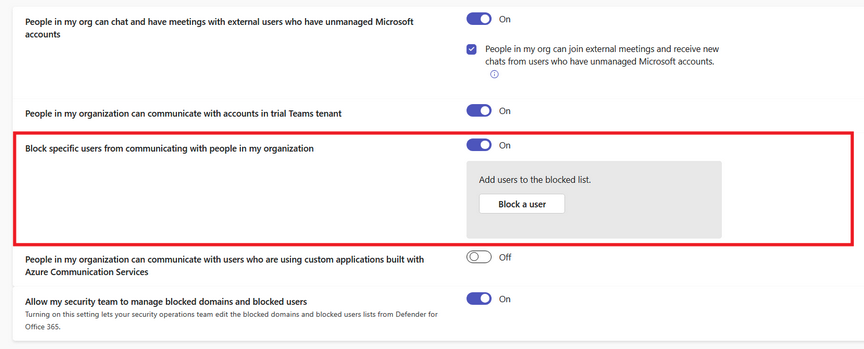
Before organizations can leverage this sophisticated new control mechanism, two specific settings within the Teams admin center must be activated. These settings, which are disabled by default, include "Block specific users from communicating with people in my organization" and "Allow my security team to manage blocked domains and blocked users." The requirement to explicitly enable these options underscores Microsoft’s commitment to administrative consent and controlled delegation of security responsibilities. Once these prerequisites are met, security administrators — those with appropriate Teams permissions — will gain the authority to directly add, remove, and review blocked external users and domains from within the intuitive interface of the Defender portal. This granular control facilitates precise threat mitigation, allowing organizations to respond rapidly to identified risks. The system is engineered to handle substantial volumes, supporting the blocking of up to 4,000 distinct domains and 200 individual email addresses, providing ample capacity for comprehensive external threat management.
This critical security capability will be accessible to all organizations subscribing to Microsoft Teams in conjunction with either a Microsoft Defender for Office 365 Plan 1 or Plan 2 subscription. The inclusion within these plans highlights Microsoft’s strategic vision to embed advanced threat protection deeply into its core productivity suite. Defender for Office 365 plans provide a robust set of features designed to protect against sophisticated attacks such as phishing, spam, malware, and business email compromise (BEC) across email, SharePoint, OneDrive, and now, Teams. By aligning this new functionality with existing Defender subscriptions, Microsoft ensures that organizations already invested in its advanced threat protection ecosystem can seamlessly extend that defense to their real-time communication channels.
The strategic rationale behind this feature is deeply rooted in the evolving landscape of cyber threats. Collaboration platforms, once primarily seen as productivity tools, have increasingly become prime targets for malicious actors. The rapid global adoption of Microsoft Teams, now serving over 320 million monthly active users, has unfortunately also attracted the attention of cybercrime syndicates and state-sponsored groups. These entities are continuously innovating their attack methodologies, moving beyond traditional email-based phishing to leverage the immediacy and perceived trustworthiness of real-time communication platforms. The ability to block external users directly addresses a significant attack vector: social engineering attacks. Cybercriminals, including sophisticated ransomware groups, have been documented impersonating IT support, legitimate business partners, or even internal staff to infiltrate networks, deliver malware, or harvest credentials through Teams.
This new centralized blocking mechanism directly counters such tactics. By enabling organizations to swiftly block known malicious actors or domains, it significantly reduces the attack surface presented by external communications. This proactive defense capability enhances security and compliance by empowering organizations with precise control over who can initiate contact with their employees. The "centralized approach" via the Defender portal offers several key advantages: it streamlines security operations by consolidating management, ensures consistent policy enforcement across the Microsoft 365 ecosystem, and reduces the administrative overhead associated with managing disparate security controls. For security teams, this means quicker identification and isolation of threats, leading to improved incident response times and a stronger overall security posture. It allows for a more agile defense, where intelligence gathered from one vector (e.g., email) can be immediately applied to another (e.g., Teams).
This specific feature is part of a broader, concerted effort by Microsoft to fortify the security of its Teams platform. The company has been steadily rolling out a suite of enhancements aimed at creating a multi-layered defense against evolving threats. In conjunction with the external user blocking capability, Teams is also set to introduce warnings for administrators regarding suspicious traffic originating from external domains. Furthermore, significant improvements to messaging security are being implemented by default in January, including enhanced malicious URL detection, protection against weaponizable file types, and a robust system for users to report false positives, ensuring that legitimate communications are not unduly hindered. These combined measures underscore a holistic strategy to protect Teams users from various forms of digital aggression, from sophisticated phishing attempts to malware delivery.
The implications of these security advancements are far-reaching. For organizations, it translates into a more secure and resilient communication environment, essential for maintaining business continuity and protecting sensitive data in an era of pervasive cyber threats. The ability to precisely control external interactions is not just about blocking malicious actors; it also enables organizations to enforce stricter communication policies, ensuring that interactions adhere to regulatory compliance standards and internal governance frameworks. This is particularly crucial for industries with stringent data protection and privacy regulations. The move reflects an industry-wide trend towards integrated security platforms, where threat intelligence and enforcement actions are coordinated across various services rather than existing in silos.
Looking ahead, this development signifies Microsoft’s ongoing commitment to evolving its security offerings in pace with the threat landscape. As hybrid work models become standard and reliance on collaboration tools intensifies, the attack surface will continue to expand. The continuous integration of advanced threat protection capabilities into platforms like Teams is not merely a feature update; it is a strategic imperative. Future iterations of such security frameworks are likely to leverage even more sophisticated artificial intelligence and machine learning algorithms to proactively identify anomalous communication patterns, detect novel social engineering techniques, and predict potential threats before they materialize. The ability to manage security through a unified portal, leveraging shared threat intelligence across an entire suite of productivity tools, is the cornerstone of effective enterprise cybersecurity in the modern digital age. This latest update for Microsoft Teams is a testament to that strategic vision, offering organizations a more robust shield against the persistent and ever-evolving dangers of the cyber realm.




 Aura Kasih
 Ayu Aulia