Ayu Aulia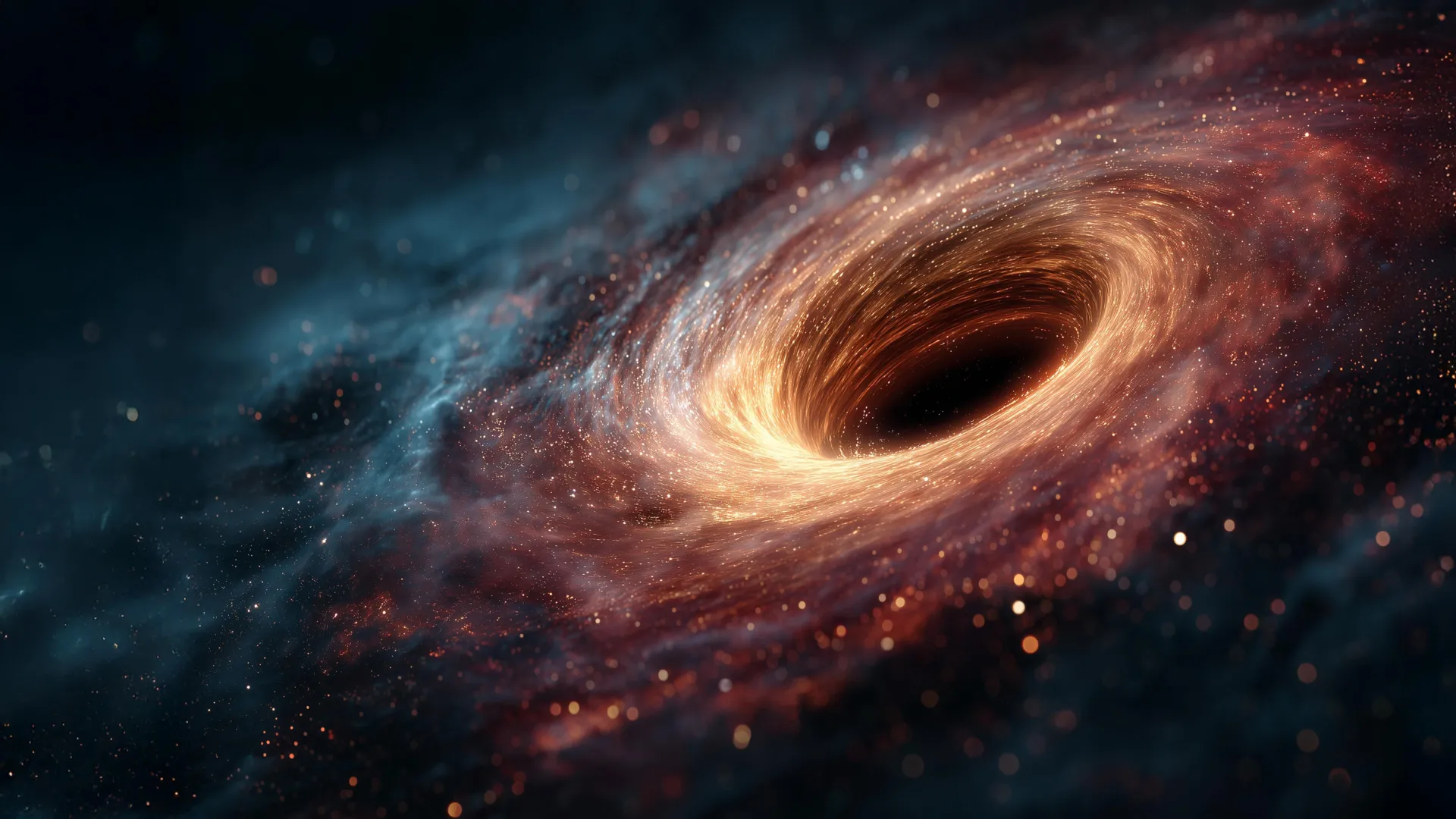
Recent astronomical investigations have yielded compelling evidence indicating that the physical characteristics and behavior of the material surrounding supermassive black holes have not remained constant throughout the universe’s expansive timeline. These findings suggest a significant evolutionary shift in the structure and dynamics of this energetic matter over billions of years, prompting a re-evaluation of established astrophysical models.
The Enigma of Quasars: Lighthouses of the Early Universe
Quasars, short for quasi-stellar radio sources, represent some of the most luminous and distant objects detectable in the cosmos. First identified in the 1960s due to their star-like appearance in optical telescopes coupled with powerful radio emissions, their immense brightness quickly became a subject of intense scientific scrutiny. These cosmic beacons are now understood to be the extraordinarily active galactic nuclei (AGN) of young galaxies, powered by gargantuan black holes residing at their cores. As these supermassive black holes (SMBHs) gravitationally ensnare vast quantities of gas, dust, and stars from their host galaxies, the infalling material does not plunge directly into the singularity. Instead, it coalesces into a rapidly rotating, disk-shaped structure known as an accretion disk.
The physics governing these accretion disks are complex and dynamic. As matter spirals inward, orbital friction and viscous forces within the disk convert gravitational potential energy into kinetic and then thermal energy. This process heats the plasma to unfathomable temperatures, reaching millions of degrees Kelvin. At such extreme temperatures, the matter emits prodigious amounts of radiation across the electromagnetic spectrum, particularly in the ultraviolet (UV) band. The sheer scale of this energy conversion is staggering; a typical quasar can outshine its entire host galaxy, comprising hundreds of billions of stars, by a factor of 100 to 1,000. This overwhelming luminosity is precisely what renders quasars visible across billions of light-years, making them invaluable probes for studying the universe’s distant past.
The Corona: A Region of Extreme X-ray Production
While the accretion disk primarily radiates in the UV, quasars are also powerful emitters of X-rays, an even more energetic form of radiation. Scientists have theorized that the intense UV light originating from the inner regions of the accretion disk plays a crucial role in generating these high-energy X-rays. This process occurs within a compact, intensely hot, and highly energized region known as the "corona," which is situated extremely close to the supermassive black hole, often enveloping the innermost parts of the accretion disk.
The corona is believed to consist of a cloud of relativistic electrons, meaning particles traveling at speeds close to the speed of light. When the lower-energy UV photons from the accretion disk interact with these high-energy electrons, they undergo a process called inverse Compton scattering. During this interaction, the photons gain substantial energy from the electrons, effectively transforming into much more energetic X-ray photons. These newly energized X-rays then escape the black hole environment, traveling across cosmic distances to be detected by space-based observatories equipped with X-ray telescopes. The exact geometry, temperature, and particle density of the corona remain areas of active research, as they are key to understanding the full spectral output of quasars.
A Foundational Relationship Under Scrutiny: The UV-X-ray Link
For nearly five decades, a fundamental relationship between the ultraviolet and X-ray emissions from quasars has been a cornerstone of astrophysical understanding. Since both types of radiation originate from regions in close proximity to the central supermassive black hole – the UV from the accretion disk and the X-rays from the corona via inverse Compton scattering – astronomers have observed a strong correlation: brighter UV output typically coincides with stronger X-ray emissions. This well-established empirical relationship has been instrumental in characterizing the physical conditions and energy conversion mechanisms operating in the extreme environment around supermassive black holes.
The long-standing assumption underpinning this correlation was its universality – the idea that the underlying physical structure and processes governing matter around black holes were essentially uniform across all quasars, regardless of their age or location in the universe. This implied a consistent interplay between the accretion disk and its corona, providing a stable diagnostic tool for black hole studies. However, a recent international study, spearheaded by researchers at the National Observatory of Athens and published in Monthly Notices of the Royal Astronomical Society, directly challenges this foundational premise.
The research reveals that the relationship between UV and X-ray luminosity in quasars from the early universe (approximately half its current age) deviates significantly from what is observed in their modern-day counterparts. This disparity points towards a non-universal X-ray-to-ultraviolet relation, indicating that the manner in which accretion disks and coronas interact and radiate has indeed evolved over roughly the last 6.5 billion years. Dr. Antonis Georgakakis, a co-author of the study, remarked on the surprising nature of this finding, emphasizing its profound implications for our understanding of black hole growth and radiative processes. He noted the persistence of the result even after employing various testing methodologies, underscoring its robustness.
Methodological Advancements and Observational Prowess
The groundbreaking conclusions of this study were made possible through the innovative combination of fresh observational data from the eROSITA X-ray telescope and archival information from the European Space Agency’s venerable XMM-Newton X-ray observatory. eROSITA, with its expansive and consistent sky coverage, offered an unprecedented opportunity to survey vast populations of quasars across broad cosmic distances. While eROSITA’s individual observations are relatively "shallow," meaning fewer X-ray photons are detected from each quasar, its sheer statistical power derived from the enormous sample size proved critical.
To extract meaningful insights from such diverse datasets, especially those with sparse photon counts, the research team employed a sophisticated Bayesian statistical framework. As explained by postdoctoral researcher Maria Chira of the National Observatory of Athens, who led the study, this methodological advance was key. Bayesian statistics are particularly adept at handling uncertainties and inferring subtle trends within large, complex datasets, enabling the researchers to uncover patterns that would otherwise have remained hidden through conventional analysis. This rigorous approach allowed for a robust assessment of the UV-X-ray relationship across different cosmic epochs, lending strong credence to their findings.
Profound Implications for Astrophysics and Cosmology
The potential non-universality of the UV-X-ray relationship carries far-reaching consequences for several domains within astrophysics and cosmology. Firstly, it directly impacts the use of quasars as "standard candles" – objects with known intrinsic luminosities that can be used to measure cosmic distances. In cosmology, standard candles, such as Type Ia supernovae, are vital tools for mapping the universe’s expansion, probing the nature of dark energy, and constraining cosmological parameters. The assumption of an unchanging black hole environment over cosmic time was a prerequisite for considering quasars as reliable standard candles for these grand cosmic surveys. The new results necessitate caution, suggesting that any cosmological inferences relying on this constancy may need re-evaluation and recalibration.
Beyond cosmology, these findings reshape our understanding of supermassive black hole evolution and their co-evolution with galaxies. If the accretion process itself, specifically the interaction between the disk and corona, has undergone significant changes, it implies that the mechanisms dictating black hole growth rates, energy output, and feedback into their host galaxies have not been static. For instance, the efficiency of converting infalling matter into radiation, or the spectral distribution of that radiation, might have differed substantially in the early universe compared to today. This could have implications for galaxy formation models, which often incorporate feedback from active galactic nuclei as a crucial element regulating star formation and galactic growth. Understanding how the disk-corona relationship changed – perhaps due to differences in accretion rates, gas availability, metallicity, or magnetic field strengths in the younger universe – will be a vital next step.
The Road Ahead: Future Research and Observational Frontiers
The current study represents a pivotal discovery, but it also opens numerous avenues for future research. Upcoming all-sky surveys by eROSITA promise to detect an even greater number of fainter and more distant quasars, further expanding the dataset. Combining these future observations with data from next-generation X-ray observatories, such as the European Space Agency’s Athena mission, and complementary multiwavelength surveys across optical, infrared, and radio bands, will be crucial.
These concerted efforts aim to address several key questions. Researchers will seek to determine whether the observed changes are indeed reflective of genuine physical evolution within black hole environments or if they might be influenced by subtle selection effects or biases inherent in current data collection methods. Refining the statistical models and incorporating more detailed physical parameters will be essential for disentangling these possibilities. Ultimately, by delving deeper into the evolving nature of supermassive black hole accretion and radiation, astronomers aspire to gain a more complete and nuanced understanding of how these cosmic titans power the most luminous objects in the universe and how their profound influence has sculpted the cosmos across billions of years. The universe, it seems, is far from static, and even the most fundamental relationships within its most extreme environments are subject to a grand cosmic evolution.




 Aura Kasih
 Safa Marwah