Lisa Mariana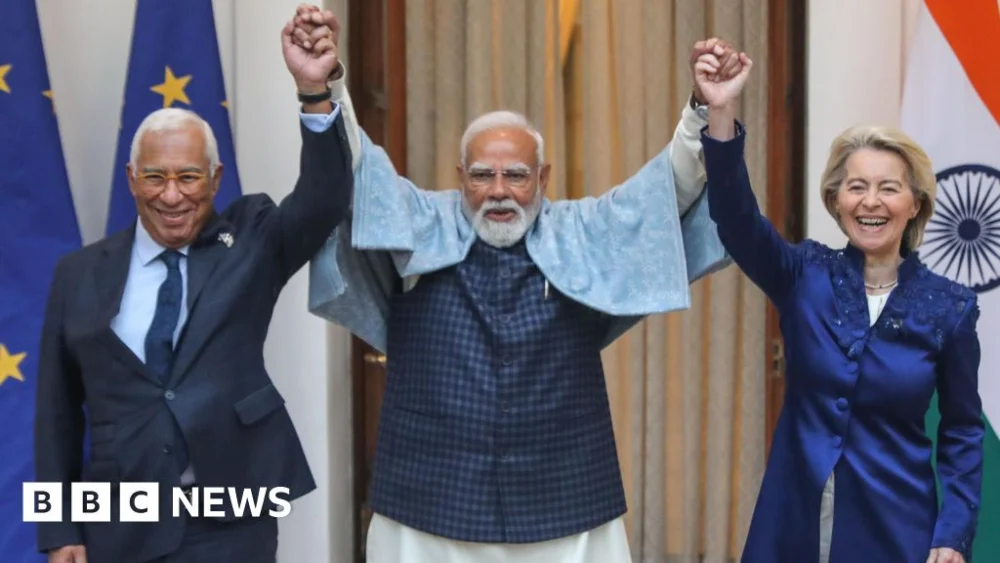
A monumental free trade agreement has been formally announced between the European Union and India, culminating nearly two decades of complex, intermittent negotiations and signaling a profound realignment of global economic and geopolitical strategies for both powerful blocs. This landmark accord, hailed by leadership on both sides as a historic achievement, underscores a mutual ambition to deepen economic integration and forge resilient partnerships in an increasingly volatile international landscape, notably against a backdrop of escalating trade tensions emanating from the United States.
The European Commission President, Ursula von der Leyen, encapsulated the significance of the moment with a statement describing the pact as "the mother of all deals," emphasizing the scale and potential impact of this collaboration. Her remarks were made following high-level discussions in New Delhi, where she, alongside European Council President Antónió Costa, engaged with Indian Prime Minister Narendra Modi at a pivotal bilateral summit. Their visit to the Indian capital also included their participation as chief guests at India’s vibrant Republic Day celebrations, a symbolic gesture highlighting the deepening diplomatic rapport between the entities.
This strategic pivot by both India and the EU towards strengthening their respective global economic and trade ties is not merely opportunistic but stems from a calculated response to evolving geopolitical pressures, particularly those exerted by the United States. For New Delhi, the impetus to diversify its trade relationships has been intensified by persistent economic friction with Washington, notably the imposition of 50% tariffs by the previous U.S. administration, which continue to complicate ongoing bilateral trade negotiations between India and the U.S. The EU, concurrently, has also experienced a period of strained relations with Washington, characterized by threats of punitive tariffs and disputes over strategic interests, exemplified by recent rhetoric concerning European allies’ stances on U.S. economic initiatives.
The broader geopolitical context profoundly shaped the tenor of recent statements from leaders. President von der Leyen articulated the immense potential of the newly formed economic zone, encompassing two billion people, asserting that "We have created a free trade zone of two billion people, with both sides set to benefit. This is only the beginning. We will grow our strategic relationship to be even stronger." Preceding her remarks, President Costa, without directly naming the United States, delivered a pointed message underscoring the agreement’s broader political resonance. He declared that the deal would transmit "an important political message to the world that India and the EU believe more in trade agreements than in tariffs" during a period marked by rising protectionism and decisions by "some countries… to increase tariffs." These statements collectively underscore a shared philosophical commitment to multilateralism and open trade, contrasting sharply with the protectionist tendencies observed elsewhere.
Further specifics regarding the intricate details of the agreement are anticipated to be unveiled during an imminent media briefing. However, the foundational elements of the pact are understood to encompass expanded market access for Indian exports across European markets, while simultaneously facilitating the entry of European investments and goods, such as automotive products and beverages, into India’s rapidly expanding economy, which ranks as Asia’s third-largest. Prime Minister Modi, speaking at the India Energy Week conference, underscored the global significance of this partnership, stating, "This is a perfect example of a partnership between two major economies of the world… This agreement represents 25% of the global GDP and one-third of global trade." This quantitative assessment highlights the sheer economic magnitude of the combined market and the potential for transformative impact on international commerce.
The EU stands as India’s preeminent trading partner in goods, with bilateral merchandise trade volumes having surged to an estimated $136 billion (£99.4 billion) in the 2024-25 fiscal year, nearly doubling over the past decade. This robust existing trade relationship provides a strong foundation upon which the new FTA aims to build, fostering even greater economic integration and mutual prosperity.
The journey towards this agreement has been protracted and fraught with challenges. Initial negotiations commenced in 2007 but encountered significant impasses in 2013, primarily due to divergent positions on market access and regulatory compliance. Key sticking points included India’s historically high tariffs on imported automobiles, access for European agricultural products, and the complexities surrounding the EU’s proposed carbon border adjustment mechanisms (CBAM). These thorny issues required intensive diplomatic engagement and technical discussions, which were formally revitalized in July 2022. Officials from both sides engaged in rigorous, often round-the-clock, negotiations in the days leading up to the EU leaders’ visit, demonstrating a determined resolve to finalize outstanding chapters of the agreement.
The successful conclusion of this agreement arrives at a time of heightened global pressure on both Delhi and Brussels to secure and diversify alternative markets for their respective export-oriented industries. The imperative for resilient supply chains, reduced dependency on single markets, and strategic autonomy has gained significant traction following recent geopolitical disruptions and the COVID-19 pandemic. India, in particular, has demonstrated a proactive approach to trade liberalization, having inked significant trade agreements with the United Kingdom, Oman, and New Zealand within the past seven months. Furthermore, a comprehensive pact signed in 2024 with the four-nation European Free Trade Association (EFTA) bloc—comprising Switzerland, Norway, Iceland, and Liechtenstein—has recently come into effect. Concurrently, the EU has also been active on the global trade front, successfully concluding a trade deal with the South American Mercosur bloc earlier this month, after an arduous negotiation period spanning a quarter-century. These parallel developments underscore a broader strategic realignment by both India and the EU, emphasizing a commitment to multilateral trade frameworks and the expansion of their global economic footprints.
While the formal signing of the agreement is slated for later in the year, pending ratification by the European Parliament and the European Council, its announcement marks a definitive turning point. Analysts will meticulously scrutinize the forthcoming detailed text to ascertain the specific compromises and concessions made regarding the previously contentious issues of automotive tariffs, agricultural market access, and the framework for addressing carbon-linked trade measures. The resolution of these complex areas will be crucial in determining the practical implications and the ultimate economic benefits for various sectors within both economies.
Background Context: A Shifting Global Economic Order
The impetus behind this comprehensive FTA extends beyond immediate trade concerns, reflecting a broader strategic calculus in a world increasingly characterized by economic nationalism, geopolitical competition, and the fragmentation of global supply chains. For India, the agreement represents a critical step in its ambition to become a global manufacturing hub and a significant player in international trade, moving beyond its traditional focus on services. Diversifying its export markets and attracting high-tech investment are central to its economic growth agenda. The EU, conversely, seeks to strengthen its position in the Indo-Pacific, a region deemed vital for future economic growth and geopolitical stability. By deepening ties with India, the EU aims to bolster its strategic autonomy, reduce over-reliance on a limited number of trade partners, and reinforce its commitment to a rules-based international order. This partnership is also seen as a counterbalance to the growing economic influence of China and a hedge against potential disruptions from other major economies. The challenges posed by the weaponization of trade, intellectual property disputes, and the increasing use of non-tariff barriers have underscored the need for robust and reliable trade partnerships, making this FTA particularly timely.
Expert-Style Analysis: Beyond Tariffs and Trade Flows
The "mother of all deals" appellation carries significant symbolic weight, positioning the FTA not merely as a commercial arrangement but as a strategic alliance. From an analytical perspective, the agreement signals a shared rejection of protectionist tendencies observed in some major global economies. It implicitly endorses a belief in the long-term benefits of interconnectedness and cooperation over isolationism. The sheer market size—two billion people—represents a formidable economic bloc that can exert considerable influence on global standards, regulations, and supply chain configurations.
A key analytical focus will be on the provisions related to non-tariff barriers (NTBs), regulatory harmonization, and digital trade. Given the complexity of modern supply chains, reducing administrative burdens, streamlining customs procedures, and ensuring mutual recognition of standards can often yield greater economic benefits than mere tariff reductions. Furthermore, the inclusion of robust provisions on intellectual property rights, sustainable development, labor standards, and environmental protection would align the agreement with contemporary global trade norms and reflect a commitment to responsible economic growth. The successful negotiation of these elements, particularly those concerning climate-related trade measures like CBAM, suggests a pragmatic approach to bridging differing regulatory philosophies. India’s engagement on these fronts indicates a willingness to adapt its economic framework to global best practices, a crucial step for deeper integration with advanced economies.
Implications: Economic Transformation and Geopolitical Rebalancing
The immediate economic implications are multifaceted. For India, the FTA is expected to significantly boost its manufacturing sector, particularly in textiles, pharmaceuticals, and engineering goods, by providing preferential access to the vast European market. It will also likely stimulate foreign direct investment from the EU into critical sectors, facilitating technology transfer and job creation. Conversely, European industries, including automotive, machinery, chemicals, and high-end consumer goods, will gain enhanced access to India’s burgeoning consumer market, characterized by a rapidly growing middle class and increasing purchasing power. The reduction of tariffs on European luxury cars and beverages, traditionally subject to high duties in India, could unlock substantial growth opportunities for these sectors.
Beyond specific sectors, the deal is poised to enhance supply chain resilience for both partners. By diversifying sourcing and manufacturing bases, both India and the EU can mitigate risks associated with over-reliance on single geographical regions. This is particularly pertinent in light of recent global disruptions that exposed vulnerabilities in concentrated supply chains.
From a geopolitical standpoint, the agreement strengthens the strategic autonomy of both India and the EU. For India, it solidifies its position as a vital partner in the Indo-Pacific strategy of many nations, offering an alternative to existing power dynamics. For the EU, it enhances its global diplomatic leverage and reinforces its role as a proponent of multilateralism and rules-based trade, particularly at a juncture when these principles are under duress. This partnership could also serve as a blueprint for future trade agreements between the EU and other developing economies, showcasing a model of comprehensive economic engagement that balances market access with sustainable development goals.
Future Outlook: Beyond Trade, Towards Comprehensive Partnership
The announcement of this FTA is not an endpoint but rather a significant milestone in a burgeoning strategic partnership. The momentum generated by this agreement is likely to pave the way for deeper cooperation across a spectrum of areas beyond traditional trade. Potential avenues include enhanced collaboration on climate change mitigation and adaptation, joint initiatives in renewable energy technologies, greater alignment on digital governance and cybersecurity, and increased academic and cultural exchanges.
The successful implementation of the FTA will require sustained political will and effective institutional mechanisms to address potential disputes and ensure smooth market integration. The formal ratification process, involving the European Parliament and Council, will be a crucial next step, providing further scrutiny and democratic legitimacy to the accord. As the world navigates a complex period of economic rebalancing and geopolitical shifts, the India-EU FTA stands as a powerful testament to the enduring value of international cooperation and the pursuit of mutual prosperity through open, rules-based trade. It heralds a new chapter in global economic relations, positioning India and the EU as pillars of a more diversified and resilient global trade architecture.




 Aura Kasih
 Safa Marwah
 Ayu Aulia