Lisa Mariana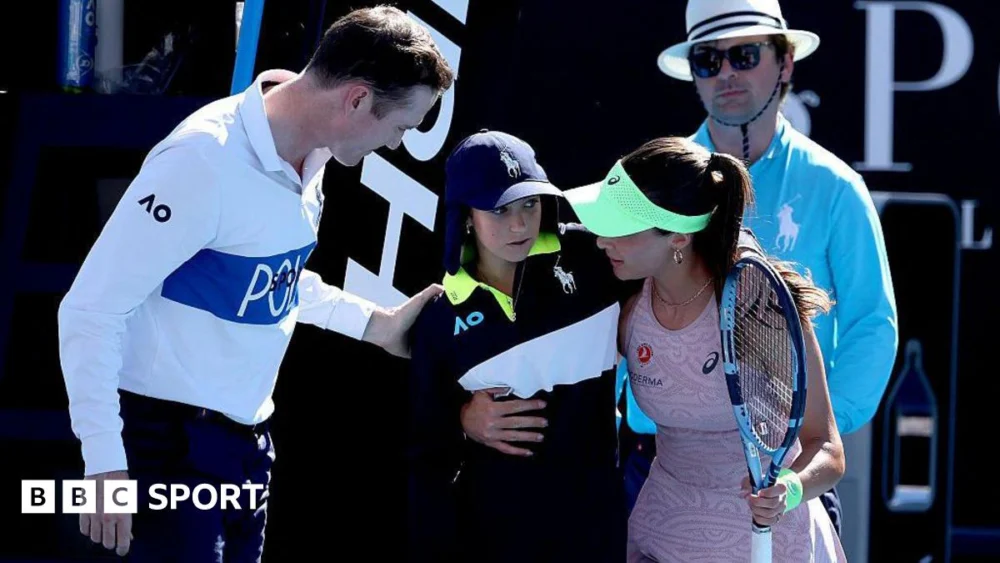
In a moment transcending the intense competition of Grand Slam tennis, Turkish qualifier Zeynep Sonmez demonstrated remarkable sportsmanship at the 2026 Australian Open, pausing her pivotal first-round encounter against Russia’s Ekaterina Alexandrova to aid a ball girl who collapsed on court, an incident that starkly underscored the persistent physiological demands of Melbourne’s formidable summer climate on all tournament participants. The compelling scene unfolded during a critical juncture of the match, adding an unexpected layer of human drama to Sonmez’s eventual upset victory, a significant milestone in her burgeoning career.
The dramatic episode occurred on one of Melbourne Park’s outer courts, where the atmosphere was thick with the anticipation of the year’s inaugural major. The day, a Sunday, saw temperatures reach a notable 28 degrees Celsius, creating conditions that, while not extreme by Australian Open standards, were certainly demanding. As Ekaterina Alexandrova, the tournament’s eleventh seed and a formidable presence on the women’s tour, was serving to clinch the second set and restore parity in the match, a young ball girl positioned near the umpire’s elevated chair suddenly lost consciousness. She fell abruptly to the court surface, a sudden and alarming event that immediately drew gasps from the spectators and concern from the players.
In the immediate aftermath of the collapse, while officials and medical personnel began to mobilize, it was Zeynep Sonmez who exhibited exceptional presence of mind and compassion. Without hesitation, the 23-year-old Turk sprinted across the court to the aid of the fallen girl. Disregarding the ongoing match and the high stakes involved, Sonmez knelt beside her, offering comfort and support. She then gently assisted the ball girl, helping her to her feet and guiding her towards the shaded periphery of the court, where medical staff were quickly on hand to provide immediate attention. This spontaneous act of kindness momentarily eclipsed the competitive ferocity of the Grand Slam, spotlighting a profound human connection amidst the athletic spectacle. The ball girl, having regained composure, was eventually escorted off the court by medical professionals, leading to a six-minute suspension of play as the incident was managed and the court made ready for resumption.
Upon the recommencement of play, Alexandrova, perhaps unsettled by the preceding events, managed to secure the second set, leveling the match at one set all. However, the unexpected interlude and the display of resilience from Sonmez appeared to galvanize the Turkish qualifier. Despite falling behind 3-0 in the deciding set, Sonmez exhibited remarkable mental fortitude and strategic acumen. She meticulously clawed her way back, demonstrating a steely resolve that belied her world ranking of 112. Her relentless pursuit culminated in a hard-fought 7-5, 4-6, 6-4 victory, secured on her fourth match point. This triumph represented not only the biggest win of her career but also marked her maiden entry into the second round of a Grand Slam event, a significant personal achievement at Melbourne Park. The win was a testament to her athletic prowess and an even stronger indicator of her composed temperament under pressure, both on and off the court.
The incident involving the ball girl brings into sharp focus the perennial challenge of managing extreme heat at the Australian Open, a tournament renowned for its gruelling summer conditions. Melbourne’s January weather can be notoriously unpredictable, oscillating between temperate days and scorching heatwaves. The forecast for the week indicated a significant escalation in temperatures, with predictions of mercury soaring to 35 degrees Celsius by the following Saturday, January 24th. Such conditions are not merely uncomfortable; they pose substantial physiological risks to athletes, officials, and support staff alike. The unique combination of high ambient temperatures, often exacerbated by radiant heat from the court surfaces, and varying humidity levels, creates a potent environment for heat stress.
Recognizing these inherent dangers, Tennis Australia, the organizing body of the Australian Open, undertook significant revisions to its Extreme Heat Policy (EHP) in 2019. This overhaul was not arbitrary but stemmed from extensive scientific research into the effects of heat stress on professional tennis players. The studies aimed to identify precise physiological thresholds and develop a more objective and comprehensive framework for evaluating heat risk. This research culminated in the development and implementation of the Heat Stress Scale (HSS), a sophisticated tool designed to inform decisions regarding player welfare and, by extension, the safety of all individuals present on court.
The HSS is a dynamic, five-point scale that takes into account four key climatic factors: air temperature, radiant heat (measured by a wet bulb globe temperature, or WBGT), humidity, and wind speed. Unlike simpler measures that rely solely on ambient temperature, the HSS provides a holistic assessment of the overall thermal load on the human body. Different thresholds on the HSS trigger specific protocols, ranging from extended breaks between sets, modifications to warm-up routines, and in the most severe cases, the suspension of play until conditions improve. This proactive approach aims to mitigate the risks of heat exhaustion, dehydration, and heatstroke, which can severely impact performance and potentially lead to serious health complications for athletes performing at peak physical exertion.
However, the welfare considerations extend far beyond the elite players. The incident with the ball girl serves as a poignant reminder that support staff, particularly the young and often less acclimatized ball kids, are equally, if not more, vulnerable to the effects of heat stress. These individuals spend hours on court, often in direct sunlight, performing physically demanding tasks such as retrieving balls and supplying towels, all while maintaining strict focus and adherence to protocol. Their age and physiological differences compared to professional athletes mean their bodies may react differently to sustained heat exposure. Tournament organizers typically implement measures such as frequent hydration breaks, shaded rest areas, regular rotations, and constant medical supervision for ball kids. Yet, as the recent incident painfully illustrates, even with such precautions, the inherent risks persist. This event may prompt further review of protocols specifically designed for the well-being of these essential, yet often overlooked, contributors to the tournament’s smooth operation.
Sonmez’s actions transcend mere adherence to rules; they exemplify the highest ideals of sportsmanship and human empathy. In an era where professional sport is often characterized by intense rivalries and hyper-competitiveness, moments of genuine compassion resonate deeply with audiences and participants alike. Her immediate response, prioritizing the well-being of a vulnerable individual over her own competitive advantage in a Grand Slam match, sends a powerful message about the values that underpin athletic excellence. Such displays elevate the sport beyond a mere contest of skill and endurance, showcasing the character and moral compass of its practitioners. It fosters a narrative where humanity and sportsmanship are celebrated alongside athletic achievement, enriching the public perception of both the athlete and the sport itself.
From a strategic perspective, the impact of heat on player performance is multifaceted. Extreme temperatures can lead to rapid dehydration, electrolyte imbalance, and a significant drop in physical and mental stamina. Players must meticulously manage their hydration, nutrition, and recovery protocols. The psychological toll is also considerable, as athletes grapple with the discomfort and the constant awareness of their bodies pushing against environmental limits. The delay caused by the ball girl’s collapse, while necessary, could have disrupted Sonmez’s focus and rhythm, especially as Alexandrova was on the cusp of leveling the match. Sonmez’s ability to re-center herself and ultimately triumph underscores a formidable mental resilience that will undoubtedly serve her well in future high-pressure encounters.
Looking ahead, the incident at the 2026 Australian Open may not only bolster Zeynep Sonmez’s public image but could also stimulate broader discussions within the professional tennis community regarding the welfare of all personnel involved in major tournaments. While the Australian Open has been at the forefront of developing sophisticated heat management policies, such events serve as stark reminders of the dynamic challenges posed by climate change and the need for continuous adaptation. Ensuring the absolute safety and well-being of every participant, from the top-ranked player to the youngest ball kid, remains a paramount responsibility for event organizers globally. As the tournament progresses and temperatures potentially rise, the effectiveness of these policies will be under renewed scrutiny, highlighting the ongoing commitment required to balance elite competition with unwavering humanistic principles.
In conclusion, Zeynep Sonmez’s remarkable first-round victory at the 2026 Australian Open against a seeded opponent was significant not only for her career but also for the profound act of compassion she displayed. Her swift, empathetic response to the ball girl’s collapse transcended the competitive arena, embedding a powerful narrative of sportsmanship into the fabric of the tournament. This incident, set against the backdrop of Melbourne’s challenging summer climate, serves as a vivid reminder of the physical demands placed on all individuals at a Grand Slam and underscores the critical importance of robust welfare policies. As Sonmez advances to the second round, her journey is now defined not just by her athletic prowess, but by an indelible moment of human kindness that resonated globally.




 Aura Kasih
 Safa Marwah
 Ayu Aulia