Ayu Aulia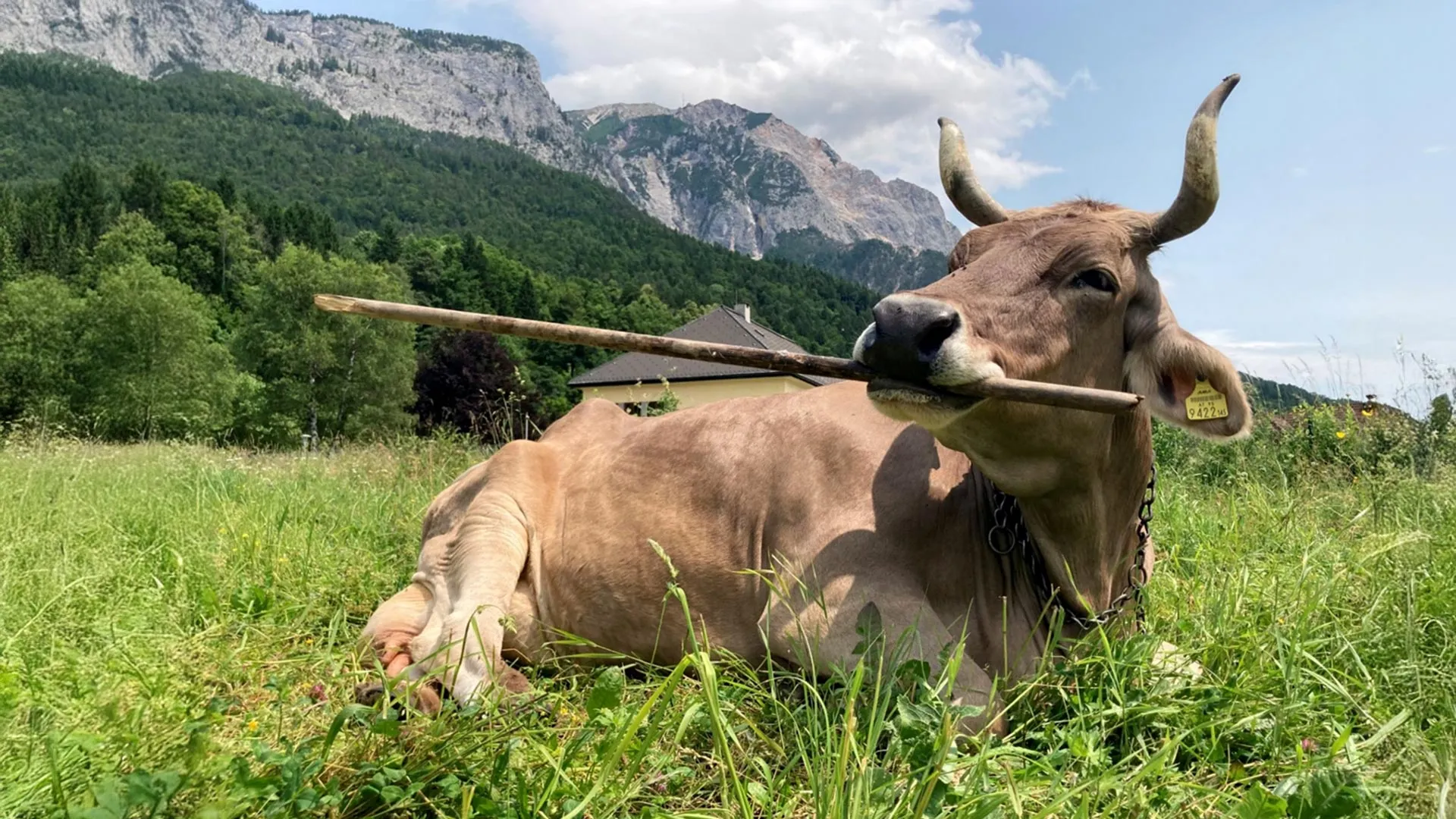
For decades, the popular imagination, often reinforced by cultural touchstones like Gary Larson’s iconic Far Side comic depicting "Cow Tools," has largely relegated cattle to a position of limited cognitive capacity, particularly concerning complex behaviors such as tool manipulation. This prevailing view posited that the bovine intellect was insufficient for the abstract thought and motor planning required to select, adapt, and deploy external objects to achieve specific goals. However, this entrenched assumption is now undergoing a radical re-evaluation, driven by a groundbreaking scientific discovery concerning a single cow named Veronika, whose demonstrable and sophisticated use of tools challenges long-held beliefs about livestock intelligence and broadens the known spectrum of animal cognitive abilities.
The recent findings, detailed in the esteemed journal Current Biology, present the first formally documented instance of tool utilization in a domestic cow, suggesting that these animals may possess a cognitive repertoire far more expansive and nuanced than previously acknowledged. This research not only provides empirical evidence that directly contradicts the "dumb cow" stereotype but also underscores a critical oversight in human observation, hinting that our understanding of various species’ intelligence might be more reflective of our limited investigative approaches than their actual cognitive boundaries. As articulated by Alice Auersperg, a distinguished cognitive biologist affiliated with the University of Veterinary Medicine, Vienna, "The findings highlight how assumptions about livestock intelligence may reflect gaps in observation rather than genuine cognitive limits." This statement encapsulates the profound implications of Veronika’s actions, which compel the scientific community to reconsider the methodologies and biases that have historically shaped our perception of animal minds.
A Paradigm Shift in Understanding Livestock Cognition
Historically, the study of animal intelligence has been heavily influenced by anthropocentric biases, often prioritizing species that exhibit behaviors analogous to human capabilities, such as advanced problem-solving, language acquisition, or dexterous tool use. Primates, cetaceans, and certain bird species (like corvids and parrots) have long been at the forefront of this research due to their observable complex behaviors. Livestock, conversely, have typically been studied through the lens of production efficiency, health, and welfare within agricultural contexts, with less emphasis placed on their intrinsic cognitive capacities beyond basic learning and social interactions relevant to husbandry. This focus has inadvertently fostered a scientific blind spot, neglecting the potential for sophisticated intelligence in animals whose lives are primarily dictated by human economic interests.
The very definition of tool use—the employment of an external object to modify the environment or achieve a goal through physical interaction—has traditionally been a stringent benchmark for advanced cognition. Its clear documentation has been rare outside of a select few animal groups, primarily non-human primates. The current research, therefore, represents a significant taxonomic expansion, inviting a comprehensive re-evaluation of how tool use is identified and understood across the animal kingdom. It suggests that complex cognitive abilities may not be confined to specific evolutionary branches but could emerge in diverse species under particular environmental and social conditions.
Veronika: The Unexpected Architect of Discovery
At the heart of this transformative research is Veronika, a Swiss Brown cow whose life trajectory deviates significantly from that of most cattle. Unlike her counterparts destined for food production, Veronika lives as a cherished companion animal on the organic farm and bakery owned by Witgar Wiegele. This unique existence, characterized by a long lifespan and regular, intimate human interaction, appears to have fostered an environment conducive to the emergence of her remarkable capabilities.
It was over a decade ago that Wiegele first observed an unusual and persistent behavior in Veronika: she would deliberately pick up sticks and other objects to scratch inaccessible areas of her body. Initially, such observations might be dismissed as anecdotal or coincidental. However, Wiegele’s continued documentation, culminating in video recordings of Veronika’s stick-use, eventually attracted the attention of the wider scientific community. When these recordings reached cognitive biologists like Auersperg, the accidental nature of the behavior was immediately dismissed. Auersperg recognized the profound significance, stating, "When I saw the footage, it was immediately clear that this was not accidental. This was a meaningful example of tool use in a species that is rarely considered from a cognitive perspective." This initial expert validation paved the way for more structured and rigorous investigation.
Scientific Scrutiny and Experimental Confirmation
To transition from anecdotal observation to robust scientific evidence, researchers embarked on a series of controlled experiments designed to systematically assess Veronika’s behavior. The chosen "tool" for these tests was a common deck brush, strategically placed in various orientations and locations within her enclosure. The research team meticulously observed and recorded Veronika’s interactions with the brush, looking for patterns that would indicate intentionality and adaptability rather than mere reflexive actions.
Across numerous trials, Veronika exhibited a striking consistency in her approach. She did not merely rub against the brush indiscriminately; instead, she consistently selected specific parts of the brush, precisely matching them to the particular area of her body she intended to scratch. This selection was far from random; it demonstrated a clear understanding of the tool’s properties and how different sections could serve different purposes for distinct bodily needs. This level of discernment is a hallmark of sophisticated tool use. Antonio Osuna-Mascaró, another key researcher involved in the study, emphasized this flexibility: "We show that a cow can engage in genuinely flexible tool use. Veronika is not just using an object to scratch herself. She uses different parts of the same tool for different purposes, and she applies different techniques depending on the function of the tool and the body region." This statement underscores the advanced nature of her cognitive processing, moving beyond simple object manipulation to a more complex, adaptable application.
The Nuances of Flexible and Multi-Purpose Tool Manipulation
The detailed analysis of Veronika’s interactions with the deck brush revealed a highly sophisticated and flexible approach to tool use, a characteristic previously documented in only a handful of non-human species, predominantly chimpanzees. Her behavior exhibited a remarkable capacity for differentiation and adaptation, signifying a deeper cognitive understanding of cause and effect and the physical properties of objects.
For larger, more robust areas of her body, such as her back, Veronika consistently opted for the bristled side of the brush, applying firm, broad motions to achieve effective scratching. This choice indicates an understanding of the bristles’ abrasive texture and their suitability for dense fur and muscle. Conversely, when addressing more sensitive regions on her lower body or flanks, she would deliberately switch to the smoother, less abrasive handle of the brush. This adaptation suggests an awareness of her own body’s sensitivity and the need for a gentler application in those areas.
Furthermore, Veronika demonstrated an impressive ability to adjust her motor control and movement patterns according to the target body region and the desired outcome. Scratching her upper body involved broader, more forceful motions, indicative of a strong, sweeping action. In contrast, movements directed at lower or more delicate areas were noticeably slower and more precise, suggesting fine motor control and careful application. This level of adaptability in both tool selection and manipulation technique unequivocally meets and surpasses the standard definition of tool use. Her actions qualify as "flexible, multi-purpose tool use," a cognitive feat where an individual utilizes different features of the same object to achieve distinct outcomes, adapting both the tool part and the technique as needed. This capacity is considered a high-level cognitive skill, highlighting the remarkable depth of her problem-solving abilities.
Overcoming Anatomical Constraints: Oral Dexterity
Veronika’s tool use is directed primarily at her own body, a category known as egocentric tool use. While this form is sometimes considered less complex than using tools to manipulate external objects in the environment, it still presents significant cognitive and physical challenges, especially for a quadrupedal animal lacking manipulative forelimbs. The most formidable of these challenges for a cow is the necessity of manipulating tools exclusively with her mouth.
Despite this inherent morphological limitation, Veronika displayed an astonishing degree of control and apparent anticipation of the effects of her actions. She did not merely clamp down on the brush; rather, she adjusted her grip and the angle of her head and neck with remarkable precision, indicative of careful motor planning. This oral dexterity suggests not only a sophisticated understanding of the tool’s mechanics but also a refined proprioception – an awareness of her own body’s position and movement – and a cognitive map of her own anatomy. The ability to manipulate an object with such precision using only the mouth, anticipating its effect on different parts of her body, speaks volumes about her cognitive foresight and problem-solving capabilities.
Environmental Enrichment: A Catalyst for Cognitive Development
The researchers hypothesize that Veronika’s extraordinary behavior is not merely an isolated genetic anomaly but likely a product of her unique living conditions. Unlike the vast majority of cattle, who experience short lifespans within highly controlled, often monotonous agricultural environments, Veronika has enjoyed a long life (over a decade at the time of observation) in a complex and stimulating setting. Her status as a companion animal means she has daily, varied interactions with humans and unrestricted access to a diverse array of objects within her environment that she can explore and manipulate.
These critical factors—longevity, environmental complexity, social interaction, and access to novel stimuli—likely created a fertile ground for cognitive development, exploration, and innovation that is largely absent in typical livestock rearing. In such an enriched environment, Veronika had both the opportunity and the time to experiment, learn, and refine her tool-using techniques. This perspective suggests that the absence of similar behaviors in other cattle might not indicate a lack of inherent cognitive potential, but rather a lack of opportunity for that potential to manifest. As the researchers eloquently noted, "[Veronika] did not fashion tools like the cow in Gary Larson’s cartoon, but she selected, adjusted, and used one with notable dexterity and flexibility. Perhaps the real absurdity lies not in imagining a tool-using cow, but in assuming such a thing could never exist." This statement serves as a powerful reminder that our scientific understanding is often constrained by our own preconceived notions and observational limitations.
Broader Implications for Animal Cognition and Welfare
This seminal discovery represents far more than just the first confirmed case of tool use in cattle; it fundamentally expands the scientific understanding of animal cognition and the taxonomic range of species capable of demonstrating such complex abilities. It compels the scientific community to critically reassess the cognitive potential of numerous species, particularly those traditionally viewed through a utilitarian lens.
The findings raise a profound question: how many other instances of sophisticated animal behavior, across a multitude of species, have gone unnoticed or misinterpreted due to human biases, insufficient observation, or inadequate environmental conditions for their expression? If a cow, an animal often stereotyped as unintelligent, can exhibit such flexible and adaptive tool use, it suggests that the cognitive landscape of the animal kingdom may be far richer and more complex than currently mapped.
This research also carries significant ethical implications, particularly concerning animal welfare. If cattle possess such advanced cognitive capabilities, including problem-solving and adaptable tool use, it necessitates a deeper consideration of their subjective experiences, their capacity for boredom, frustration, and well-being. The traditional agricultural models, which often prioritize efficiency over cognitive enrichment, may need to be re-evaluated in light of this new understanding, advocating for environments that support natural behaviors and cognitive stimulation.
Future Directions and a Call for Collaborative Observation
Looking ahead, the research team is committed to exploring the specific environmental and social conditions that foster the development of such complex behaviors. This future research will be crucial in understanding whether Veronika is an exceptional outlier or if her environment simply unlocked a latent potential present in many cattle. Such investigations could inform new approaches to animal husbandry that prioritize cognitive enrichment.
Furthermore, the researchers have issued a broader appeal, encouraging farmers, veterinarians, and the public to report any similar observations of cattle or other livestock using sticks or other objects for purposeful actions. This call for citizen science highlights the potential for a collaborative approach to uncover more instances of complex animal behavior that might otherwise remain unseen within traditional scientific frameworks.
In conclusion, Veronika’s remarkable ability to flexibly and purposefully use tools represents a pivotal moment in the study of animal cognition. It serves as a potent reminder that intelligence manifests in myriad forms across the natural world, often challenging our anthropocentric expectations. As we continue to unravel the mysteries of animal minds, discoveries like Veronika’s underscore the critical importance of open-minded observation, rigorous scientific inquiry, and a willingness to dismantle long-held assumptions, ultimately fostering a more accurate and respectful understanding of the diverse intelligences with whom we share our planet.




 Aura Kasih
 Lisa Mariana
 Safa Marwah