Lisa Mariana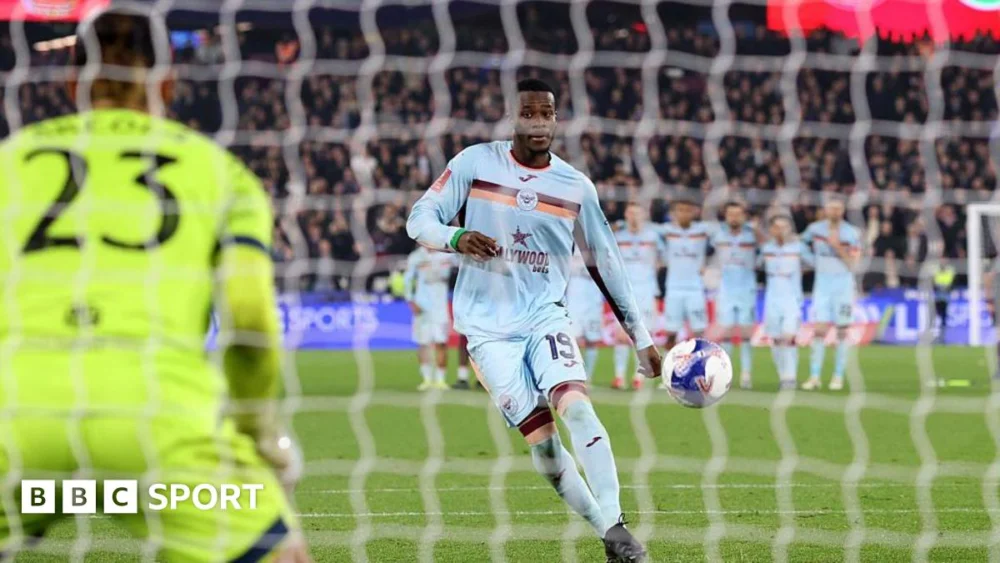
The recent FA Cup quarter-final penalty shootout exit for Brentford, marked by Dango Ouattara’s ill-fated Panenka attempt, reignites the perennial debate within football: when, if ever, is the opportune moment for such a high-risk, high-reward manoeuvre, and what are the profound implications when it fails? This incident serves as a poignant illustration of the fine line between audacious brilliance and costly miscalculation, embedding itself in the club’s narrative of shattered cup aspirations.
The specific moment of Ouattara’s misstep unfolded during a tense penalty shootout following a 2-2 draw between Brentford and West Ham. With the weight of progression resting on his shoulders, the 24-year-old forward opted for the delicate chip down the centre, a technique synonymous with supreme confidence. However, his execution lacked conviction, resulting in a feeble effort that was comfortably gathered by West Ham goalkeeper Alphonse Areola, who had correctly anticipated the attempt and remained central. This solitary missed spot-kick abruptly concluded Brentford’s journey in the competition, transforming a potential landmark achievement into another season of unfulfilled major cup final dreams, despite Igor Thiago’s two equalisers to Jarrod Bowen’s strikes in normal time. The outcome was particularly galling for Brentford, who had fielded a formidable side against a much-altered West Ham lineup.
In the immediate aftermath, Brentford manager Keith Andrews was resolute in his defence of Ouattara, emphasising the inherent bravery required to step up in such a critical moment. Andrews’ perspective underscored the psychological fortitude necessary for penalty takers, stating, "It takes serious courage to do that. He practises that technique a lot, if it goes in everyone’s raving about him." His stance sought to shield the player from the often-harsh public scrutiny, condemning the tendency to "persecute and ridicule" athletes for such misses. Conversely, former West Ham forward Joe Cole, speaking on TNT, expressed a blend of admiration for Ouattara’s initial confidence and bewilderment at the execution. Cole observed the player’s composed demeanour leading up to the kick, only for the outcome to be "unexplainable," suggesting a disconnect between intent and delivery. Similarly, ex-Tottenham midfielder Glenn Hoddle highlighted the protracted decision-making process, positing that Ouattara’s lengthy deliberation led to a mental overload, resulting in a compromised execution. Hoddle surmised that the young player would undoubtedly harbour significant regret over his choice of technique at that critical juncture.
The Panenka penalty occupies a unique, almost theatrical, space within football. Its very nature invites a heightened level of commentary and judgment. A conventionally missed penalty – perhaps struck wide or saved by a diving goalkeeper – typically elicits disappointment. A missed Panenka, however, frequently provokes a more intense backlash, often interpreted as a display of arrogance or a tactical misjudgment. Lee Trundle, a former striker renowned for his flair, articulated this sentiment, noting that the unconventional nature of the Panenka often draws disproportionate criticism. Trundle, who successfully executed the technique in semi-professional settings, views it simply as another legitimate method of scoring, arguing that a keeper saving a centrally-chipped Panenka is no different in principle than saving a powerful shot aimed at a corner after correctly guessing the direction. The underlying contention is that if the ball finds the net, it’s celebrated as genius; if it fails, it’s derided as folly.
Statistical analysis, surprisingly, lends some credence to the strategic efficacy of targeting the centre of the goal. Data from major international tournaments, specifically the World Cup since 1966 and the Euros since 1980, indicates that penalties aimed down the middle—whether with a delicate chip or sheer power—boast an impressive 84% success rate. This figure significantly surpasses the 78% success rate for kicks aimed left and the even lower 74% for those directed right. This statistical anomaly suggests that goalkeepers, under immense pressure, are overwhelmingly predisposed to commit to a dive, leaving the central portion of the goal vulnerable. The Panenka capitalises precisely on this instinct, requiring the goalkeeper to defy their natural inclination and remain stationary.
The Panenka penalty, named after its inventor Antonín Panenka following his iconic execution in the 1976 European Championship final, has evolved from a novel, almost rebellious, act into a more mainstream, albeit still daring, component of a penalty taker’s repertoire over the past five decades. Its prominence has been cemented by a pantheon of footballing legends who have successfully employed it in high-stakes encounters. Lionel Messi, Thierry Henry, and Francesco Totti are among the illustrious names who have showcased their nerve and skill with perfectly weighted chips. Perhaps the most audacious and high-pressure Panenka remains Zinedine Zidane’s effort in the 2006 World Cup final, a kick that defied belief by striking the underside of the crossbar before narrowly crossing the line, a testament to its precise execution under the most extreme scrutiny.
England, in particular, has experienced the sting of the Panenka in crucial shootouts. Andrea Pirlo’s nonchalant chip against Joe Hart in the Euro 2012 quarter-final stands out, a moment that visibly shifted the psychological momentum of the shootout in Italy’s favour. Pirlo later explained his decision was a direct response to Hart’s perceived confidence, aiming for a psychological blow rather than merely a goal. Similarly, in the 2022 EFL Cup final, Liverpool’s Fabinho responded to Chelsea goalkeeper Kepa Arrizabalaga’s attempts at distraction by calmly dinking his penalty down the middle, a move that delighted his supporters and preceded a perfect run of conversions for Liverpool, culminating in an 11-10 victory. These instances highlight the Panenka’s dual function: a method of scoring and a potent psychological weapon.
Yet, for every iconic success, there exists a cautionary tale of a high-profile failure. Dango Ouattara’s recent miss is far from an isolated incident. In 1992, Gary Lineker infamously fluffed an attempted Panenka against Brazil, denying him the chance to equal Sir Bobby Charlton’s England goal-scoring record. Sergio Aguero, typically a reliable penalty taker for Manchester City, suffered a moment of embarrassment in May 2021 when his attempted chip against Chelsea was comfortably saved by Edouard Mendy, contributing to a 2-1 defeat. More recently, in January, Brahim Diaz’s audacious Panenka to potentially win the Africa Cup of Nations for Morocco in stoppage time was thwarted, with Senegal ultimately emerging victorious. These instances serve as stark reminders of the inherent gamble involved, where the margin for error is razor-thin and the consequences often severe.
The question of "the right time" for a Panenka remains largely subjective and context-dependent. It transcends mere technical proficiency, delving deep into psychological warfare. Factors influencing this decision include the player’s intrinsic confidence, their history with the technique, the opponent goalkeeper’s tendencies (do they habitually commit early?), the scoreline, the stage of the competition, and even the preceding events in the match or shootout. A player who has consistently performed well and feels in a state of flow might be more inclined to attempt it. Conversely, a player struggling for form or burdened by prior misses might be better served by a conventional, powerful strike. The Panenka is, at its heart, a psychological gamble: the taker bets on the goalkeeper’s instinct to dive, and the goalkeeper bets on the taker’s nerve to execute.
Ultimately, the Panenka penalty is a fascinating microcosm of football itself – a blend of skill, strategy, psychology, and sheer audacity. It demands not just technical precision but also an unshakeable belief in one’s ability to defy convention under immense pressure. While statistical data might quietly endorse the logic of targeting the centre, the emotional and psychological weight attached to the Panenka ensures it will forever remain a high-wire act. Dango Ouattara’s recent miss, while personally devastating, contributes another chapter to the rich, complex narrative of this iconic, yet perilous, footballing manoeuvre, forever reminding us that sometimes, even with the best intentions, the price of audacity can be profoundly high.




 Ayu Aulia
 Ridwan Kamil
 Safa Marwah
 Aura Kasih