Safa Marwah
The digital landscape, increasingly complex and interconnected, places identity at the absolute core of enterprise security. While organizations invest substantially in robust mechanisms for initial user authentication, a critical vulnerability often persists in the less scrutinized realm of password reset and account recovery processes. This oversight creates an attractive vector for attackers seeking to escalate privileges, effectively bypassing hardened front-door defenses by exploiting the perceived softer underbelly of identity management.
This comprehensive analysis delves into the systemic risks associated with inadequately secured password reset pathways, illustrating how these mechanisms become prime targets for malicious actors aiming to gain unauthorized elevated access. We will dissect the primary methods employed by adversaries to compromise recovery procedures and subsequently outline a strategic framework of seven advanced countermeasures designed to significantly bolster organizational resilience against such sophisticated threats, ensuring security without compromising operational efficiency.
The Vulnerable Underbelly: How Attackers Exploit Password Recovery
Attackers recognize that the path of least resistance often lies not in directly cracking strong authentication but in subverting the recovery mechanisms designed to help legitimate users regain access. These processes, frequently designed for user convenience, can inadvertently become backdoors for unauthorized privilege escalation. The typical attack paradigms leveraging password resets include:
1. Exploitation of Compromised Standard Accounts: A common initial foothold involves gaining control of a low-privilege user account, often through phishing or credential stuffing. From this vantage point, attackers meticulously map the network, identifying higher-value targets such as administrative accounts, service accounts, or executive credentials. They then leverage their existing access to initiate password resets for these privileged accounts, often exploiting weaknesses in self-service portals or helpdesk procedures that fail to adequately verify the legitimacy of the reset request. This lateral movement, facilitated by a weak reset process, allows an attacker to "blend in" as a legitimate user, making detection significantly more challenging.
2. Social Engineering Against Helpdesk Personnel: Human factors remain a perennial vulnerability. Attackers frequently employ sophisticated social engineering tactics, impersonating legitimate employees—often feigning urgency or distress—to pressure helpdesk staff into performing unauthorized password resets. Under duress, or due to inconsistent identity verification protocols, support personnel may inadvertently grant an attacker control over a targeted account. This method preys on human trust, the desire to be helpful, and a lack of stringent, multi-factor identity verification procedures within the support framework.

3. Interception of Reset Tokens and Codes: Many password reset workflows rely on sending one-time codes or reset links via email or SMS. If an attacker has already compromised a user’s email account, intercepted SMS messages (e.g., via SIM swapping), or if recovery settings are misconfigured to send tokens to an insecure secondary channel, they can easily capture these tokens. With the reset token in hand, the attacker can initiate a password change without ever knowing the original password, gaining full control of the account. This highlights the inherent risk in relying on channels that may not be as secure as the primary authentication pathway.
4. Abuse of Over-Permissioned Administrative Roles: Within complex IT environments, it is not uncommon for administrators or even certain power users to possess overly broad password reset rights. This can occur through legacy configurations, insufficient role-based access control (RBAC), or a lack of granular delegation. An attacker who compromises such an over-permissioned account can then reset credentials for virtually any other account within their scope, regardless of whether it falls within their legitimate operational responsibilities. This creates a direct and highly effective pathway for rapid privilege escalation, often going unnoticed until significant damage has been done.
Strategic Countermeasures: Fortifying the Identity Recovery Lifecycle
Mitigating these risks requires a multi-layered, proactive approach that extends the rigor of initial authentication to every facet of the password recovery process. The following seven strategies provide a robust framework for securing identity recovery:
1. Mandate Phishing-Resistant Multi-Factor Authentication (MFA):
MFA is unequivocally one of the most impactful controls against identity compromise, yet its effectiveness is contingent upon the methods employed. While basic MFA (e.g., SMS codes, email links) offers a layer of defense, these methods are susceptible to sophisticated phishing, SIM swapping, and token interception attacks. For all accounts, and especially for privileged or high-value identities, organizations must transition to phishing-resistant MFA solutions. Technologies such as FIDO2 security keys, certificate-based authentication, or strong biometric methods offer superior protection by cryptographically binding the authentication process to a physical device or a user’s unique biological attribute, rendering stolen credentials or intercepted tokens largely useless to an attacker. This significantly raises the bar for adversaries, making large-scale credential harvesting or token replay attacks far less viable.
2. Implement Robust Device Trust and Posture Assessment:
The context from which a password reset is initiated is as crucial as the user’s identity itself. Requests originating from unmanaged, unapproved, or potentially compromised devices introduce substantial risk. Organizations should integrate device trust frameworks into their identity recovery workflows. This involves evaluating various device attributes, including compliance with security policies (e.g., up-to-date patches, antivirus status), geographic location, IP reputation, and whether the device is known and managed by the organization. Any request from an untrusted or suspicious device should trigger elevated verification requirements or be outright blocked. Solutions that bind user identities to trusted devices, such as those leveraging Zero Trust principles, ensure that authentication and recovery only succeed from approved, enrolled, and continuously validated endpoints, significantly reducing the attack surface.
3. Enforce Adaptive and Intelligent Password Policies:
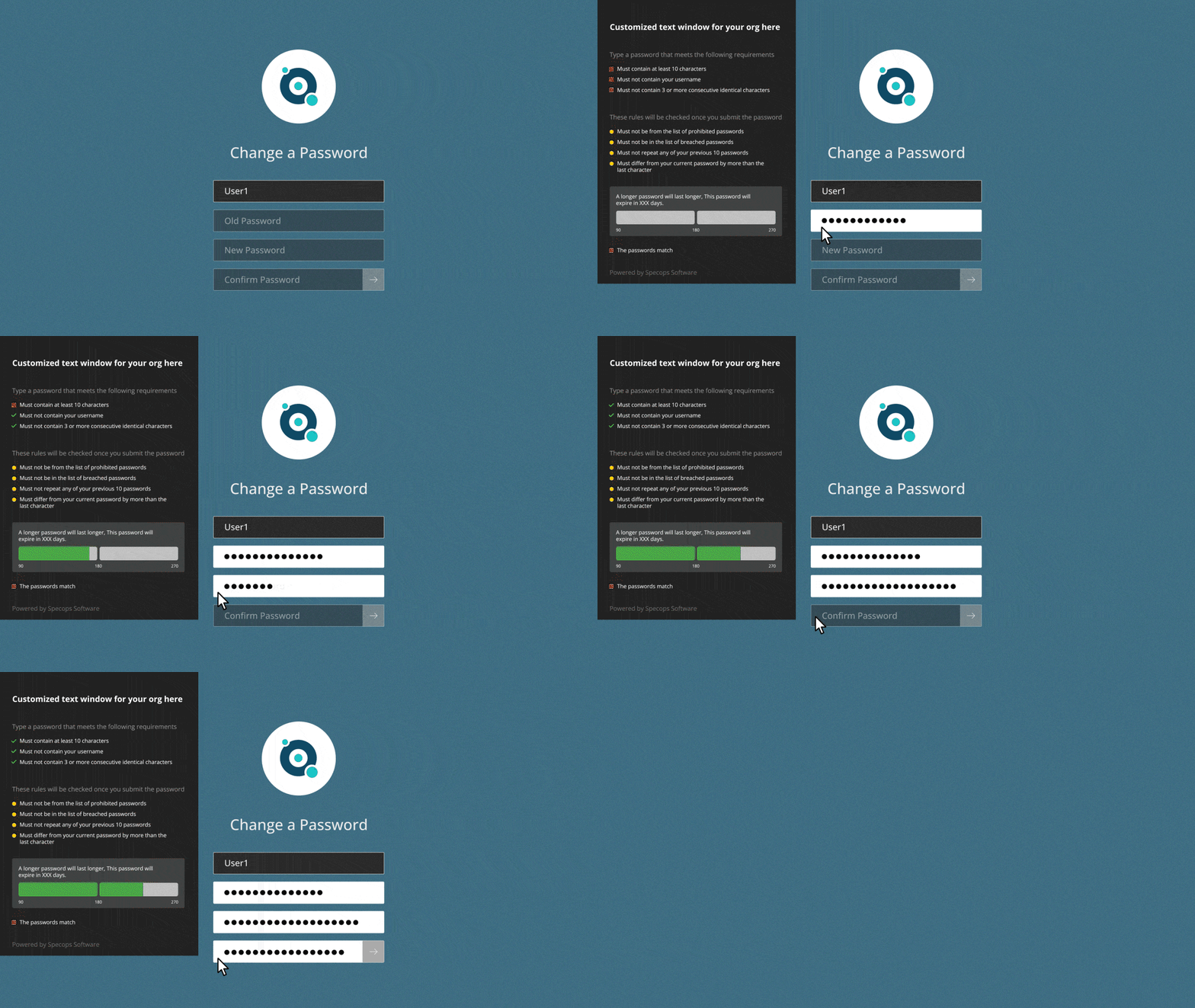
The strength of a newly set password directly impacts the security of the recovered account. Traditional rigid password complexity rules often lead to predictable patterns or user frustration. Modern password policies must be adaptive and intelligent, focusing on entropy and preventing the use of known compromised credentials. This includes enforcing minimum length requirements that encourage passphrases over complex, short strings, blocking all passwords found in public breach databases, and preventing the recycling of previously used passwords. Advanced solutions can integrate with threat intelligence feeds to continuously update lists of prohibited passwords, providing a dynamic defense against common attack vectors while improving user experience by allowing longer, more memorable, yet highly secure passphrases.
4. Cultivate a Culture of Security Awareness and Rigorous Helpdesk Protocols:
The human element remains a critical control point. Comprehensive and continuous security awareness training is vital for all employees, focusing specifically on recognizing social engineering tactics, phishing attempts targeting password resets, and suspicious MFA prompts. Users must be empowered to identify and report unusual activity rather than succumbing to urgency. Concurrently, helpdesk teams, often the first line of defense for recovery requests, require stringent, multi-factor identity verification protocols. These protocols should be standardized, regularly audited, and designed to resist social engineering pressure. Training should emphasize critical thinking, adherence to procedures, and the escalation of any suspicious requests, ensuring that access is never granted based on incomplete or unverified information.
5. Establish Comprehensive Audit Trails and Anomaly Detection:
Visibility into identity-related events is paramount for detecting and responding to privilege escalation attempts. Organizations must log every password reset request, including details such as the user involved, the account targeted, the timestamp, the originating IP address, and the device used. This granular logging forms the foundation for effective monitoring. Security Information and Event Management (SIEM) systems and specialized Identity and Access Management (IAM) tools should be configured with robust anomaly detection capabilities. Alerts should be triggered for unusual patterns, such as multiple failed reset attempts, resets for dormant or highly privileged accounts, activity outside normal business hours, or requests originating from unexpected geographic locations. Regular audits of who possesses password reset permissions are also essential to identify and rectify overly broad access rights that could be exploited.
6. Implement the Principle of Least Privilege (PoLP) and Just-in-Time Access:
The principle of least privilege dictates that users, including administrators, should only be granted the minimum necessary permissions required to perform their specific roles, and for the shortest possible duration. In the context of password resets, this means strictly limiting who can reset passwords for others and ensuring these permissions are highly granular. Privileged Access Management (PAM) solutions can enforce just-in-time (JIT) access, where elevated permissions (including password reset capabilities for specific accounts) are granted only when explicitly requested, for a limited time, and often with mandatory approval workflows. This minimizes the window of opportunity for attackers to leverage compromised administrative accounts for widespread privilege escalation, effectively segregating high-privilege operations from everyday user activity.
7. Abolish Knowledge-Based Authentication (KBA) for Recovery:
Knowledge-based authentication (KBA), often relying on "secret questions" (e.g., "What was your mother’s maiden name?"), has proven to be an inherently weak security mechanism. Answers to these questions are increasingly discoverable through social media, public records, or sophisticated social engineering, rendering them ineffective as a reliable form of identity verification. Organizations must move away from KBA for password recovery. Instead, recovery processes should exclusively leverage possession-based verification methods, such as secure MFA prompts delivered to trusted devices, or biometrics. This shift aligns with modern security paradigms that prioritize what a user has or is over what they know, which can often be compromised or guessed.
Implications and Future Trajectories
Securing password resets is not merely a technical task; it is a fundamental pillar of an organization’s overall cybersecurity posture. Neglecting this crucial aspect undermines all other investments in authentication and access control. As the threat landscape evolves, with adversaries employing increasingly sophisticated AI-driven social engineering and automation, the resilience of identity recovery processes will become even more critical.
The future of identity management is trending towards passwordless authentication, continuous adaptive risk assessment, and self-sovereign identity models. These advancements aim to reduce reliance on static credentials altogether, shifting towards dynamic, context-aware verification that continuously evaluates trust based on multiple signals. However, until these paradigms become universally adopted, robustly securing the existing password recovery lifecycle remains an immediate and non-negotiable imperative. A holistic, adaptive, and identity-centric security strategy, combining technological safeguards with rigorous policy enforcement and ongoing user education, is essential to stay ahead of persistent and evolving threats. Organizations that prioritize the fortification of their identity recovery mechanisms will significantly enhance their ability to detect, prevent, and respond to the most insidious forms of privilege escalation, thereby safeguarding their critical assets and maintaining operational integrity in an adversarial digital environment.



 Ridwan Kamil
 Aura Kasih
 Lisa Mariana
 Ayu Aulia