Ayu Aulia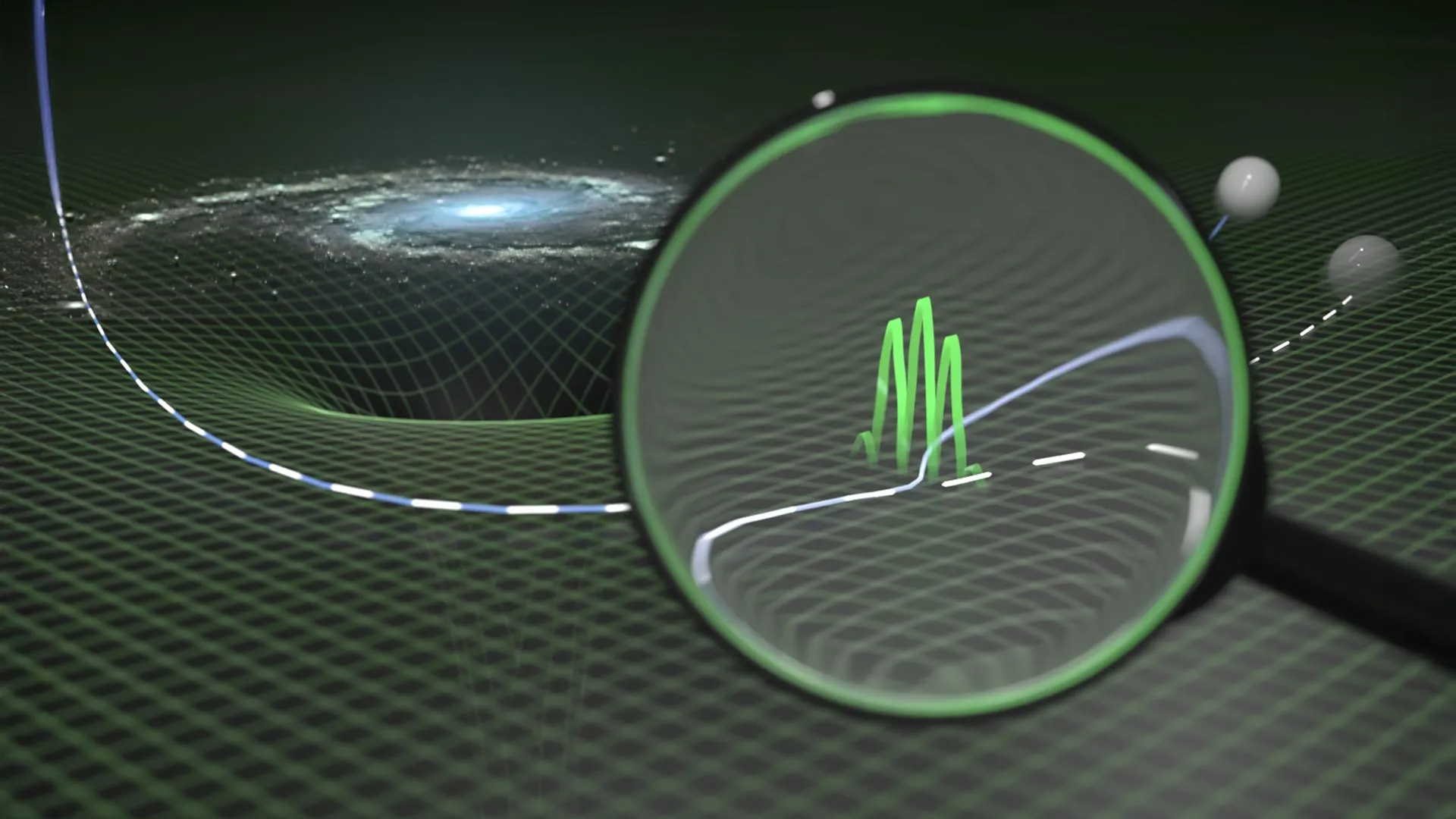
A new theoretical framework posits that the fabric of spacetime itself may exhibit quantum fluctuations, potentially altering the paths of objects across vast cosmic distances. This research introduces a novel "q-desic" equation, suggesting that the precise, predictable trajectories dictated by Einstein’s general theory of relativity could be subtly, yet significantly, modified by quantum effects, especially when considering the universe’s accelerating expansion. Such deviations could offer an unprecedented observational pathway to reconcile quantum mechanics with gravity, addressing one of physics’ most enduring paradoxes.
The pursuit of a unified theory that seamlessly integrates quantum mechanics with general relativity represents the most profound and persistent challenge in contemporary theoretical physics. On one hand, quantum theory has achieved unparalleled success in describing the fundamental constituents of matter and energy at the subatomic scale, providing the bedrock for fields ranging from particle physics to quantum computing. Its probabilistic nature and emphasis on discrete energy levels have revolutionized our understanding of the microscopic world. Conversely, Albert Einstein’s general theory of relativity offers an exquisitely precise description of gravity, space, and time, elegantly explaining phenomena from the orbits of planets to the dynamics of black holes and the large-scale structure of the cosmos. Despite their individual triumphs within their respective domains, these two pillars of modern physics remain fundamentally incompatible, operating under different conceptual frameworks and mathematical formalisms. General relativity treats spacetime as a smooth, continuous manifold, while quantum mechanics describes a universe characterized by inherent uncertainty and discreteness at its most fundamental level.
Numerous theoretical constructs have been proposed over decades in an effort to bridge this conceptual chasm. Prominent among these are string theory, which posits that fundamental particles are not point-like but rather one-dimensional vibrating strings; loop quantum gravity, which attempts to quantize spacetime itself into discrete "loops"; canonical quantum gravity, focusing on quantizing the gravitational field directly; and asymptotically safe gravity, which explores whether quantum gravity could be well-behaved at high energies. Each of these ambitious approaches offers a unique perspective on how gravity might behave under quantum conditions, yet all have struggled with a common impediment: the absence of clear, falsifiable predictions that could be tested through experiment or observation. Without such empirical guidance, the scientific community has lacked a definitive method to discern which, if any, of these theoretical candidates accurately reflects the underlying reality. A recent study, however, may have unearthed a potential avenue for empirical validation, offering a glimpse into how quantum fluctuations in spacetime could manifest observably.
The quest for a definitive experimental signature of quantum gravity has often been likened to a metaphorical search for a unique "slipper" – a single, undeniable piece of evidence that would definitively confirm one theoretical framework over others. For too long, the theoretical landscape of quantum gravity has been populated by numerous elegant but untestable hypotheses. The current research endeavors to identify such a measurable characteristic, focusing on a cornerstone concept within general relativity: geodesics. In Einstein’s theory, the motion of objects through spacetime is dictated by these geodesics, which represent the shortest possible paths between two points. On a flat, Euclidean surface, a geodesic is simply a straight line. However, in the curved four-dimensional fabric of spacetime, as warped by massive objects, these paths become more intricate. For example, the trajectory of a satellite orbiting Earth is not due to a mysterious force pulling it, but rather the satellite following the "straightest" possible path through spacetime that has been curved by Earth’s mass. This elegant geometric interpretation underpins all gravitational interactions in general relativity, from planetary orbits to the bending of light around stars.
The core innovation of the new investigation lies in attempting to apply the principles of quantum physics to the very geometry of spacetime itself. In classical general relativity, the curvature of spacetime is precisely described by a mathematical entity known as the metric tensor. This metric dictates distances and angles within spacetime, and thus the paths (geodesics) that objects follow. However, quantum mechanics fundamentally asserts that properties like position and momentum are not precisely defined for particles; instead, they are described by probability distributions or wave functions, subject to inherent uncertainties. The researchers proposed to extend this quantum uncertainty to the metric tensor itself. If the metric, which defines spacetime’s curvature, is treated as a quantum quantity, then the curvature of spacetime would no longer be perfectly defined at every point. Instead, it would become subject to quantum fluctuations, exhibiting a "fuzziness" or probabilistic nature.
This conceptual leap immediately introduces formidable mathematical complexities. Quantizing a field like gravity, which also defines the very stage on which quantum events unfold, is notoriously difficult. The team, comprising Benjamin Koch, Ali Riahinia, and Angel Rincón, tackled this challenge by employing a novel method to quantize the metric for a specific, yet highly relevant, scenario: a spherically symmetric gravitational field that remains constant over time. This particular configuration is mathematically tractable and serves as an excellent model for ubiquitous astrophysical systems, such as the gravitational field generated by a star like our Sun or a non-rotating black hole. By focusing on this simplified yet significant case, the researchers were able to perform the necessary calculations without being overwhelmed by the full complexity of a general quantum gravity problem.
The subsequent step involved calculating how a small object, essentially a test particle, would move within this newly defined quantum gravitational field. A crucial aspect of their methodology involved carefully considering whether the classical metric could simply be replaced by its quantum expectation value – essentially an average of the quantum fluctuations. This mathematical rigor was essential to ensure the validity of their quantum-corrected predictions. The outcome of their painstaking analysis was the derivation of a new equation, which they termed the "q-desic equation," in direct reference to its classical counterpart, the geodesic equation. The profound implication of this new equation is that in a quantum spacetime, particles do not strictly adhere to the shortest paths predicted by classical general relativity. Instead, their trajectories are subtly, yet measurably, altered by the inherent quantum uncertainties of the spacetime fabric. This finding suggests a revolutionary possibility: by precisely observing the trajectories of freely moving objects, scientists might be able to detect the quantum nature of spacetime itself.
The magnitude of these predicted quantum deviations from classical paths initially appears to be extraordinarily small. When considering only the effects of ordinary gravity, the calculated differences in trajectories amount to approximately 10-35 meters. Such minuscule deviations are far beyond the capabilities of any current or foreseeable experimental apparatus, rendering them practically unobservable in typical gravitational scenarios like Earth’s orbit around the Sun. This aligns with common intuition, as quantum effects are generally expected to be dominant only at extremely small scales.
However, a dramatic shift in the predictions occurred when the researchers incorporated another fundamental component of Einstein’s equations: the cosmological constant. This constant, initially introduced by Einstein to force a static universe but later reinterpreted, is now widely associated with "dark energy," the mysterious force responsible for the accelerating expansion of the universe on the grandest scales. Its inclusion into the q-desic equation yielded a startling and unexpected result. The quantum-corrected paths diverged significantly from the classical geodesics, not only at the microscopic Planck scale but also at vast cosmological distances.
The implications of this finding are profound. While the quantum deviations remain negligible for intermediate scales, such as the solar system, they become potentially substantial at cosmic scales, specifically at distances around 1021 meters. This is precisely the realm where general relativity encounters some of its most perplexing puzzles. For instance, the observed rotation speeds of spiral galaxies far exceed what can be accounted for by their visible matter alone, leading to the hypothesis of vast halos of unseen "dark matter." Similarly, the formation and distribution of large-scale structures in the universe present challenges to purely classical gravitational models. The study suggests that these discrepancies, traditionally attributed to exotic forms of matter or energy, might instead arise from the quantum nature of spacetime itself, manifesting as altered gravitational dynamics on cosmological scales.
The research, published in the esteemed journal Physical Review D, not only introduces a sophisticated new mathematical framework for exploring the interplay between quantum theory and gravity but, more critically, it illuminates a potential pathway toward empirical validation. The unexpected discovery that quantum corrections could produce discernible effects at large cosmic scales has generated considerable excitement within the physics community. It transforms quantum gravity from a purely theoretical exercise into a field potentially amenable to observational scrutiny. If future astronomical observations can detect these predicted deviations in cosmic trajectories, it would provide the long-sought "slipper," a concrete piece of evidence guiding physicists toward the correct theory of quantum gravity.
Future work will involve refining the q-desic equation, extending its applicability beyond spherically symmetric fields, and exploring its full implications for various cosmological phenomena. The possibility that these quantum effects could offer a novel explanation for phenomena like galaxy rotation curves, potentially offering an alternative or complementary perspective to the dark matter hypothesis, underscores the transformative potential of this research. Such a development would not only deepen our understanding of gravity but also fundamentally reshape our view of the universe’s large-scale structure and evolution. The journey to unify physics’ greatest theories is far from over, but this new work provides a compelling reason to believe that the answers may lie not just in abstract mathematics, but in the subtle dance of quantum mechanics across the vast expanse of the cosmos.



 Ridwan Kamil
 Safa Marwah
 Aura Kasih
 Lisa Mariana