Ayu Aulia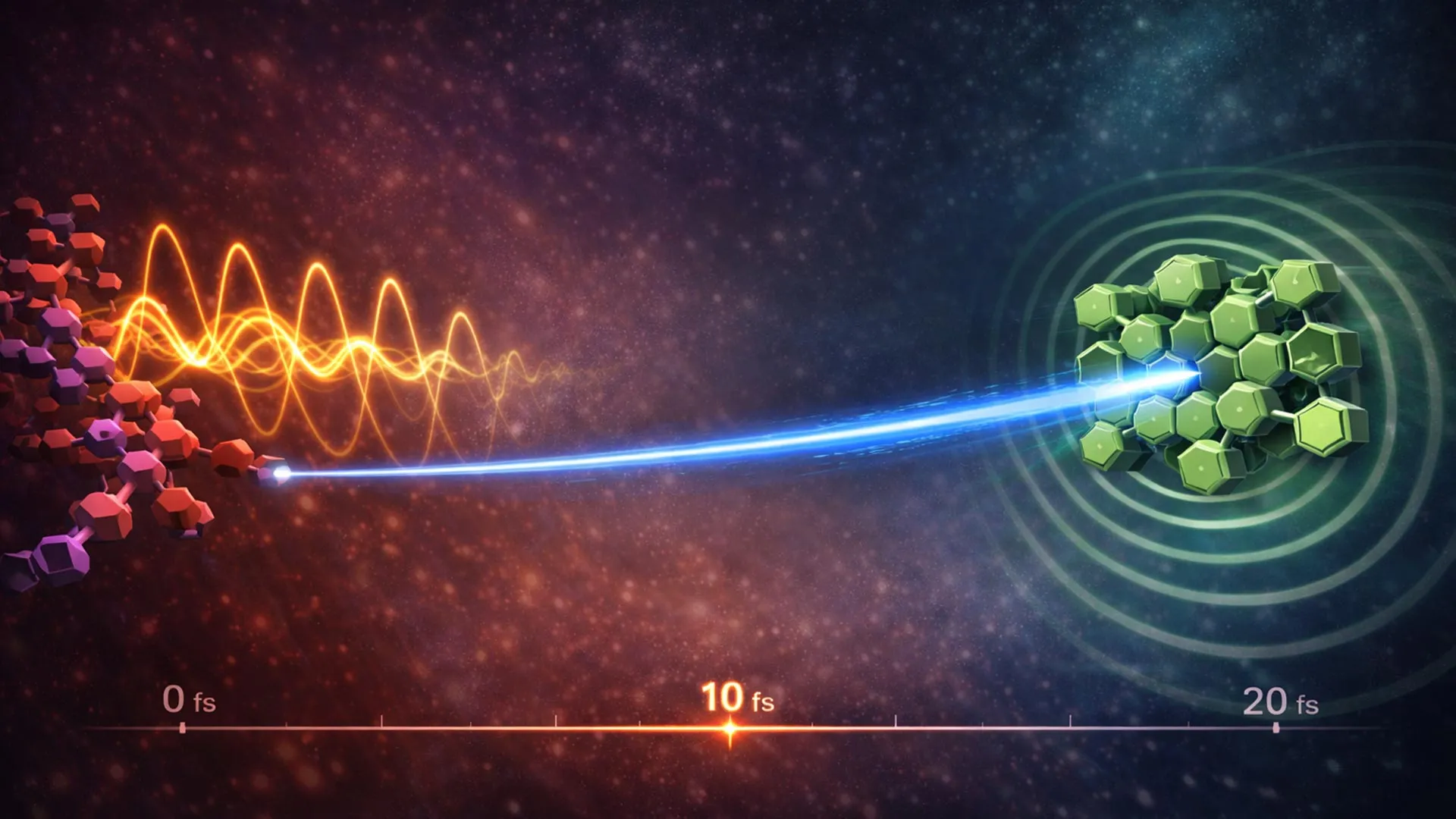
A groundbreaking scientific revelation has fundamentally altered established perceptions regarding the mechanics of solar energy conversion, demonstrating that electrons can traverse photovoltaic interfaces with unprecedented speed, approaching the theoretical limits of natural processes. This paradigm-shifting discovery, rooted in meticulous observation of events occurring within quadrillionths of a second, suggests entirely new pathways for engineering highly efficient solar energy systems capable of transforming sunlight into electricity with significantly reduced energy loss.
At the heart of this transformative finding is the identification of molecular vibrations not merely as passive accompaniments but as active drivers in the charge separation process. Researchers at the University of Cambridge have pinpointed a mechanism where specific molecular oscillations act as a "catapult," launching electrons across material boundaries in a single, coherent burst rather than through a slower, diffusive motion. This defies long-held conventional wisdom that dictated the prerequisites for rapid charge transfer, opening a novel design philosophy for next-generation optoelectronic devices.
Unveiling the Ultrafast Dynamics of Charge Separation
The core experimental challenge involved observing phenomena that unfold on an incredibly fleeting timescale: 18 femtoseconds. To grasp this temporal brevity, consider that a single femtosecond is one quadrillionth of a second. To put it into perspective, one second contains more femtoseconds than the total number of hours that have elapsed since the estimated beginning of the universe. Within such an infinitesimal window, the atoms composing molecules are in constant, vigorous motion. The Cambridge team’s remarkable achievement lies in their ability to detect electrons migrating between distinct materials at a pace essentially synchronous with these inherent atomic vibrations. This capability effectively allows scientists to "witness" electron movement on the same intrinsic clock as the atoms themselves, providing an unparalleled view into the quantum dance of energy transfer.
This research, detailed in a recent publication in Nature Communications, directly challenges foundational design principles prevalent in solar energy science for decades. Previously, the scientific community largely accepted that achieving ultrafast charge transfer necessitated two primary conditions: substantial energy differentials between the involved materials and robust electronic coupling between them. While these conditions facilitate charge separation, they often come with inherent trade-offs, potentially compromising overall efficiency by constraining achievable voltage levels and fostering undesirable energy dissipation. The new findings dismantle this perceived necessity, offering a pathway to overcome these limitations.
Deconstructing the Conventional Wisdom: Excitons and Energy Conversion
To fully appreciate the significance of this breakthrough, it is essential to understand the fundamental process of light-to-energy conversion in many solar materials, particularly those based on carbon. When photons of light strike these materials, the absorbed energy excites an electron, which remains electromagnetically bound to the "hole" it left behind, forming a neutral quasiparticle known as an exciton. For practical applications in devices like solar cells, photodetectors, or photocatalytic systems, this tightly bound electron-hole pair must rapidly dissociate into free, mobile charge carriers – a free electron and a free hole.
The efficiency of any light-harvesting technology, from solar panels to advanced sensors, hinges critically on the speed and efficacy of this charge separation process. The faster the exciton dissociates into its constituent free charges, the less opportunity there is for the electron and hole to recombine and release their energy as heat or light, thereby wasting the absorbed solar energy. Consequently, ultrafast charge separation is a crucial determinant of how effectively sunlight is converted into usable electrical power.
The "Impossible" Experiment: Defying Expectations
Driven by a desire to investigate whether the presumed trade-off between ultrafast transfer and energy conditions was truly unavoidable, the Cambridge researchers embarked on a deliberately counter-intuitive experimental design. They constructed a system that, by all conventional theoretical metrics, should have exhibited sluggish charge transfer. This involved pairing a polymer donor material with a non-fullerene acceptor, carefully chosen to possess an almost negligible energy difference between them and only a weak electronic interaction at their interface. According to established design rules, such a configuration ought to have significantly hampered charge transfer kinetics.
The results, however, were strikingly contrary to these expectations. Instead of a slow, inefficient process, the electron traversed the interface between the polymer donor and the acceptor in an astonishingly brief 18 femtoseconds. This speed not only surpasses that observed in many previously studied organic systems but remarkably synchronizes with the natural rhythm of atomic motion itself. The observation of such rapid transfer within the timeframe of a single molecular vibration was, as the lead researcher noted, truly extraordinary.
Molecular Vibrations: The Unsung Heroes of Ultrafast Transport
The key to unraveling this unexpected phenomenon lay in sophisticated ultrafast laser spectroscopy experiments. These investigations revealed that upon absorbing light, the polymer material initiates vibrations in highly specific, high-frequency patterns. These particular molecular oscillations play a pivotal role: they dynamically mix the electronic states of the donor and acceptor materials. This mixing effectively creates a transient pathway, providing a powerful, directional impetus that propels the electron across the boundary in a ballistic, rather than random, motion. The electron is not passively drifting; it is actively launched.
Further corroborating this mechanism, once the electron arrives at the acceptor molecule, it triggers a new, coherent vibration within that molecule. This distinctive vibrational "fingerprint" is a rare observation in organic materials and serves as a direct indicator of the extreme speed and precision with which the charge transfer has occurred. It provides unequivocal evidence that the transfer is clean, efficient, and directly coupled to the vibrational dynamics of the molecular system.
This insight fundamentally redefines our understanding of charge separation mechanisms. The ultimate speed of charge separation is not solely dictated by the static electronic structure of the materials, as previously assumed. Instead, it is profoundly influenced by the dynamic manner in which molecules vibrate. This realization furnishes scientists and engineers with an entirely new design principle, a fresh "rulebook" for material development. Rather than attempting to suppress or mitigate molecular vibrations – often seen as sources of energy loss – the focus can now shift to identifying and harnessing the specific vibrational modes that actively drive and accelerate charge transfer.
Profound Implications for Energy Technologies and Beyond
The ramifications of this discovery are vast and extend across the spectrum of light-harvesting technologies. Ultrafast charge separation is an indispensable process in a multitude of systems, including organic solar cells, which offer advantages in flexibility and manufacturing cost; photodetectors, critical for sensing and imaging applications; and photocatalytic devices, which hold immense promise for generating clean fuels like hydrogen through solar water splitting. Moreover, similar ultrafast processes underpin natural photosynthesis, the intricate mechanism by which plants convert sunlight into chemical energy. Understanding and mimicking these natural efficiencies could lead to unprecedented breakthroughs in bio-inspired energy systems.
Professor Akshay Rao, a co-author of the study and a prominent figure in physics at the Cavendish Laboratory, underscored the transformative potential: "Instead of trying to suppress molecular motion, we can now design materials that use it – turning vibrations from a limitation into a tool." This shift in perspective signifies a profound change in the approach to material science, moving from passive acceptance of physical constraints to active manipulation of atomic-level dynamics.
This complex and highly interdisciplinary research was a testament to international scientific collaboration, bringing together experts from the Cavendish Laboratory and the Yusuf Hamied Department of Chemistry at the University of Cambridge, alongside vital contributions from partner institutions in Italy, Sweden, the United States, Poland, and Belgium. This collective effort has not only provided a deeper understanding of fundamental physics at the nanoscale but has also laid a robust foundation for a new generation of highly efficient, vibrationally optimized solar energy and optoelectronic materials. The journey toward a more sustainable energy future may well be propelled by the subtle, yet powerful, rhythm of molecular vibrations.




 Ridwan Kamil
 Safa Marwah
 Aura Kasih
 Lisa Mariana