
 Aura Kasih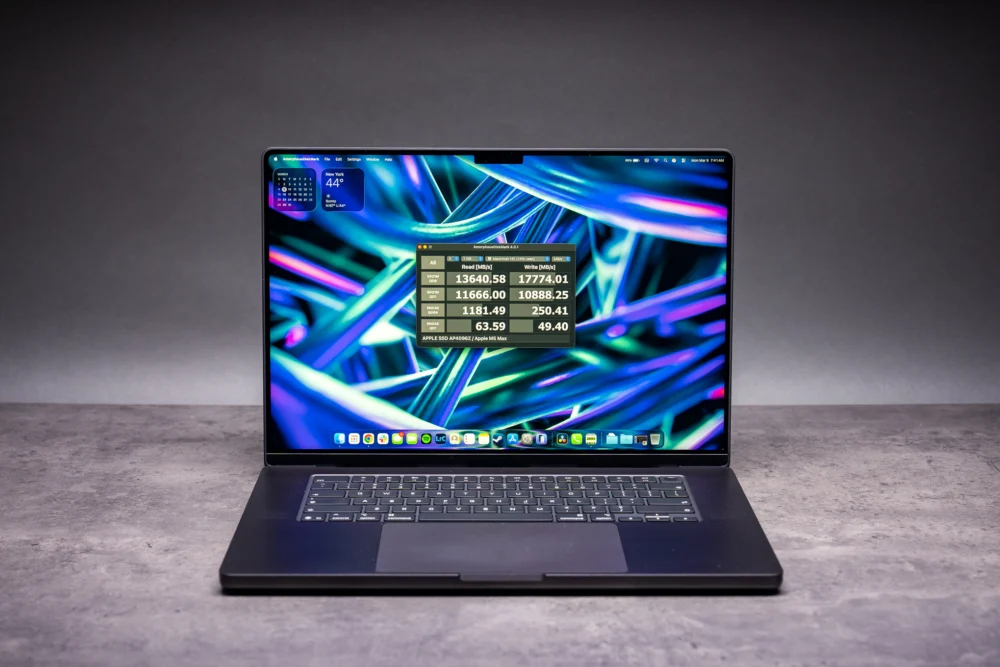
Apple’s latest M5 Max chip heralds a significant leap in portable computing power, particularly for users upgrading from MacBook Pro models three or more years in the past. While the design of the new MacBook Air and MacBook Pro lines remains largely consistent with their predecessors, the M5 Max processor introduces a paradigm shift in storage speeds, offering a compelling reason for those with aging hardware to consider an upgrade. This analysis delves into the performance benchmarks, architectural advancements, and broader implications of Apple’s newest silicon, focusing on its impact on professionals and power users.
The headline advancement of Apple’s 2026 MacBook Pro lineup, featuring the M5 Max chip, lies in its storage subsystem. Apple claims a doubling of sustained read and write speeds compared to the M4 Pro and Max generations. This claim is substantiated by rigorous testing, with the 16-inch MacBook Pro equipped with the M5 Max achieving a remarkable sustained read speed of 13.6 GB/s and an even more impressive write speed of 17.8 GB/s. These figures represent an 86% increase in read performance and a staggering 123% boost in write performance over the M4 Max configuration. Similar enhancements have been observed across the M5-powered MacBook Air and the M5-equipped MacBook Pro, underscoring a consistent architectural improvement in storage throughput across the new chip family.
At the core of this performance surge is Apple’s innovative M5 Max silicon. The M4 Max featured a configuration of 16 CPU cores, comprising 12 performance cores and 4 efficiency cores. The M5 generation, however, introduces a novel "super core" alongside redesigned performance cores. The M5 Max processor boasts six of these super cores and 12 enhanced performance cores, specifically engineered for power-efficient, multi-threaded workloads. Notably, the dedicated efficiency cores, while present in the base M5 chip, are omitted in the Pro and Max variants, suggesting a strategic shift towards maximizing raw computational power and efficiency in these high-end configurations.
In single-core CPU benchmarks, the new super core delivers a modest but expected 8-9% performance uplift over the M4 Max, as evidenced by benchmarks like Geekbench 6 and Cinebench. This incremental gain is typical for year-over-year processor generations. The multicore performance, however, presents a more nuanced picture. While the M5 Max shows approximately a 10% increase in Geekbench CPU multicore performance, this is achieved with 12.5% more cores. Cinebench 2026 multicore performance sees a 14% improvement. These figures suggest that while the M5 Max offers more cores, the enhanced performance cores of the M4 Max exhibit strong competitive capabilities, particularly in workloads that can effectively leverage their architecture for extended durations. Further in-depth testing across a wider array of demanding applications will be crucial to fully elucidate the long-term multicore advantages of the M5 Max.
The graphical processing capabilities of the M5 Max also demonstrate substantial progress. The M5 Max chip delivers a 26% improvement in GPU performance when measured using the OpenCL framework, and an 18% enhancement in Metal graphics rendering. This translates to tangible real-world benefits, such as an eight-second reduction in 4K Premiere Pro export times compared to the M4 Max, representing an approximate 10% efficiency gain in video editing workflows.
The true impact of the M5 Max is most vividly illustrated when comparing it to older MacBook Pro generations. Upgrading from a 2023 MacBook Pro equipped with the M2 Max chip, featuring 12 CPU cores and 38 GPU cores, to the M5 Max offers a dramatic performance differential. Single-core CPU performance in Geekbench 6 is an impressive 55% faster, while multicore performance nearly doubles. Metal rendering performance sees a 64% improvement. The M5 Max also slashes Premiere Pro 4K export times by a significant 30%, a benefit likely amplified by the accelerated SSD write speeds. This substantial leap in performance creates a night-and-day difference for users transitioning from the M2 Max generation.

The implications of these advancements extend beyond raw benchmark numbers. The introduction of the M5 Max chip, particularly its accelerated SSD technology, redefines expectations for portable workstation performance. For creative professionals, developers, and researchers who handle large datasets, complex simulations, or high-resolution media, the ability to read and write data at unprecedented speeds can drastically reduce project turnaround times and enhance workflow efficiency. The rapid transfer of large video files, the quick loading of massive 3D models, or the swift compilation of extensive codebases are all areas where the M5 Max’s storage enhancements will be immediately noticeable.
From a strategic perspective, Apple’s consistent evolution of its in-house silicon underscores its commitment to vertical integration and performance leadership. By designing both the hardware and the software ecosystem, Apple can meticulously optimize each component for maximum synergy. The M5 Max represents another step in this ongoing journey, pushing the boundaries of what is achievable in a portable computing device. The introduction of the "super core" architecture suggests a refined understanding of modern computing demands, where a blend of raw power and energy efficiency is paramount.
The pricing structure for the new MacBook Pro models, with the 16-inch M5 Max configuration reaching up to $6,149, positions these machines firmly within the professional and prosumer market. While the M4 Max and M5 Max models share the same price point in comparable configurations, the value proposition shifts significantly for users holding onto older hardware. Those who purchased MacBook Pros with the M2 Max chip three years ago, and are now encountering performance bottlenecks, will find the M5 Max a transformative upgrade. The enhanced CPU and GPU capabilities, coupled with the revolutionary SSD speeds, offer a compelling justification for a hardware refresh.
However, for users who invested in the M4 Max or even the M3 Max generation within the last year or two, the upgrade path to the M5 Max may appear less critical. The incremental performance gains over the M4 Max, while present, might not warrant an immediate switch for many. The primary draw for these users would be the exceptionally fast SSD speeds, which could influence workflows heavily reliant on rapid data access.
Looking ahead, the architectural innovations introduced with the M5 Max, such as the "super core," are likely to set the trajectory for future Apple silicon development. The company’s continued focus on heterogeneous core architectures, optimizing for diverse workloads and power efficiency, suggests a long-term strategy aimed at delivering increasingly powerful and versatile computing experiences. The performance gap between the latest generation and older models will continue to widen, reinforcing the benefits of timely hardware upgrades for professionals seeking to maintain a competitive edge.
In conclusion, Apple’s M5 Max chip represents a substantial advancement in portable computing, particularly for users upgrading from older MacBook Pro models. The dramatic improvements in sustained SSD read and write speeds, coupled with refined CPU and GPU architectures, offer a compelling performance uplift. While users with M4 Max or M3 Max machines may not find an immediate imperative to upgrade, those on M2 Max or earlier generations will experience a transformative leap in productivity and capability. The M5 Max solidifies Apple’s position at the forefront of mobile silicon innovation, setting new benchmarks for professional-grade performance in a laptop form factor. Further comprehensive reviews will undoubtedly provide deeper insights into the practical applications and long-term benefits of this powerful new chip.




 Ayu Aulia
 Ridwan Kamil
 Safa Marwah
 Lisa Mariana