Lisa Mariana
A significant technical malfunction has rendered thousands of clients of the prominent UK financial services provider, Hargreaves Lansdown, unable to access their digital investment platforms and execute crucial transactions, sparking widespread concern among investors and raising questions about operational resilience in the digital finance sector.
The Bristol-headquartered firm, a titan in the UK’s investment landscape, acknowledged a substantial system outage affecting its web portal and mobile application. This disruption, which commenced late Thursday evening and persisted into Friday morning, has severely curtailed users’ ability to log into their accounts, monitor portfolios, or initiate trades. In response to mounting client anxieties, the company issued a statement confirming the existence of "technical issues" that were impeding account functionality. Crucially, the statement emphasized that client assets and data remained "secure" and explicitly denied any evidence of a "cyber incident data breach," aiming to alleviate fears of a malicious attack.
The Unfolding Crisis: A Timeline of Disruption
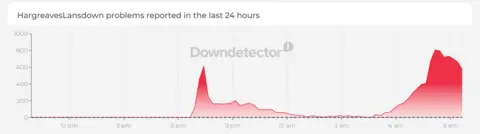
The initial signs of trouble emerged on Thursday night, as an increasing number of Hargreaves Lansdown users reported difficulties. Independent web outage trackers, such as Downdetector, registered a sharp spike in problem reports, numbering in the hundreds and quickly escalating into the thousands by Friday morning. These reports consistently highlighted issues with logging in and executing transactions, painting a clear picture of widespread operational paralysis across the platform. The firm’s digital channels, vital for its two million private investment clients, became largely inaccessible, triggering a cascade of frustration.
Hargreaves Lansdown’s communication strategy unfolded primarily through its official X (formerly Twitter) account, where it tendered an apology for the "inconvenience caused" and assured clients of ongoing efforts to restore full service functionality as swiftly as possible. However, the online response from affected users was swift and overwhelmingly negative. Many took to social media to voice their anger, with some questioning the firm’s diligence in maintaining its infrastructure, others openly threatening to transfer their holdings to rival platforms, and a significant number demanding clarification on potential compensation for financial losses incurred due to the outage.
Profound Impact on Individual Investors
The inability to transact during periods of market activity carries tangible and often significant financial implications for investors. For active traders, even brief interruptions can translate into substantial missed opportunities or exacerbated losses. Paul, a long-standing Hargreaves Lansdown client of over 15 years who relies on the platform for daily trading, articulated the direct financial cost, estimating "a few thousand pounds of missed profit" as a direct consequence of the technical issues. His frustration was palpable, lamenting the "vague statements" from customer service and the lack of concrete information regarding the root cause or estimated resolution time. As the UK’s largest retail investment platform, the gravity of such a widespread service failure cannot be overstated for its client base.
The concerns extended beyond mere inconvenience, touching upon the fundamental ability of investors to manage their financial risk and capitalize on market movements. Rob Bolton, a London-based customer, expressed acute anxiety over his inability to access his Stocks and Shares ISA account via either the website or mobile application. He underscored the critical nature of the situation, particularly "considering the geopolitical context and the volatility in the markets." In an environment where global events can trigger rapid shifts in asset values, being locked out of one’s investment portfolio can lead to significant distress and potential financial detriment.
Gerardo Vece, residing in Buckinghamshire, highlighted an even more precarious situation for investors holding highly sensitive assets. He described investments in oil and gas, which are "leveraged and designed to be held for less than one day," making them inherently volatile. His inability to trade these assets, either online or via telephone, meant he was prevented from actively managing his exposure or realizing potential gains. This scenario exemplifies the concept of "opportunity cost"—the benefit that a person could have received but gave up to take another course of action. In this context, the opportunity cost for investors like Vece could be substantial, directly impacting their investment returns.
Operational Resilience and Regulatory Scrutiny
This incident casts a spotlight on the critical importance of operational resilience within the financial services industry. Regulators globally, including the UK’s Financial Conduct Authority (FCA), have increasingly emphasized the need for firms to possess robust systems and controls capable of withstanding and rapidly recovering from operational disruptions, whether caused by technical failures, cyberattacks, or other unforeseen events. The FCA’s guidelines on operational resilience mandate that firms identify their "important business services" and set impact tolerances for outages, ensuring that even in the face of disruption, critical functions can be maintained or swiftly restored to prevent undue harm to consumers and market integrity.
While Hargreaves Lansdown swiftly clarified that the issue was not a cyber security incident, this distinction, though reassuring in one aspect, does not diminish the severity of an extended technical failure. An internal system malfunction can be just as disruptive as an external attack, if not more so, in terms of its impact on client trust and the firm’s operational continuity. The incident will undoubtedly prompt internal reviews at Hargreaves Lansdown regarding its IT infrastructure, redundancy measures, and disaster recovery protocols. It may also attract the attention of regulatory bodies keen to understand the cause, the duration of the outage, and the measures being implemented to prevent recurrence.
The Broader Implications for Digital Finance
In an era where digital platforms are the primary interface for investment management, the reliability of these systems is paramount. Investors increasingly expect seamless, 24/7 access to their portfolios, particularly in fast-paced global markets. An outage of this scale, affecting a major player like Hargreaves Lansdown, sends ripples across the industry, reminding both firms and clients of the inherent vulnerabilities of digital reliance.
Reputational Damage and Client Exodus Risk: For Hargreaves Lansdown, a firm built on trust and accessibility, a prolonged outage risks significant reputational damage. In a highly competitive market, disgruntled clients may indeed follow through on threats to move their business, seeking platforms perceived as more reliable. Rebuilding trust will require not only fixing the immediate problem but also transparent communication about the underlying causes and demonstrable improvements in system resilience.
Compensation and Redressal Mechanisms: The question of compensation for "missed profits" or losses incurred due to the inability to trade is complex. Financial services firms typically assess such claims on a case-by-case basis, often requiring clients to demonstrate a direct and quantifiable loss unequivocally linked to the outage, rather than general market movements. Proving what an investor would have done in a hypothetical scenario can be challenging. However, for clear instances where a client was prevented from executing a time-sensitive order that would have mitigated a known loss, or secured a definite gain, the firm might be obligated to provide redress. The Financial Ombudsman Service (FOS) serves as an independent body for resolving unresolved complaints between consumers and financial firms, and affected clients may turn to it if they are dissatisfied with the company’s response.

Investment in IT Infrastructure: This incident serves as a stark reminder to all financial institutions of the critical need for continuous, substantial investment in robust, scalable, and resilient IT infrastructure. Legacy systems, while functional, often struggle to cope with the demands of modern digital trading volumes and sophisticated user expectations. Firms must prioritize not only cybersecurity but also the foundational stability and redundancy of their core platforms to ensure uninterrupted service delivery. This includes implementing comprehensive backup systems, failover mechanisms, and rigorous testing protocols.
Future Outlook: Lessons to Be Learned
The resolution of the immediate technical issues at Hargreaves Lansdown will mark only the beginning of a more extensive process. The firm will need to undertake a thorough post-incident review to identify the root causes, assess the effectiveness of its incident response, and implement corrective actions. This will likely involve enhancing monitoring systems, strengthening contingency plans, and potentially re-evaluating aspects of its technology architecture.
For the wider financial services industry, this event reinforces the ongoing challenge of balancing innovation with stability. As digital transformation accelerates, so too does the complexity of managing vast, interconnected IT ecosystems. The imperative for firms is clear: prioritize operational resilience, invest proactively in robust technology, and maintain transparent communication with clients, especially during periods of disruption. The trust of investors, once eroded, is arduous to restore, making uninterrupted service delivery not just a convenience, but a fundamental pillar of modern financial stewardship.



 Ayu Aulia
 Ridwan Kamil
 Safa Marwah
 Aura Kasih