Safa Marwah
A prominent French football institution, Olympique de Marseille, has formally acknowledged a recent cyberattack attempt, an incident that surfaced following claims by a malicious actor regarding unauthorized access to the club’s digital infrastructure and the subsequent exfiltration of sensitive data pertaining to personnel and supporters. This revelation places one of Europe’s most storied sports organizations at the forefront of a growing wave of cyber challenges confronting high-profile entities globally, underscoring the pervasive and evolving nature of digital security risks.
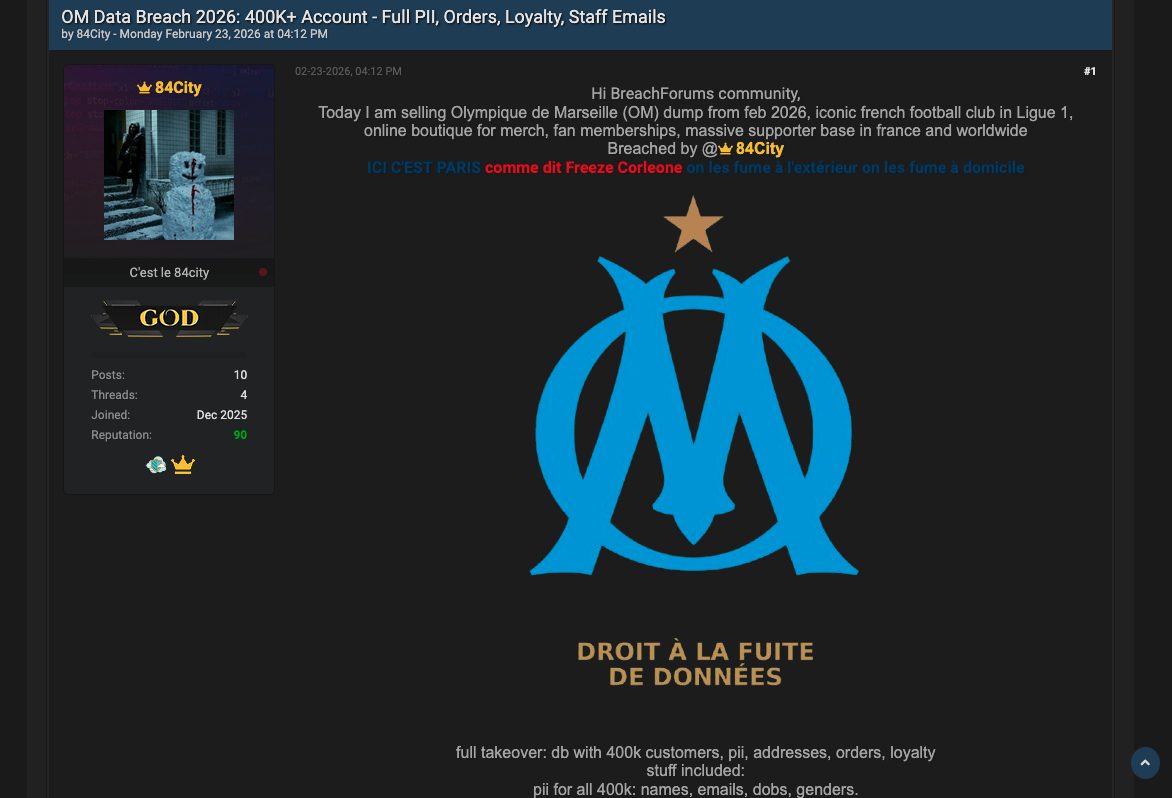
The confirmation from Olympique de Marseille (OM), a club boasting a rich 126-year history and the distinction of being the first French team to clinch the UEFA Champions League title in 1993, arrived in response to assertions made by a threat actor earlier this week. The malicious entity had publicly declared its successful breach of the club’s servers during the preceding month and subsequently disseminated a sample of the allegedly compromised information on a clandestine hacking forum. This public disclosure prompted the club to issue an official communication, initiating a broader discourse on the vulnerability of even deeply entrenched and popular institutions within the digital landscape.
The alleged data exfiltration reportedly encompasses a comprehensive database containing personal identifiable information (PII) of a significant number of individuals associated with the club, including staff members and its extensive supporter base. The threat actor’s claims detail the acquisition of data on approximately 400,000 individuals, a substantial figure that highlights the potential scope of impact. Specific data points cited include names, physical addresses, transaction records, email addresses, and mobile phone numbers. Furthermore, the cybercriminal group asserted access to over 2,050 accounts associated with the club’s Drupal Content Management System (CMS), among which are 34 accounts belonging to Olympique Marseille staff and an additional 1,770 linked to contributors and moderators. The availability of such information on a dark web forum, purportedly for sale, intensifies the severity of the situation, signaling a direct monetization attempt by the perpetrators.
In its official statement, Olympique de Marseille characterized the event as an "attempted cyberattack," situating it within a broader "national and international context marked by a resurgence of attacks targeting large organizations." This phrasing, while acknowledging the incident, subtly attempts to manage public perception, suggesting a proactive defense rather than a complete system compromise. The club emphasized the swift and effective mobilization of its technical teams and specialized service providers, asserting that "the situation was quickly brought under control." As a result, OM maintains that "all our activities are continuing as normal and in complete security," while investigations into the precise scope and nature of the incident remain ongoing. Crucially, the club sought to reassure its vast fan base by stating unequivocally that "no banking details or passwords have been compromised," a critical detail designed to mitigate immediate panic regarding financial security.
However, the discrepancy between the club’s classification of the event as an "attempted" attack and the threat actor’s claims of a successful data exfiltration and subsequent leak warrants closer scrutiny. The presence of actual data samples on a hacking forum, irrespective of the full integrity of the claimed database, indicates a degree of unauthorized access and data egress. The distinction often lies in the extent of control gained by the attacker and the effectiveness of the defensive measures in limiting further intrusion or data acquisition. Even an "attempted" attack that results in partial data exposure represents a significant security lapse and necessitates a full incident response protocol.

The information allegedly stolen, particularly the extensive PII, presents multiple vectors for subsequent malicious activities. Email addresses and phone numbers are prime targets for sophisticated phishing and smishing campaigns, where attackers impersonate trusted entities to trick individuals into divulging further sensitive information or installing malware. Names and addresses, combined with transaction data, can facilitate targeted social engineering attacks or even identity theft. The compromise of CMS accounts, especially those belonging to staff, contributors, and moderators, poses an additional layer of risk. Such access could potentially lead to website defacement, injection of malicious code, or further lateral movement within the club’s internal network, amplifying the initial breach.
Olympique de Marseille’s response aligns with standard incident management protocols for organizations operating under stringent data protection regulations, such as the General Data Protection Regulation (GDPR) in Europe, which applies due to the club’s operations within the EU. The reporting of the incident to the French data protection authority (CNIL) is a mandatory step under GDPR, requiring organizations to notify supervisory authorities of personal data breaches within 72 hours of becoming aware of them, especially if there is a risk to individuals’ rights and freedoms. Furthermore, the club’s decision to file a complaint indicates its intent to pursue legal avenues and involve law enforcement in the investigation, aiming to identify and prosecute the perpetrators.
The advice issued to supporters – to "remain vigilant against phishing attempts, and report any suspicious activity" – is a practical and necessary measure following any confirmed or suspected data exposure. It empowers individuals to protect themselves against potential follow-up attacks, acknowledging that even if passwords and banking details were not directly compromised, other PII could still be exploited. This proactive communication with affected individuals is another cornerstone of responsible data breach management.
This incident at Olympique de Marseille is not an isolated event but rather indicative of a broader and concerning trend within the sports industry. High-profile sports organizations, including clubs, leagues, and federations, have become increasingly attractive targets for cybercriminals. The reasons for this heightened interest are multi-faceted. Firstly, sports entities manage vast quantities of sensitive data, ranging from fan demographics and ticketing information to player contracts, medical records, and financial transactions. This data richness makes them lucrative targets for data exfiltration and subsequent sale on dark web marketplaces. Secondly, their high public profile and global reach mean that successful cyberattacks can generate significant media attention, enhancing the prestige of the attacking group or amplifying the impact of their actions.
The disruption of critical IT systems, such as ticketing platforms or club websites, can also have substantial financial repercussions and reputational damage. Furthermore, the passionate and loyal fan bases associated with sports clubs can be particularly susceptible to social engineering tactics, as their emotional connection to the club can override their caution when presented with seemingly legitimate communications.
A notable precedent within the French football ecosystem occurred in November when the French Football Federation (FFF) disclosed its own data breach. That incident involved attackers gaining unauthorized access to administrative management software utilized by various football clubs, exploiting a compromised account. The FFF breach underscored systemic vulnerabilities within the broader French football IT infrastructure, raising questions about shared platforms, third-party vendor security, and the interconnectedness of digital systems across the sport. The recurrence of such incidents, now affecting a prominent club like Olympique de Marseille, suggests that while awareness is growing, the implementation of robust, pervasive cybersecurity defenses across the sector may still be lagging behind the evolving threat landscape.
Expert analysis consistently highlights the critical need for comprehensive cybersecurity strategies that extend beyond mere perimeter defenses. Organizations like Olympique de Marseille, with their complex digital footprints encompassing official websites, e-commerce platforms, fan engagement portals, and internal administrative systems, require a multi-layered approach. This includes advanced threat detection capabilities, regular security audits, vulnerability assessments, robust access controls, multi-factor authentication (MFA) for all user accounts (especially administrative ones), and continuous employee training on cybersecurity best practices and phishing awareness. Furthermore, having a well-rehearsed incident response plan is paramount, enabling rapid containment, eradication, recovery, and post-incident analysis.
The long-term implications for Olympique de Marseille extend beyond the immediate technical remediation. Reputational damage, while often difficult to quantify, can erode fan trust and potentially impact commercial partnerships. In an era where data privacy is increasingly valued by consumers, a perception of lax security can deter engagement and loyalty. The club will need to demonstrate not only that it has addressed the immediate vulnerabilities but also that it is committed to an ongoing, proactive cybersecurity posture to rebuild and maintain stakeholder confidence.
Looking ahead, the sports industry, much like other high-value sectors, must brace for an escalation in cyber threats. Attackers are becoming more sophisticated, employing advanced techniques such as supply chain attacks, zero-day exploits, and highly customized social engineering campaigns. The integration of emerging technologies like AI and IoT in sports operations will also introduce new attack surfaces that require meticulous security planning. Collaborative intelligence sharing between sports organizations, national federations, and cybersecurity agencies will become increasingly vital to identify emerging threats and disseminate best practices. The Olympique de Marseille incident serves as a stark reminder that in the digital age, even the most revered institutions must maintain constant vigilance against an ever-present and evolving array of cyber adversaries.




 Ridwan Kamil
 Aura Kasih
 Lisa Mariana
 Ayu Aulia