
 Ayu Aulia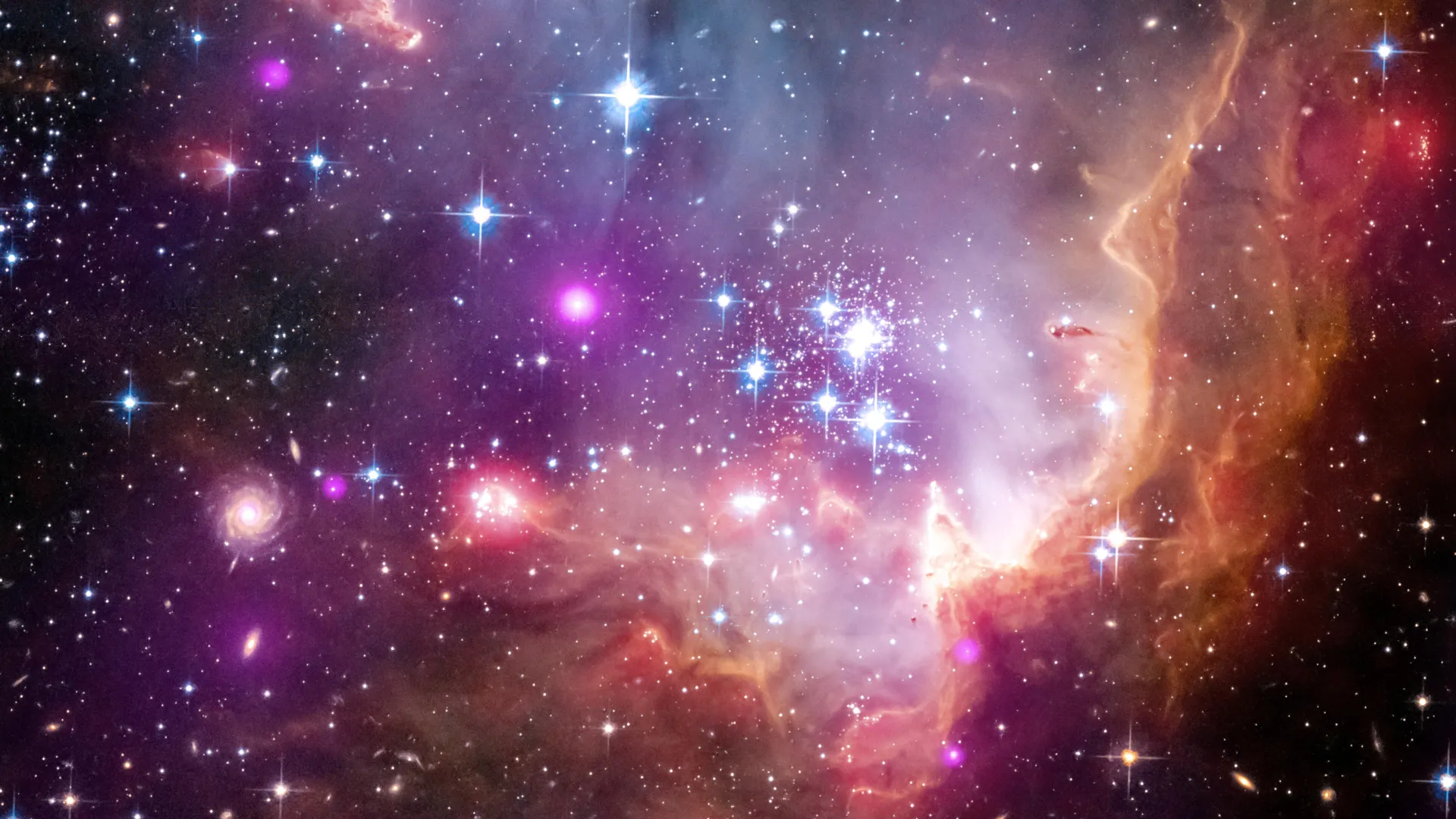
New astrophysical research has unveiled a dramatic explanation for the perplexing, chaotic stellar motions within the Small Magellanic Cloud (SMC), one of the Milky Way’s closest galactic companions, attributing its disarray to a violent, direct collision with its larger neighbor, the Large Magellanic Cloud (LMC), an event that fundamentally reshaped its internal dynamics and challenges its long-held role as a pristine analog for early universe galaxies. For decades, the Small Magellanic Cloud has presented a persistent enigma to astronomers, a compact, gas-rich dwarf galaxy visible to the unaided eye from the Southern Hemisphere, whose proximity has allowed for extensive observation. Orbiting our own Milky Way alongside its more massive counterpart, the Large Magellanic Cloud, these three galactic entities have engaged in a complex gravitational dance over hundreds of millions of years, leading to a rich history of interaction. Despite meticulous studies mapping its stellar populations, tracking its gas distribution, and measuring its overall motion, a fundamental puzzle persisted: unlike the orderly, rotating disks characteristic of most galaxies, the stars within the SMC exhibited a perplexing lack of coherent orbital motion around its gravitational center. This perplexing behavior defied conventional astrophysical models and left the scientific community searching for a comprehensive explanation.
A breakthrough, detailed in recent findings published in The Astrophysical Journal, offers a compelling and dramatic resolution to this long-standing puzzle. A research team from the University of Arizona has presented compelling evidence suggesting that the Small Magellanic Cloud’s anomalous internal kinematics are the direct consequence of a catastrophic, head-on collision with the Large Magellanic Cloud. This seminal discovery not only elucidates the SMC’s unusual state but also precipitates a critical re-evaluation of its suitability as a benchmark for understanding galactic formation and evolution across cosmic timescales. The implications are profound, suggesting that what was once considered a relatively undisturbed relic may, in fact, be a galaxy undergoing a profound and ongoing transformation.
Himansh Rathore, a graduate student at the Steward Observatory and the lead author of the pivotal study, articulated the significance of these observations, stating, "We are witnessing a galaxy transforming in live action." He further emphasized, "The SMC offers us a unique, front-row perspective on a highly transformative process that is fundamental to how galaxies evolve." This perspective underscores the extraordinary opportunity presented by the Magellanic Clouds – a rare chance to observe the dynamic, often destructive, forces that sculpt galactic structures in real-time, or at least within a relatively recent cosmic epoch.
A key characteristic of the Small Magellanic Cloud is its unusually high gas content relative to its stellar mass. In quiescent galaxies, it is standard astrophysical theory that gas, under the influence of gravity, gradually cools and condenses into a rotating disk, analogous to the flattened, spinning plane of our own solar system where planets orbit a central star. This process is foundational to the formation of stars and the establishment of stable galactic architectures. However, prior investigations utilizing advanced astronomical instruments, including the venerable Hubble Space Telescope and the European Space Agency’s Gaia satellite, had consistently revealed that the stars within the SMC deviated significantly from this expected pattern of orderly, rotational movement. Their trajectories appeared randomized, lacking the characteristic coherence of a well-behaved galactic disk.
According to Rathore and his team, the most plausible explanation for this deviation lies in a cataclysmic collision that transpired approximately a few hundred million years ago. During this violent encounter, the Small Magellanic Cloud is believed to have plunged directly through the dense disk of the Large Magellanic Cloud. The ensuing interaction involved two primary disruptive forces. Firstly, the immense gravitational forces exerted by the LMC during the close passage exerted powerful tidal stresses on the SMC. These forces acted to distort the SMC’s overall structure, effectively ripping apart its nascent internal order and scattering its constituent stars into the disorganized, non-rotational motions observed today. Secondly, the dense interstellar medium (ISM) within the LMC’s disk played a crucial role. As the SMC traversed this region, the LMC’s gas exerted a phenomenon known as ram pressure stripping. This intense pressure acted like a cosmic wind, effectively stripping away the rotational energy and much of the gas from the SMC, preventing it from settling into a stable, rotating disk.
To illustrate this complex process, Rathore offered a compelling analogy: "Imagine sprinkling water droplets on your hand and moving it through the air — as the air rushes past, the droplets get blown off because of the pressure it exerts. Something similar happened to the SMC’s gas as it punched through the LMC." This vivid comparison highlights the destructive efficiency of ram pressure, a mechanism increasingly recognized as a significant factor in shaping the evolution of galaxies, particularly dwarf galaxies interacting with more massive hosts in dense environments like galaxy clusters. The removal of gas not only disrupts existing rotation but also stifles future star formation, fundamentally altering the galaxy’s evolutionary trajectory.
Beyond explaining the stellar disarray, the study also provides a definitive resolution to a long-standing and perplexing contradiction concerning the Small Magellanic Cloud’s gas kinematics. For many years, observational data had indicated that the gas within the SMC appeared to exhibit a degree of rotation. Given that stars typically form from and subsequently inherit the motion of the gas clouds from which they coalesce, astronomers logically anticipated that the stars within the SMC would also display this rotational signature. However, as noted, this expectation was consistently contradicted by direct stellar observations. The new analysis brilliantly resolves this discrepancy by demonstrating that the apparent rotation of the gas was, in fact, an illusion arising from complex projection effects. The collision stretched and distorted the SMC into an elongated, non-equilibrium configuration. Consequently, gas moving along this stretched morphology, when viewed from Earth at certain angles, could create the misleading impression of a rotating disk, even as the true, underlying kinematic structure was one of profound disorganization and non-circular motion. This highlights the intricate challenges of interpreting astronomical data, where line-of-sight effects can profoundly influence perceived kinematics.
For several decades, the Small Magellanic Cloud has held a privileged position in astrophysical research, serving as a crucial reference point for investigating fundamental processes such as star formation and the broader mechanisms of galactic evolution. Its unique characteristics — relatively small size, high gas content, and particularly its low abundance of heavy elements (metallicity) — made it an invaluable local analog for the kinds of dwarf galaxies believed to have populated the early universe. These ancient, pristine systems are thought to be the building blocks of larger galaxies, and their study offers critical insights into the conditions of the cosmos shortly after the Big Bang. However, these new findings fundamentally challenge the SMC’s long-held role as a "normal" or undisturbed exemplar.
Leo Besla, a co-author of the study and a leading expert in Magellanic Cloud dynamics, underscored this re-evaluation, stating, "The SMC went through a catastrophic crash that injected a lot of energy into the system. It is not a ‘normal’ galaxy by any means." This assertion implies that any conclusions drawn about early universe galaxies based on the SMC’s properties must now be re-examined through the lens of its violent interaction history. A galaxy still reeling from such a powerful impact cannot be considered an unperturbed model for systems that evolved in isolation or under different interaction regimes. This realization has significant implications for our understanding of cosmic benchmarks and the methodologies employed in extragalactic astronomy.
To arrive at these groundbreaking conclusions, the research team employed a sophisticated suite of computational tools and theoretical models. They utilized highly detailed N-body and hydrodynamical computer simulations, meticulously calibrated to match the known observational properties of both the Small and Large Magellanic Clouds. These properties included their precise gas content, estimated stellar masses, and their three-dimensional positions and velocities relative to the Milky Way. By combining these robust simulations with advanced theoretical calculations, the researchers were able to precisely model how the SMC’s gas and stellar components would behave as it traversed the LMC’s dense gaseous environment. Furthermore, the team developed innovative new techniques specifically designed to interpret the highly scrambled and disorganized motions of stars within a galaxy that has undergone such a profound collisional event, allowing them to disentangle the complex kinematic signatures left by the impact.
The significance of this re-evaluation extends deeply into the field of galaxy evolution. If the Small Magellanic Cloud, with its low metallicity and high gas fraction, is indeed still recovering from a major collision, it can no longer reliably serve as a pristine model for understanding the star formation histories and chemical evolution of galaxies in the nascent universe. This necessitates a recalibration of models that have historically relied on the SMC as a local laboratory for early cosmic conditions. The findings underscore the dynamic nature of galactic environments and the pervasive influence of interactions, even for seemingly isolated dwarf galaxies.
Beyond its implications for galaxy evolution, the collision between the Magellanic Clouds may also offer unprecedented insights into the elusive nature of dark matter. In a separate, forthcoming study slated for publication in 2025, the same research team has uncovered compelling evidence that the impact left a discernible, lasting mark on the Large Magellanic Cloud itself. Specifically, its prominent central bar-shaped structure is observed to be tilted significantly out of the galaxy’s main plane, a feature the team has robustly linked to the profound gravitational disturbance caused by the SMC’s passage.
Rathore elaborated on this intriguing connection, explaining that the precise degree of this tilt within the LMC’s bar is directly dependent on the total amount of dark matter contained within the Small Magellanic Cloud. This correlation presents a novel and potentially powerful method for estimating the quantity and distribution of dark matter, a mysterious substance that does not emit, absorb, or reflect light, and thus cannot be directly observed. Its presence is inferred solely through its gravitational influence on visible matter. This new technique offers an independent means to constrain the dark matter halo of the SMC, complementing traditional methods that often rely on stellar velocity dispersion or gravitational lensing. Understanding the dark matter content of dwarf galaxies like the SMC is crucial for cosmological models, as these systems are believed to be rich in dark matter and play a critical role in the hierarchical structure formation of the universe.
The discoveries emanating from the study of the Magellanic Clouds serve as a powerful reminder of the dynamic and transformative nature of the cosmos. As Rathore succinctly articulated, "We are used to thinking of astronomy as a snapshot in time. But these two galaxies have come very close together, gone right through one another, and transformed into something different." This perspective emphasizes that galaxies are not static entities but rather living, evolving systems constantly shaped by gravitational interactions, mergers, and environmental processes. The Magellanic Clouds, positioned uniquely within our galactic neighborhood, offer a compelling, close-up laboratory for observing these fundamental cosmic dance steps.
The future outlook for this line of research is rich with potential. Further high-resolution observations of both the SMC and LMC, particularly kinematic studies of their stellar and gaseous components, will be crucial to refine the models and test the predictions of the collision hypothesis. Advanced simulations that incorporate even more detailed physics, such as magnetic fields and cosmic ray feedback, could provide deeper insights into the precise mechanisms of ram pressure stripping and tidal disruption. Furthermore, applying these newly developed analytical techniques to other interacting dwarf galaxies throughout the local group could reveal similar histories of unseen collisions, thereby enhancing our overall understanding of the prevalence and impact of such events on galaxy evolution. The ongoing study of the Magellanic Clouds continues to offer an unparalleled window into the forces that shape galaxies, from the smallest dwarfs to the grand spirals, profoundly influencing our cosmic narrative.


 Ridwan Kamil
 Safa Marwah
 Aura Kasih
 Lisa Mariana