
 Ayu Aulia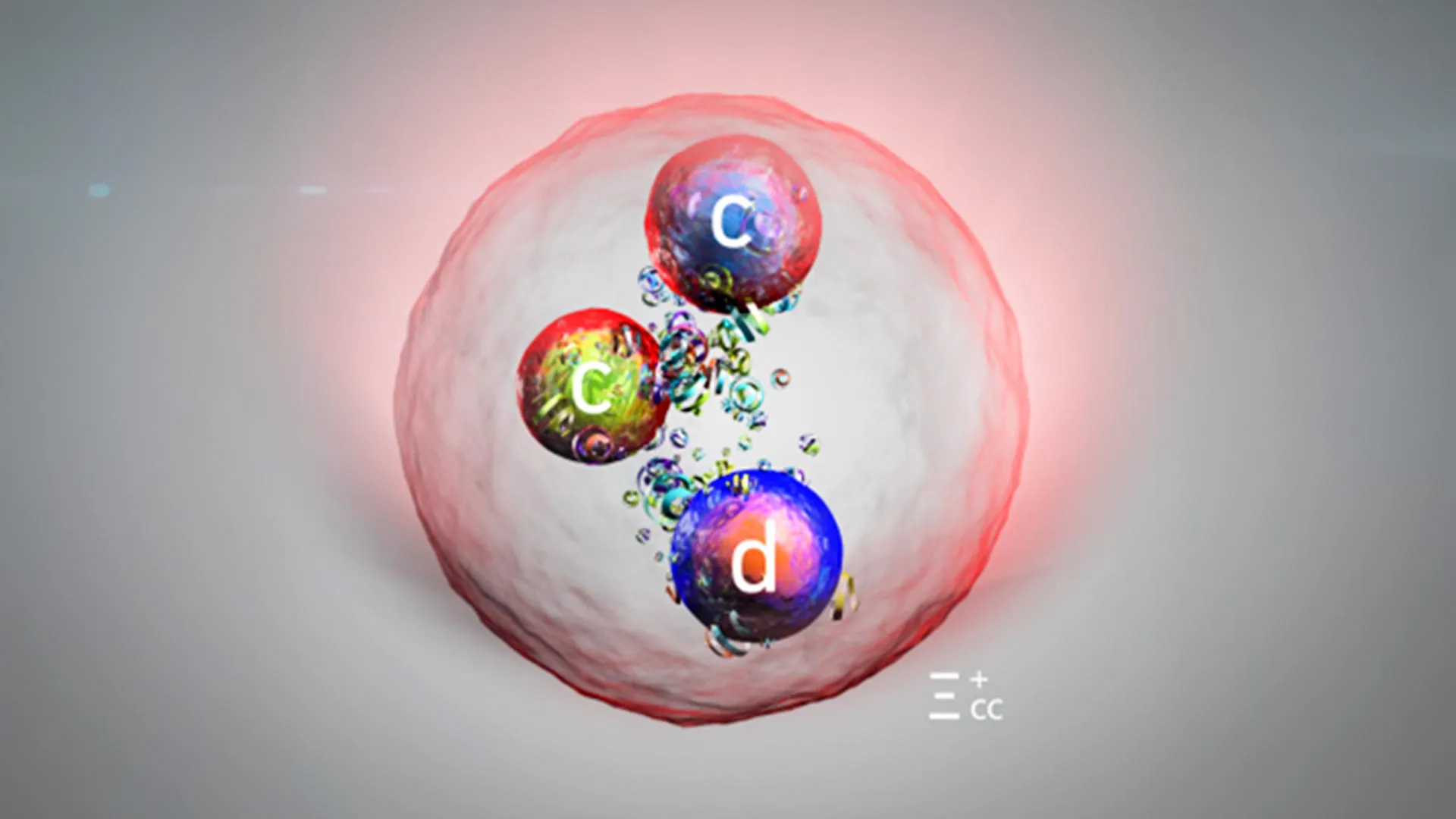
At the forefront of particle physics, an international collaboration at CERN’s Large Hadron Collider (LHC) has definitively identified a novel subatomic entity, a "doubly charmed" baryon structurally akin to the proton, named the Ξcc+. This groundbreaking discovery, spearheaded by a significant contribution from researchers at The University of Manchester, marks a pivotal moment, being the inaugural particle detection leveraging the newly enhanced LHCb detector and offering unprecedented insights into the fundamental composition of matter.
The recent identification of the Ξcc+ particle represents a profound advancement in our understanding of the fundamental constituents of the universe. Classified as a baryon, this particle is composed of two charm quarks and one down quark, making it a heavier relative within the same family as the ubiquitous proton. Its discovery at the LHC, the world’s most powerful particle accelerator, signifies a triumph of international scientific collaboration and cutting-edge technological innovation. This particular finding is not merely an addition to the "particle zoo" but provides critical experimental data for refining the theoretical framework that describes the strong nuclear force, quantum chromodynamics (QCD).
Delving into the Realm of Baryons and Quarks
To fully appreciate the significance of the Ξcc+, it is essential to contextualize it within the Standard Model of particle physics. Baryons are composite subatomic particles made of three quarks, bound together by the strong force. The most familiar baryons are the proton and the neutron, which form the nuclei of atoms. A proton consists of two up quarks and one down quark (uud), while a neutron comprises one up quark and two down quarks (udd). Quarks themselves come in six "flavors": up, down, strange, charm, bottom, and top, each possessing different masses and properties. The charm quark, significantly heavier than the up and down quarks, imparts a greater mass to any particle it constitutes.
The Ξcc+ particle, with its composition of two charm quarks and one down quark (ccd), is particularly intriguing. It belongs to the "Xi" (Ξ) family of baryons, which typically contain at least one strange quark. However, the Ξcc+ is distinguished by possessing two heavy charm quarks, a configuration that makes it a "doubly charmed" baryon. Prior to this discovery, only baryons with a single heavy quark (e.g., a single charm or bottom quark) had been firmly established. The detection of a particle with two heavy quarks provides a unique laboratory to study how these more massive quarks interact within a baryon structure, offering a critical test for theoretical predictions of the strong force’s behavior in such complex systems. Understanding the internal dynamics and binding energies of such exotic baryons is crucial for developing a more complete and accurate picture of how quarks assemble into matter.
The Upgraded LHCb Detector: A New Era of Precision
The discovery of the Ξcc+ would not have been possible without the substantial upgrade to the LHCb detector. The LHCb experiment is specifically designed to investigate the differences between matter and antimatter by studying particles containing beauty (b) or charm (c) quarks. These particles are often unstable and decay rapidly, requiring highly sophisticated detectors capable of precise tracking and timing measurements. The LHCb upgrade was an ambitious international undertaking, involving over a thousand researchers from twenty countries, with the United Kingdom emerging as the leading contributing nation, and The University of Manchester providing significant intellectual and technical leadership.
The upgrade involved a comprehensive overhaul of nearly all detector components to cope with the increased luminosity of the LHC, which translates to a significantly higher rate of proton-proton collisions. This higher collision rate allows for the generation of more data, enabling physicists to observe rarer phenomena and achieve greater statistical precision. Key to this enhancement was the redesign of the tracking system, which is responsible for accurately plotting the trajectories of particles emerging from collisions. Researchers from The University of Manchester played an instrumental role in designing and constructing essential parts of this advanced tracking system, specifically focusing on the silicon pixel detector modules. These modules, meticulously assembled within the University’s Schuster Building, are critical for resolving the precise decay vertices of short-lived particles, allowing scientists to reconstruct their original identities and properties, such as mass and lifetime. The ability to "photograph" particle interactions at an astonishing rate of 40 million frames per second, as described by Dr. Stefano De Capua, who led the production of these silicon detector modules, underscores the technological prowess embedded in the LHCb experiment. These custom-designed silicon chips, with variants finding utility in medical imaging, exemplify the synergistic benefits of fundamental research.
Professor Chris Parkes, who served as the head of the University’s Department of Physics and Astronomy and led the international collaboration during the crucial installation and initial operational phases of the upgraded LHCb detector, emphasized the profound legacy connecting past and present scientific endeavors. His decade-long oversight of the United Kingdom’s involvement, guiding the project from its initial conceptualization to its successful completion, highlights the sustained commitment required for such ambitious scientific undertakings. He drew a parallel between Rutherford’s transformative gold-foil experiment in Manchester, which fundamentally altered our understanding of atomic structure, and the present discovery at CERN, both driven by an insatiable curiosity and enabled by state-of-the-art technology. This continuity of pioneering research underscores the extraordinary capabilities of the upgraded LHCb detector and the strength of the UK’s, and particularly Manchester’s, contributions to the global particle physics community.
The Definitive Identification Process
The definitive identification of the Ξcc+ particle was achieved through meticulous analysis of its decay products. In the high-energy proton-proton collisions occurring within the LHC, a vast array of new particles are transiently created. While the Ξcc+ itself is extremely short-lived, it decays into a specific combination of three lighter, more stable particles: a Λc+ (Lambda-c-plus), a K− (kaon-minus), and a π+ (pion-plus). The LHCb detector precisely tracks these decay products, allowing physicists to reconstruct their trajectories and energies. By applying principles of conservation of energy and momentum, scientists can then infer the properties of the parent particle that gave rise to these decay products.
The critical data for this discovery was accumulated during 2024, the inaugural year of the upgraded LHCb experiment operating at its full design capacity. A clear and statistically robust signal of approximately 915 events was observed, corresponding to a parent particle with a reconstructed mass of 3619.97 MeV/c². This measured mass is in excellent agreement with theoretical predictions for a doubly charmed baryon and aligns with expectations derived from the previously discovered related particle, the Ξcc++ (Xi-cc-plus-plus), which consists of two charm quarks and an up quark (ccu). The consistency between experimental observation and theoretical models provides strong validation for both the Standard Model and the sophisticated analytical techniques employed by the LHCb collaboration.
Resolving a Two-Decade Enigma in Particle Physics
The confirmation of the Ξcc+ particle also resolves a long-standing mystery that has perplexed the particle physics community for over two decades. Earlier experimental claims regarding the observation of this particle had been reported, but these findings lacked sufficient statistical significance and could not be independently corroborated by other experiments. This left the existence of the Ξcc+ in a state of scientific uncertainty, prompting extensive debate and further theoretical investigation.
The new, high-precision measurement from the upgraded LHCb detector definitively settles this ambiguity. The measured mass of 3619.97 MeV/c² does not align with the mass reported in the unconfirmed earlier claims, but it precisely matches the values predicted by theoretical models based on quantum chromodynamics and experimental data from its partner particle, the Ξcc++. This outcome underscores the paramount importance of rigorous experimental validation and the continuous advancement of detector technology in particle physics. The ability of the LHCb experiment to produce such unambiguous results with high statistical certainty has provided closure on a prolonged scientific question, reinforcing confidence in the predictive power of current theoretical frameworks.
Manchester’s Enduring Legacy and Future Contributions
The University of Manchester’s instrumental role in this discovery is deeply rooted in its rich history of pioneering physics research. The institution’s legacy in particle physics began with Ernest Rutherford and his colleagues, who, between 1917 and 1919, performed the seminal experiments in a Manchester basement that led to the identification of the proton and the nuclear model of the atom. This foundational work laid the groundwork for modern particle physics. Decades later, in the 1950s, scientists at the university were again at the forefront, becoming the first to identify a member of the broader Xi (Ξ) particle family, thereby establishing a continuous thread of innovation that directly connects to the present discovery of the Ξcc+.
Looking ahead, The University of Manchester is poised to maintain its leadership role in the next evolutionary phase of the LHC program, known as LHCb Upgrade 2. This subsequent enhancement is designed to capitalize on the High-Luminosity LHC (HL-LHC) accelerator, which will significantly boost the rate of particle collisions, generating an even greater volume of data. The increased luminosity will enable physicists to explore rare particle decays with unprecedented detail, potentially uncovering subtle deviations from Standard Model predictions that could hint at the existence of new physics beyond our current understanding. Manchester’s continued involvement in designing and building advanced detector components and contributing to data analysis will be crucial for these future endeavors, ensuring the university remains at the cutting edge of fundamental physics research.
Implications for Fundamental Physics and Beyond
The discovery of the Ξcc+ particle carries profound implications for fundamental physics. It provides a unique test bed for Quantum Chromodynamics (QCD), the theory describing the strong force that binds quarks together. By studying the properties of baryons with different quark compositions, particularly those with multiple heavy quarks, physicists can probe the intricacies of the strong force in novel configurations. This helps refine theoretical models and calculations of baryon masses, magnetic moments, and decay processes, ultimately leading to a more comprehensive understanding of how matter is structured at its most fundamental level. The successful prediction and subsequent confirmation of the Ξcc+ particle reinforce the robustness of the Standard Model while also providing benchmarks for potential future discoveries that might challenge its boundaries.
Beyond its immediate impact on particle physics, the advanced detector technologies developed for experiments like LHCb often find unexpected applications in other fields. The silicon chip technology, for instance, employed in the LHCb detector’s "high-speed camera" function, already demonstrates variants suitable for medical imaging. Such cross-disciplinary benefits underscore the broader societal value of investing in curiosity-driven fundamental research. The details of this momentous Ξcc+ discovery were formally presented to the international scientific community at the prestigious Rencontres de Moriond Electroweak conference, solidifying its place as a significant milestone in the ongoing quest to unravel the universe’s deepest secrets.




 Aura Kasih
 Lisa Mariana

 Ridwan Kamil
 Safa Marwah