Safa Marwah
In a significant evolution of its security infrastructure, Apple has initiated the deployment of its novel Background Security Improvements feature, delivering an urgent patch for a critical WebKit flaw, identified as CVE-2026-20643. This landmark release marks a strategic pivot towards a more agile and less disruptive patching methodology, allowing targeted security enhancements for iPhones, iPads, and Macs without mandating a comprehensive operating system upgrade or device reboot.
The Critical WebKit Vulnerability and its Resolution
The vulnerability, designated CVE-2026-20643, represented a severe cross-origin issue within the Navigation API of WebKit, the proprietary browser engine underpinning Safari and all third-party browsers on Apple’s platforms. At its core, this flaw permitted malicious web content to circumvent the Same Origin Policy (SOP), a foundational security control designed to isolate documents and scripts from different origins to prevent unauthorized interaction. A successful bypass of the SOP could enable an attacker to access sensitive data, such as cookies, local storage, or other confidential information, from legitimate websites visited by the user, leading to potential data exfiltration, session hijacking, or other forms of privacy and security breaches. The severity of such a flaw necessitates an immediate and robust response, given WebKit’s pervasive role in the user experience across billions of Apple devices.
The resolution implemented by Apple focused on enhancing input validation within the affected Navigation API. Improved input validation ensures that data received from external sources, particularly untrusted web content, is rigorously checked against predefined rules and formats before being processed. This prevents malformed or malicious inputs from exploiting logical flaws or unexpected behaviors within the application, thereby neutralizing the vector for the Same Origin Policy bypass. This targeted approach to remediation underscores the precision offered by the new patching mechanism.
The discovery of this critical vulnerability is attributed to security researcher Thomas Espach, whose diligent work brought the flaw to Apple’s attention. Prompt and effective reporting by security researchers is an indispensable component of the cybersecurity ecosystem, enabling vendors to proactively address weaknesses before they can be widely exploited by malicious actors. The subsequent availability of the fix across iOS 26.3.1, iPadOS 26.3.1, macOS 26.3.1, and macOS 26.3.2 ensures broad protection for the user base on recent operating system versions.
Introducing Apple’s Background Security Improvements: A Paradigm Shift
This deployment of CVE-2026-20643’s fix stands as the inaugural application of Apple’s Background Security Improvements (BSI) feature. Introduced with iOS 26.1, iPadOS 26.1, and macOS 26.1, BSI represents a significant architectural shift in how Apple delivers security updates. Historically, security patches for core components, even minor ones, often necessitated a full operating system update, requiring users to download substantial software packages and perform a device restart. This process, while effective, could be disruptive and create delays in widespread adoption, leaving users exposed for longer periods.
BSI fundamentally alters this paradigm by enabling the delivery of "lightweight security releases." These are small, incremental patches specifically designed for components such as the Safari browser, the underlying WebKit framework stack, and other crucial system libraries. The defining characteristic of BSI is its "out-of-band" nature; these patches can be delivered and applied independently of the regular, larger security update cycle that accompanies full operating system releases. This capability grants Apple unprecedented agility in responding to newly discovered vulnerabilities, particularly zero-day exploits that require immediate mitigation.
The strategic rationale behind BSI is multi-faceted. In an increasingly complex threat landscape, where new vulnerabilities are discovered with alarming frequency, the ability to deploy targeted fixes rapidly is paramount. Traditional update cycles, often on a monthly or quarterly cadence, can be too slow to counteract fast-moving threats. BSI closes this window of vulnerability, providing a mechanism for "rapid-response" patching that minimizes user exposure time. Moreover, by segmenting security updates from full OS upgrades, Apple can streamline its development and testing processes, ensuring that critical fixes are deployed efficiently without being tied to the broader complexities of a complete system overhaul.
Operational Mechanics and User Implications
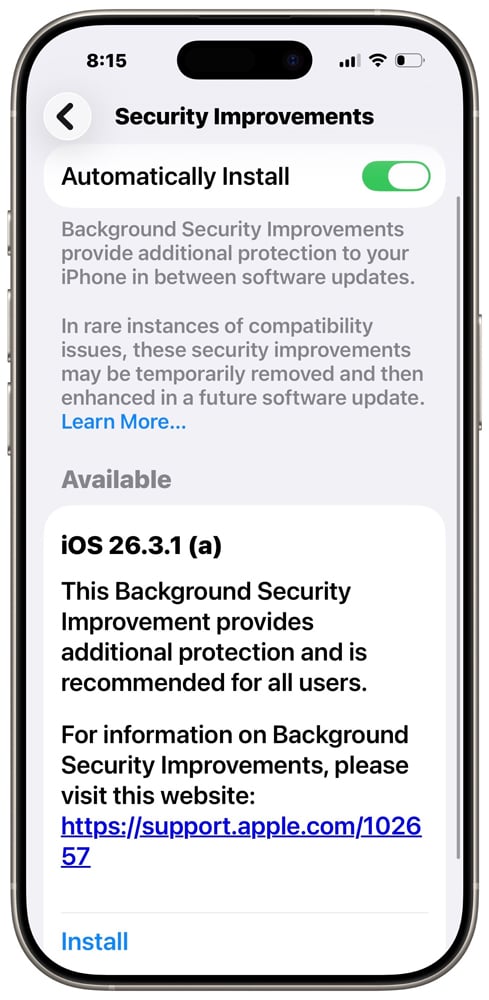
From a user perspective, the operation of Background Security Improvements is designed to be seamless and largely invisible. Unlike major OS updates, these incremental patches are applied to specific components in the background, typically without requiring user intervention or a device restart. This "set it and forget it" approach significantly enhances the user experience, eliminating the friction often associated with maintaining device security. Users no longer need to consciously interrupt their workflow or schedule dedicated time for security updates, fostering a continuous state of enhanced protection.
Users retain a degree of control over this feature, accessible through the device settings under the "Privacy & Security" menu. While the default behavior is designed for automatic application, the ability to manage these improvements provides transparency and, in rare instances, allows for troubleshooting. However, Apple issues a stern caution regarding the uninstallation of these background patches. Removing a Background Security Improvements update effectively reverts the device to its baseline operating system version (e.g., iOS 26.3.1) without any of the incremental security fixes that were applied. This action strips away the rapid-response security protections delivered through BSI, leaving the device at a potentially vulnerable security level until the patches are reapplied or integrated into a future full operating system update. Consequently, unless a specific background security improvement demonstrably causes a compatibility issue or operational problem, the prevailing recommendation is strongly against their uninstallation. This highlights the critical nature of these small, yet potent, security enhancements.
Strategic Rationale and Industry Context
Apple’s introduction of Background Security Improvements aligns with a broader industry trend towards more granular and continuous software patching. Modern software development and deployment paradigms, particularly in cloud services and browser technologies, emphasize agility and frequent updates. Browsers like Google Chrome, for instance, operate on a rapid release cycle, pushing out security updates every few weeks. Operating systems, however, have traditionally lagged in this regard due to their inherent complexity and the potential for system-wide instability. Apple’s BSI bridges this gap, bringing operating system-level security patching closer to the agility seen in browser-specific updates.
This move is strategically vital for Apple’s overall security posture. With billions of devices globally, the attack surface for potential exploits is immense. Rapidly patching critical vulnerabilities, especially those in fundamental components like WebKit, is essential for maintaining user trust and protecting the integrity of its ecosystem. By reducing the time attackers have to exploit newly discovered flaws, Apple can significantly diminish the effectiveness of targeted attacks and large-scale campaigns. It also eases the pressure on its full OS development cycle, allowing these larger releases to focus more on new features and broader system enhancements, rather than being solely dictated by urgent security imperatives.
Advantages and Potential Considerations
The advantages of Background Security Improvements are substantial. For users, the primary benefit is continuous, unobtrusive security. Devices remain protected against the latest threats without the need for frequent reboots or manual updates. For Apple, it provides enhanced responsiveness to the dynamic threat landscape, strengthening its reputation as a security-conscious platform provider. This agility can be particularly crucial in mitigating zero-day vulnerabilities, where every hour counts in protecting users from active exploitation.
However, this new approach also introduces certain considerations. Apple itself acknowledges the possibility of "rare instances of compatibility issues," where a background security improvement might temporarily be removed and subsequently enhanced in a future software update. This underscores the inherent complexity of patching live systems and the need for robust testing, even for seemingly minor updates. For enterprise environments and IT administrators, managing a fleet of devices that might have varying levels of background patches, in addition to baseline OS versions, could introduce new layers of complexity in patch management and compliance verification. Transparent reporting and clear documentation from Apple will be crucial for these stakeholders. Furthermore, while the updates are designed to be seamless, maintaining user awareness and understanding of this new security layer, particularly the implications of uninstallation, will be an ongoing communication challenge.
The Future of Patch Management on Apple Platforms
The successful initial deployment of Background Security Improvements for CVE-2026-20643 marks a pivotal moment for Apple’s security strategy. It signifies a long-term commitment to a more proactive, agile, and user-friendly approach to cybersecurity. As the digital threat landscape continues to evolve, characterized by increasingly sophisticated and rapidly deployable exploits, the ability to deliver targeted, out-of-band patches will become not merely a convenience, but a necessity.
This new capability positions Apple to respond to emerging threats with unparalleled speed, enhancing the resilience of its ecosystem. It also sets a potential precedent for other platform vendors, demonstrating a viable model for balancing comprehensive security with minimal user disruption. The continuous evolution of patching mechanisms, moving from infrequent, monolithic updates to frequent, granular, and background-applied improvements, represents a maturing of the software security industry, ultimately benefiting billions of users worldwide. As Apple continues to refine and expand the scope of BSI, it is poised to significantly elevate the baseline security posture of its vast device ecosystem, contributing to a more secure digital environment for all its users.




 Aura Kasih
 Lisa Mariana
 Ayu Aulia