
 Ayu Aulia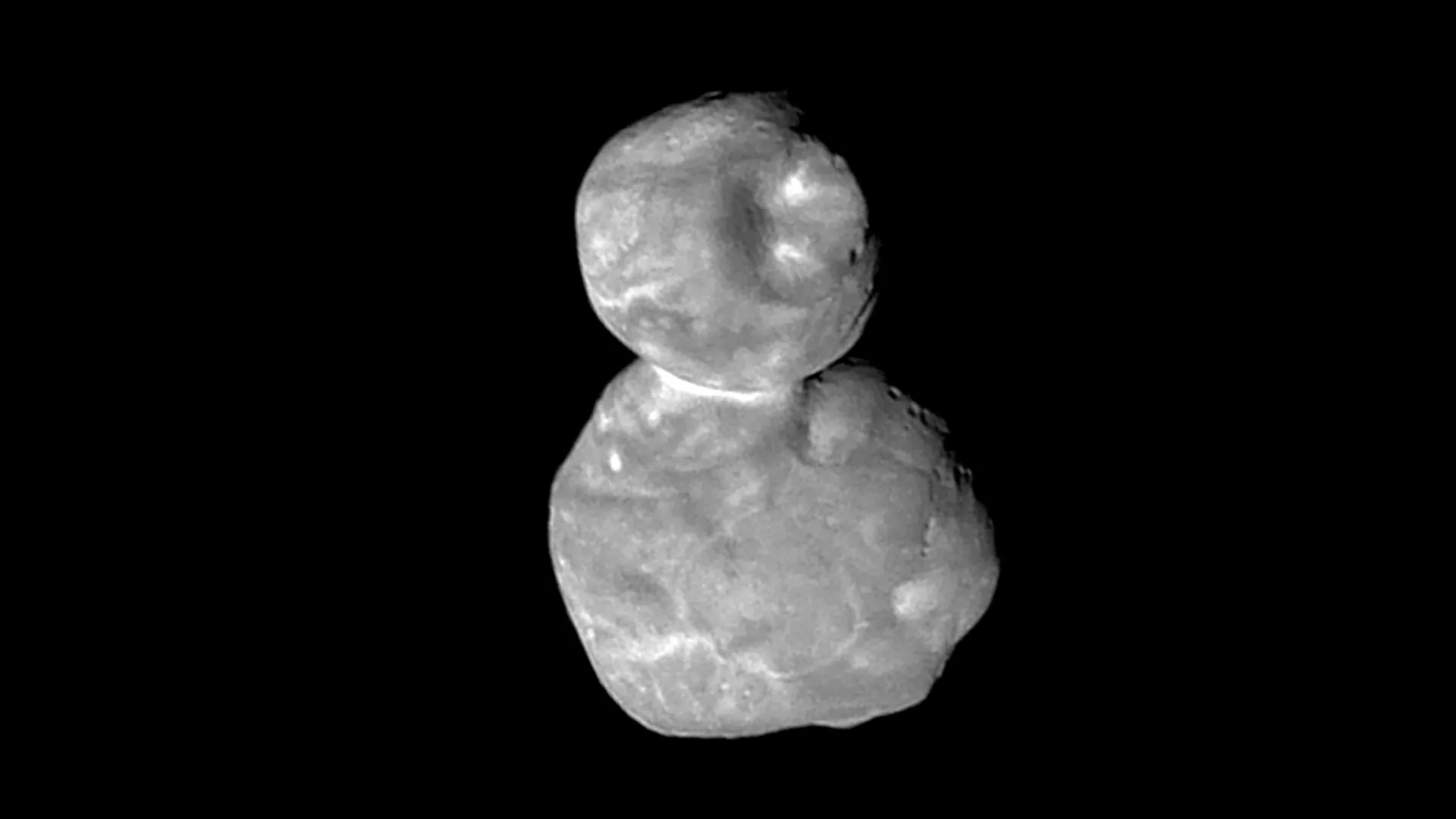
For decades, celestial observatories have cataloged peculiar, double-lobed objects in the farthest reaches of our solar system, their distinctive, conjoined forms evoking comparisons to terrestrial snowmen. Recent groundbreaking research from Michigan State University has illuminated a surprisingly elegant and prevalent mechanism for the genesis of these enigmatic structures, providing a crucial piece in the complex puzzle of planetary formation.
Beyond the inner solar system, past the gas giants and their myriad moons, lies the Kuiper Belt—a vast, frigid expanse teeming with remnants from the solar system’s earliest epoch. This colossal reservoir, stretching far beyond Neptune’s orbit, is a fossilized testament to the conditions that prevailed during the birth of our stellar neighborhood some 4.5 billion years ago. Within this primordial deep freeze reside countless planetesimals, the foundational building blocks from which planets eventually coalesced. A significant fraction of these icy bodies, approximately one in ten, exhibit a peculiar morphology: they are "contact binaries," two distinct, rounded lobes gently fused together, creating the iconic "snowman" appearance. The precise astrophysical processes capable of producing such delicate yet stable configurations had long eluded definitive explanation, prompting various hypotheses ranging from violent impacts to highly improbable chance encounters.
The prevailing scientific understanding of planetesimal formation and subsequent interactions has been significantly refined by the work of Jackson Barnes, a graduate student at Michigan State University. His pioneering computer simulations have for the first time successfully replicated the spontaneous formation of these double-lobed structures through a process of gravitational collapse, a finding that offers a compelling and widely applicable solution to a long-standing astronomical enigma. The detailed methodology and results of this research were recently published in the esteemed journal, Monthly Notices of the Royal Astronomical Society.
Prior computational models, while instrumental in advancing our understanding of celestial dynamics, often simplified the physics of low-velocity collisions by treating interacting bodies as fluid masses. This assumption, while simplifying calculations, inherently prevented the natural emergence of the distinct, two-part morphology observed in contact binaries. In such models, colliding objects tended to merge seamlessly into a single, larger, and more spherical entity, failing to preserve the individual identities of the constituent lobes. Barnes’ innovative approach leveraged the sophisticated computational power of MSU’s Institute for Cyber-Enabled Research (ICER), enabling the creation of a far more realistic digital environment. Crucially, his model incorporated the inherent structural strength of forming objects, allowing them to settle against each other rather than instantly amalgamate into a homogenous mass. This nuanced physical representation proved to be the linchpin in unlocking the mystery of contact binary formation.
The appeal of this gravitational collapse model lies not only in its explanatory power but also in its universality. Earlier theories often invoked rare cosmic events or highly specific, unusual conditions to account for these shapes. While such scenarios are not entirely impossible within the vastness of the cosmos, they struggle to explain the observed prevalence of contact binaries. As Professor Seth Jacobson, a senior author on the paper and an expert in Earth and Environmental Sciences, succinctly articulated, "If we think 10 percent of planetesimal objects are contact binaries, the process that forms them can’t be rare." The elegant simplicity and statistical likelihood of gravitational collapse align remarkably well with empirical observations, suggesting a fundamental process rather than an anomalous occurrence.
The widespread scientific and public attention garnered by contact binaries reached an unprecedented peak in January 2019, when NASA’s New Horizons spacecraft executed a historic flyby of Arrokoth (formerly known as Ultima Thule). This distant Kuiper Belt object, located approximately 6.6 billion kilometers from Earth, provided humanity’s first close-up view of a primordial contact binary. Its distinct two-lobed shape, composed of a larger "pancake" lobe and a smaller, more spherical lobe, served as irrefutable visual evidence of these unusual formations. The stunning images from New Horizons not only captivated the world but also spurred astronomers to re-examine other Kuiper Belt objects with renewed scrutiny, confirming that approximately one in ten planetesimals indeed share this distinctive morphology. The Kuiper Belt’s inherently sparsely populated nature means that objects drift with relatively few high-energy collisions, creating an environment where even fragile, gently merged structures can persist for eons, largely undisturbed.
The Kuiper Belt itself serves as a crucial relic, a frozen archive preserving the conditions of the early Milky Way galaxy. In its nascent stages, our galaxy existed as a rotating disc of gas and dust, from which our Sun and planets eventually formed. This ancient, unprocessed material still lingers in the Kuiper Belt, comprising not only countless planetesimals but also larger dwarf planets such as Pluto and numerous comets. Studying these pristine objects offers direct insights into the initial conditions and processes that governed the assembly of our planetary system.
The formation of planetesimals was among the very first steps in the hierarchical accretion process that built our solar system. Within the swirling protoplanetary disk surrounding the young Sun, microscopic dust grains and pebbles began to adhere to one another, much like snowflakes aggregating to form a snowball. These tiny particles, initially held together by van der Waals forces, gradually grew large enough for their own nascent gravity to become dominant, drawing in more material and forming larger, more substantial clusters. As these rotating clouds of accumulating material continued to collapse under their own gravity, they sometimes underwent a process of fragmentation, splitting into two distinct, gravitationally bound bodies that began to orbit each other. Astronomers have frequently observed such binary planetesimal systems within the Kuiper Belt, providing empirical evidence for this initial phase.
The crucial insight provided by Barnes’ simulation is the subsequent evolution of these binary pairs. Instead of remaining in a stable orbit indefinitely, or experiencing a destructive collision, the two bodies within the simulated binary system gradually spiraled inward due to gravitational interactions and possibly tidal forces. Critically, the model demonstrates that rather than impacting violently and shattering or merging into a single sphere, the two objects gently make contact and slowly fuse. This "soft landing" preserves their individual, rounded shapes, resulting in the familiar bilobed "snowman" configuration. The ability of the simulation to capture this delicate interaction, where structural integrity is maintained, is what differentiates it from previous, less successful attempts.
Once joined in this distinctive fashion, these contact binaries exhibit remarkable long-term stability, capable of remaining intact for billions of years. According to Barnes, their enduring persistence is primarily attributable to the exceptionally low probability of subsequent disruptive impacts within the Kuiper Belt. In this remote and sparsely populated region, collisions between substantial objects are exceedingly rare. Without a significant disruptive event, there is no external force powerful enough to separate the two conjoined lobes or to significantly alter their shape. Observational evidence further supports this notion, as many binary objects within the Kuiper Belt display surprisingly few impact craters, suggesting a relatively quiescent history since their formation.
While the hypothesis of gravitational collapse as a mechanism for forming contact binaries had been entertained by scientists, prior computational models simply lacked the detailed physical fidelity necessary to rigorously test this idea. Barnes’ work represents a significant leap forward, being the first to successfully incorporate the requisite physical processes—specifically, the treatment of objects with structural strength rather than as fluid bodies—to accurately recreate these enigmatic formations. "We’re able to test this hypothesis for the first time in a legitimate way," Barnes affirmed, underscoring the profound excitement generated by this research within the planetary science community.
The implications of this research extend beyond merely explaining the "snowman" shape. The model developed by Barnes holds promise for helping researchers unravel the mysteries of even more complex systems, potentially involving three or more interconnected objects. The research team is actively engaged in developing an improved simulation, aiming to represent the intricate dynamics and behavior of collapsing dust and pebble clouds with even greater fidelity. This ongoing work promises to further refine our understanding of the very earliest stages of solid body accretion in protoplanetary disks.
As space agencies like NASA continue to plan and execute missions designed to explore the distant, uncharted frontiers of our solar system, Professor Jacobson and Barnes anticipate the discovery of an increasing number of these distinctively shaped worlds. Each new observation will provide further validation for their model and offer invaluable data points for refining our understanding of how planets and their constituent building blocks assembled themselves in the cosmos. This research not only demystifies a peculiar class of celestial objects but also enriches our fundamental understanding of the universal processes that shaped our planetary home and, by extension, countless other planetary systems across the galaxy.



 Aura Kasih
 Lisa Mariana
 Ridwan Kamil


 Safa Marwah