Lisa Mariana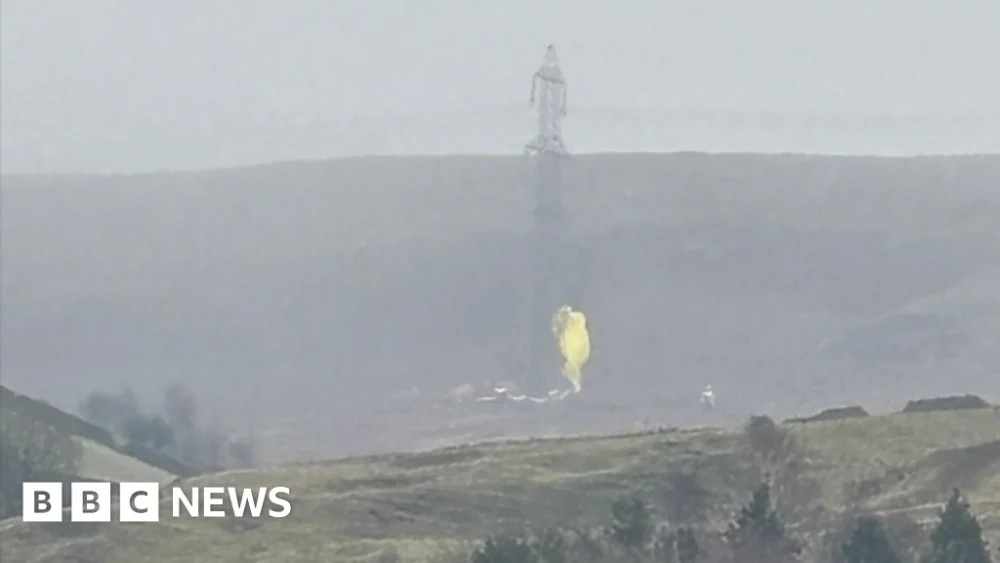
An unfolding aviation incident in Greater Manchester has triggered a significant multi-agency emergency response, following the reported crash of a light aircraft believed to have been carrying two individuals. The event, which occurred in the rural expanse of Littleborough, near Rochdale, has drawn immediate attention due to initial indications of a deployed airframe parachute system and the challenging environmental conditions at the scene.
Emergency services, including units from the Greater Manchester Police, Greater Manchester Fire and Rescue Service, and the North West Air Ambulance, were swiftly dispatched to a remote agricultural area adjacent to the M62 motorway shortly after 11:00 GMT. The precise location of the incident has been identified as farmland accessible via Tunshill Lane, a secluded route situated off Kiln Lane and in proximity to the Tunshill Golf Club. The rapid deployment underscores the severity and potential complexity of the situation, initiating a coordinated effort to secure the crash site, assess any casualties, and establish the full circumstances surrounding the event.
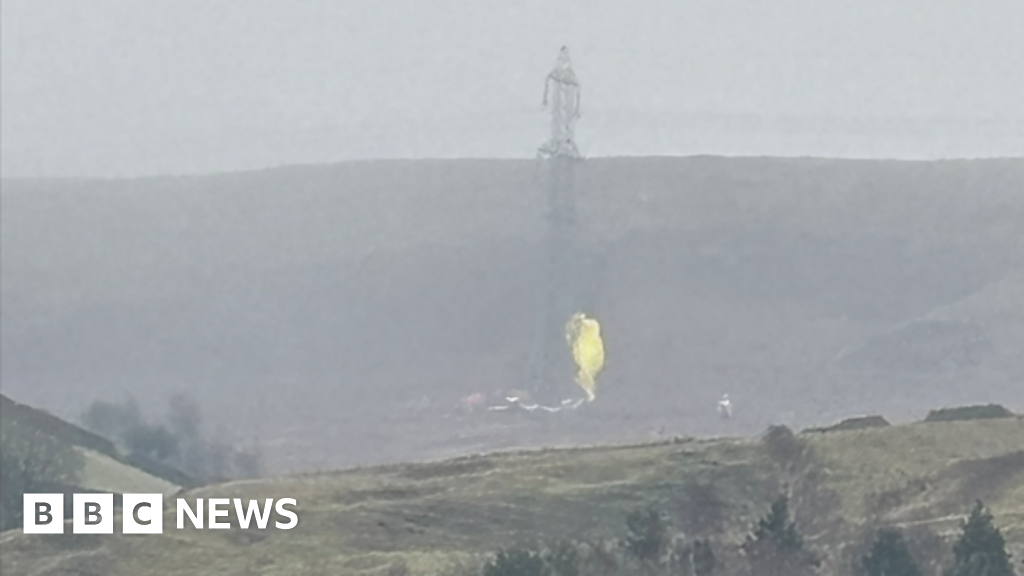
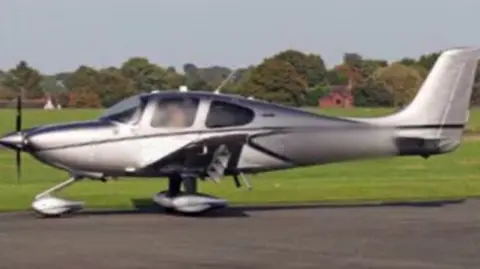
Preliminary identification, based on flight tracking data, suggests the aircraft involved is a Cirrus SR20 model. This particular type of light aircraft is notable within general aviation for its inclusion of a unique safety feature: the Cirrus Airframe Parachute System (CAPS). This ballistic parachute system is designed to deploy in an emergency, lowering the entire aircraft and its occupants safely to the ground. Compelling visual evidence, rapidly disseminated across digital platforms, depicted what appeared to be a distinctive yellow parachute canopy entangled within a nearby electricity pylon amidst foggy conditions, strongly indicating that the CAPS system was activated prior to impact. This detail immediately shifted the focus of initial observations from a conventional crash to one involving advanced safety mechanisms.
The Cirrus SR20, a four-seat, single-engine composite aircraft, has been a popular choice for private pilots and flight training since its introduction. Its integration of the CAPS system, a pioneering safety innovation, has often been a significant selling point, distinguishing it from many other aircraft in its class. The system, developed by Ballistic Recovery Systems (BRS), consists of a large parachute packed into the aircraft’s fuselage, deployed by a solid-propellant rocket motor. When activated, the parachute extracts from its housing, unfurls, and significantly reduces the aircraft’s descent rate, aiming to provide a survivable impact for the occupants. This safety feature has been credited with saving numerous lives in various emergency scenarios, ranging from engine failures to mid-air collisions. The apparent deployment in this incident highlights the critical role such advanced safety systems play in mitigating the catastrophic outcomes typically associated with aircraft accidents.
The immediate aftermath of such an incident necessitates stringent protocols for scene management and investigation. Greater Manchester Police issued a statement confirming their presence, emphasizing the priority of assessing casualties and securing the area. The public has been advised to avoid the vicinity to allow emergency personnel unhindered access and to conduct their vital work. The complexity of a crash site, particularly one involving an aircraft with a deployed parachute, requires meticulous handling to preserve evidence for the subsequent investigation. The presence of a parachute adds another layer of inquiry, as investigators will seek to understand why it was deployed and how effectively it functioned under the specific conditions.
The air ambulance, an integral part of the rapid response, was observed departing the scene and subsequently landing at Salford Royal Hospital. While the specific condition of any casualties remains officially unconfirmed, the deployment of an air ambulance typically signifies injuries requiring urgent medical attention and specialized transport to a major trauma centre. This aspect of the response underscores the potential for serious injuries among the aircraft’s occupants, even with the deployment of the parachute system. The transfer to a hospital specializing in critical care indicates the gravity with which the medical aspect of this incident is being handled.
Local residents and workers in the vicinity provided early accounts of the unfolding drama, painting a picture of a dynamic and rapidly evolving situation. Pete Robinson, a farmer from Shaw, recounted hearing a flurry of sirens and observing a "massive response" ascending Blackstone Edge. Initially mistaking the parachute for a paraglider due to the misty conditions and the sheer scale of the emergency presence, he noted the "horrendous wind" on the moor edge, a factor that could significantly complicate both the parachute’s deployment and subsequent descent, as well as the rescue operations. His observations highlight the challenging meteorological environment prevailing at the time of the incident, which can be a critical element in aviation investigations.
Stephanie Mills, associated with Dickey Steps Riding School, corroborated the presence of numerous emergency vehicles and the striking visual of a large yellow parachute affixed to the pylon. Her statement about not hearing any noise before the incident is significant. It could suggest a sudden mechanical failure leading to the rapid deployment of CAPS, or it could simply be a result of the wind direction or the distance from the crash site. Andrew Mayall, a green keeper at Whittaker Golf Club, also noticed the anomaly around 10:00 GMT, initially attributing the large yellow object to a sheet blown by the strong winds characteristic of the area. These firsthand accounts from individuals on the ground offer valuable initial context, providing a glimpse into the immediate perceptions and the scale of the incident before official information becomes fully available.
Beyond the immediate rescue and stabilization efforts, the incident initiates a comprehensive investigation led by the Air Accident Investigation Branch (AAIB) of the United Kingdom. The AAIB is an independent body responsible for investigating civil aircraft accidents and serious incidents within the UK, with the sole objective of preventing future occurrences. Their work will be crucial in determining the causal factors behind this crash. This process typically involves a multi-faceted approach:
- Site Examination: Meticulous documentation and recovery of wreckage, components, and any relevant debris.
- Witness Interviews: Gathering detailed testimonies from anyone who observed the aircraft or the incident.
- Data Analysis: Reviewing flight tracking data, air traffic control recordings, weather reports, and any available onboard data recorders (though light aircraft like the SR20 may not carry the same sophisticated recorders as commercial airliners).
- Aircraft Records Review: Examining maintenance logs, pilot qualifications, flight plans, and fuel records.
- Component Analysis: Detailed examination of the engine, airframe, and particularly the CAPS system, to ascertain its operational status and any potential malfunctions.
The investigation will aim to ascertain whether the incident was a result of mechanical failure, pilot error, environmental factors such as severe weather or turbulence, or a combination of these elements. The fact that the CAPS system was deployed will be a central point of inquiry, as investigators seek to understand why the pilot made the decision to activate it and how the system performed under the specific conditions. Lessons learned from this incident will contribute to the ongoing refinement of aviation safety protocols, aircraft design, and emergency procedures, not only for Cirrus aircraft but potentially for general aviation as a whole.
This incident also underscores the inherent risks associated with general aviation, despite continuous advancements in safety technology. While statistically less frequent than road accidents, aircraft incidents often draw significant public attention due to their dramatic nature. The presence of challenging weather conditions, as noted by witnesses, is often a critical factor in light aircraft operations. Pilots of small aircraft are highly dependent on visual flight rules (VFR) in many instances, making visibility and wind conditions paramount for safe flight. The moorland environment around Littleborough, known for its exposure to strong winds and rapidly changing weather, presents a demanding operational context for any aircraft.
As the investigation progresses, further details will undoubtedly emerge regarding the status of the occupants, the precise sequence of events leading to the crash, and the ultimate findings of the AAIB. The focus remains on understanding this complex event to enhance aviation safety for all future flights. The community, while urged to maintain distance from the ongoing emergency operations, will undoubtedly follow the developments with keen interest, hoping for positive outcomes for those involved and clarity on the circumstances that led to this dramatic incident in their rural landscape.



 Ayu Aulia
 Aura Kasih
 Safa Marwah