Aura Kasih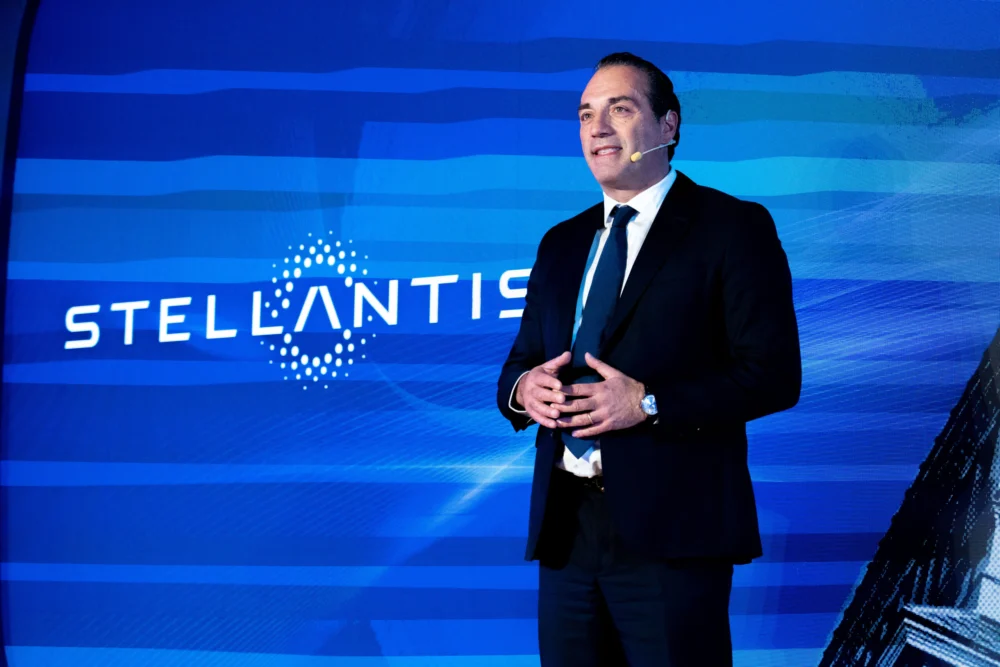
In a stark illustration of the seismic shifts occurring within the global automotive industry, Stellantis, the multinational automotive giant behind brands like Jeep, Dodge, and Chrysler, finds itself confronting a substantial financial setback, largely attributed to a miscalculated strategic pivot towards electric vehicles (EVs). This significant valuation adjustment, coupled with persistent challenges in product development and market positioning, underscores a broader industry struggle to navigate evolving consumer preferences and the volatile geopolitical climate surrounding automotive technology.
The automotive sector is currently experiencing a widespread deceleration in demand for electric vehicles, a trend that has led to considerable financial strain for numerous manufacturers. General Motors recently absorbed a $7.6 billion impact, while Ford reported a $19.5 billion write-down. Stellantis, however, has reported the most substantial financial charge to date, a staggering $26.5 billion write-down, signaling deep-seated issues within its electrification strategy. While the precise allocation of this figure to specific EV-related losses remains undisclosed, the immediate consequence was a dramatic 25% erosion of the company’s stock value.
This financial shockwave for Stellantis occurs against a backdrop of cooling EV demand and fluctuating political support for green technologies, a scenario impacting all major automakers. However, Stellantis appears particularly vulnerable, a situation exacerbated by what analysts describe as a history of lagging behind technological advancements and evolving consumer tastes. Compounding these financial pressures is an additional $16.7 billion charge related to warranty and recall claims. This includes a significant recall of over 320,000 Jeep 4xe plug-in hybrid vehicles due to battery fire risks, a costly and reputation-damaging event that further amplifies the company’s financial woes.
The corporate lineage of Stellantis, tracing through Fiat Chrysler, DaimlerChrysler, and Chrysler Corp., reveals a consistent pattern of operational challenges and strategic missteps. Critics often characterize the company as a lagging participant, prone to prioritizing short-term gains and readily available solutions over long-term, innovative development. This approach is exemplified by its continued emphasis on internal combustion engine (ICE) vehicles, particularly V8 engines, which remain a core component of its most profitable segments in the American market, such as Ram pickup trucks and Jeep SUVs.
Despite the global push towards electrification, Stellantis is significantly increasing its production of V8 engines at its Saltillo, Mexico facility, anticipating a threefold increase in output for 2026 to meet demand for its popular Ram 1500 pickups, Jeep Wranglers, and other high-margin models. This strategic decision, while catering to current market demand, raises questions about the company’s long-term commitment to electrification and its preparedness for future regulatory landscapes and consumer shifts.
Stellantis CEO Antonio Filosa has publicly acknowledged the strategic flexibility afforded by current regulatory policies, specifically citing the "Big Beautiful Bill" – a reference to the Trump administration’s relaxation of pollution and mileage standards. This regulatory environment, according to Filosa, allows the company "more flexibility in choosing… a mix between ICE and electric versions that we sell. And this will mean, to us, a lot of additional profit." This perspective highlights a pragmatic, albeit potentially short-sighted, approach to maximizing profitability in the near term by leveraging existing strengths in ICE technology, even as the industry collectively grapples with the transition to zero-emission vehicles.
The company’s recent EV offerings in the United States have faced considerable headwinds. The Dodge Charger Daytona, an ambitious attempt to electrify American muscle car heritage, ultimately required the introduction of a gasoline variant due to insufficient market traction. Similarly, the Jeep Wagoneer S EV, priced at over $70,000 with options, has struggled to gain traction in showrooms, signaling a disconnect between the company’s high-end EV offerings and consumer willingness to adopt them. The upcoming 2026 Jeep Recon, intended to compete with models like the Tesla Model Y, also carries a significant price tag of $67,000, without the benefit of federal tax credits, further challenging its market appeal.

The rollback of environmental regulations by the Trump administration has fundamentally altered the competitive calculus for automakers. The repeal of emissions and fuel economy standards, along with the elimination of the EPA’s "endangerment finding" for greenhouse gases, removes the financial penalties for failing to meet these targets. This regulatory shift effectively liberates automakers from the obligation to purchase expensive emissions credits from EV leaders like Tesla or invest heavily in developing EVs that have not yet proven profitable.
In this environment, many automakers, including the Detroit Three, are embracing a strategy of "choice," allowing them to prioritize the production of profitable ICE vehicles, primarily trucks and SUVs, at least until future administrations potentially reintroduce stricter regulations. While proponents of these deregulation efforts argue that they aim to make vehicles more affordable, the elimination of fuel-saving technologies like stop-start systems, which previously reduced gasoline consumption by up to 26.4%, suggests a prioritization of immediate cost savings over long-term fuel efficiency. Furthermore, the prevalence of feature-rich trucks and SUVs has significantly driven up the average price of new vehicles, contributing to affordability concerns for many consumers.
Stellantis, like its peers, maintains that it remains committed to electric vehicles. However, its product portfolio remains disproportionately weighted towards trucks and SUVs, a segment where it has historically excelled. The company’s flagship Ram pickup truck, after a brief period of surpassing the Ford F-150 in sales, has experienced a significant decline. While some of this downturn can be attributed to the controversial decision to replace the V8 engine with a more efficient "Hurricane" inline-six, a more significant factor appears to be the troubled launch of the redesigned 2025 Ram. Production bottlenecks, quality issues, and the discontinuation of the more affordable "Classic" model in favor of premium trims like the $87,000 Tungsten edition have alienated a segment of its customer base.
A critical gap in Stellantis’s product lineup has been its lack of a direct competitor to the highly popular compact SUV segment, dominated by models such as the Toyota RAV4, Honda CR-V, and Hyundai Tucson. The Jeep Compass, while positioned in this general category, is significantly smaller and unable to compete effectively. Tom Libby, director of industry analysis for S&P Global Mobility, highlights this deficiency, stating, "That’s really where the market is, and the Koreans and Japanese are all over those segments." This oversight means Stellantis has been effectively competing in only a fraction of the market, conceding substantial sales volume to rivals.
The company has also grappled with significant management instability. Antonio Filosa’s ascension to CEO followed the unexpected resignation of Carlos Tavares in late 2024, who faced mounting pressure from dealers, suppliers, the UAW, shareholders, and the board due to declining sales and aggressive cost-cutting measures. This recurring pattern of leadership changes and strategic shifts creates an environment of uncertainty, hindering the consistent execution of long-term plans. As Libby observes, "You can’t keep changing course and expect things to improve."
In Europe, Stellantis’s Peugeot and Citroen brands have achieved considerable success in EV sales. However, even here, the regulatory landscape is shifting, with the European Union softening its 2035 mandate for internal combustion engine bans. In response, Stellantis plans to reintroduce diesel engines in at least seven European models. While some analysts view this as a strategic move to differentiate from Chinese automakers lacking diesel offerings, it represents a backward step in a region where diesel’s market share has plummeted from over 50% in 2015 to a mere 7.7% today, while EVs are rapidly gaining traction.
Stellantis’s extensive brand portfolio, encompassing 14 core marques globally, including several underperforming European brands like Lancia, Vauxhall, and DS, presents another significant challenge. The company appears hesitant to make the difficult decisions required to streamline its offerings, with each new leadership team seemingly reluctant to divest from underperforming brands. Despite public affirmations of commitment to brands like Chrysler, their product development and market presence have stagnated.
The attempts to re-establish Fiat and Alfa Romeo in the American market have yielded minimal results, with Alfa Romeo selling just over 5,600 vehicles last year and Fiat a mere 1,300. This underscores a fundamental issue: despite its diverse brand portfolio, Stellantis lacks a dominant mainstream anchor brand in the United States comparable to Chevrolet, Ford, Toyota, or Honda. Furthermore, it lacks a high-margin luxury brand that can effectively compete in the premium segment, a space currently occupied by brands like Cadillac, whose EV sales have demonstrated significant potential.

The financial consequences of these strategic missteps are evident in Stellantis’s market share. In August, the company’s share of the U.S. retail market reached an all-time low of 5.4%, though it has since recovered to 6.3% by November. This decline is particularly concerning given that Stellantis is losing ground not only to established Japanese competitors but also to Hyundai and Kia, whose comprehensive lineups of affordable sedans, SUVs, and well-designed EVs have driven substantial sales growth.
A critical indicator of long-term health is customer loyalty. Stellantis’s manufacturer loyalty measure, which tracks the percentage of owners who purchase another vehicle from the same manufacturer, dropped to approximately 41% in August before rebounding to 47% by the fourth quarter. This means fewer than half of current Stellantis owners are choosing to purchase another vehicle from the company’s seven American brands. This figure lags significantly behind competitors like GM (66%), Toyota (64%), and Ford (61%), highlighting a challenge in retaining customers in an increasingly competitive market.
Despite these considerable challenges, Stellantis has demonstrated the capacity to produce compelling vehicles when its strategies align with market demands. The Ram pickup truck, the Jeep Wrangler’s off-road resurgence, and the Dodge Challenger have all enjoyed periods of significant success. Even the overlooked Maserati GranTurismo Folgore electric grand tourer showcases the company’s engineering prowess.
Stellantis’s immediate path forward likely involves leveraging its established customer base and profitable ICE segments. However, sustained investment in electrification and advanced technologies remains critical to future viability. The impending influx of competitive EVs from China into Europe, Canada, and eventually the U.S. market necessitates a robust and innovative response.
The delayed Ram 1500 REV pickup truck represents a potential technological leap, utilizing an Extended Range Electric Vehicle (EREV) architecture. This system employs an internal combustion engine solely to generate electricity for the battery, offering extended range capabilities that could appeal to consumers apprehensive about EV range anxiety and charging times. The Ram claims the REV can achieve 145 miles on electric power alone, with a total range of 690 miles.
Furthermore, Stellantis is reportedly working to revitalize the nearly dormant Chrysler brand, with plans for a sedan based on the Halcyon concept and a potential affordable sporty car priced below $30,000. The company is also exploring the use of advanced battery technology, including semi-solid-state batteries from Factorial Energy, which have demonstrated impressive range capabilities in prototype vehicles. If Stellantis can successfully integrate these next-generation battery technologies, it could position itself as a technological leader, potentially leapfrogging current lithium-ion limitations and competing more effectively with global rivals. Achieving significant improvements in EV range and charging times could fundamentally alter consumer perception and create new opportunities for Dodge, Chrysler, and Ram in the electric vehicle market. While the clock is ticking for Stellantis, the potential for strategic innovation and adaptation remains, offering a pathway to navigate the evolving automotive landscape.



 Ayu Aulia
 Ridwan Kamil
 Safa Marwah
 Lisa Mariana