Lisa Mariana
The landscape of special educational needs and disabilities (SEND) in England is undergoing a critical re-evaluation, as governmental bodies prepare to unveil significant reforms aimed at creating a more inclusive and sustainable support system for children and young people.
Understanding Special Educational Needs and Disabilities (SEND)
Special Educational Needs and Disabilities (SEND) refers to the diverse range of additional support required by children and young people to thrive in their educational journey. This encompasses individuals facing challenges across various domains, including physical, communication, social, emotional, and mental health needs, which necessitate provisions beyond the typical offerings of mainstream educational settings. The core objective of SEND provision is to ensure that every child, regardless of their specific challenges, receives an education tailored to their individual requirements, enabling them to achieve their full potential.
A cornerstone of the SEND framework in England is the Education, Health and Care Plan (EHCP). This legally binding document is designed for children and young people whose needs are deemed more complex than can be met through standard school-based support. An EHCP is a holistic assessment that identifies a child’s educational, health, and social care needs, outlining the specific support and provisions required to address them. Parents or carers can apply for an EHCP, triggering a multi-agency assessment process involving educational psychologists, health professionals, and social workers. Once in place, local authorities bear the responsibility for ensuring that the provisions detailed within the EHCP are meticulously implemented. These plans offer comprehensive support and can remain active until the young person reaches the age of 25, provided they continue to engage with the education system. The EHCP represents a crucial mechanism for securing tailored support, acting as a safeguard for individuals with complex needs throughout their educational trajectory.
The Escalating Demand for SEND Support: Trends and Drivers
Recent statistics reveal a significant and sustained increase in the number of pupils receiving SEND support across England’s schools. Currently, over 1.7 million pupils, equating to approximately one in five of the entire school population, are identified as having special educational needs. Within this group, a more intensive tier of support is provided through EHCPs to about 483,000 pupils, representing roughly 5% of all students and just under a third of those with identified SEND. When extending this demographic to include young people up to the age of 25 still within the education system, the total number of individuals holding EHCPs climbs to 639,000. This figure marks a doubling in just a decade, underscoring a profound shift in the prevalence and identification of SEND.

Several factors are widely understood to be driving this escalating demand. A predominant influence is the notable rise in diagnoses of Autism Spectrum Disorder (ASD). ASD is now cited as the primary need in a substantial one-third of all EHCPs. This increase is attributed to a combination of enhanced diagnostic capabilities, greater public and professional awareness leading to earlier identification, and potentially a broadening of diagnostic criteria over time. Furthermore, the period following the Covid-19 pandemic has witnessed a surge in demand for speech and language support, as well as an increased need for assistance with social, emotional, and mental health challenges. Experts suggest that pandemic-induced social isolation, disrupted routines, and heightened anxieties may have exacerbated existing vulnerabilities or contributed to new developmental and emotional difficulties among young people. This confluence of factors has placed immense pressure on the existing SEND system, prompting widespread recognition of its strain.
Financial Pressures and Systemic Sustainability
The escalating demand for SEND support has translated directly into significant financial strain on local authorities and the wider public purse. Over the past decade, overall spending on SEND has surged by two-thirds, according to analysis by the Institute for Fiscal Studies (IFS). Projections from the Office for Budget Responsibility (OBR) indicate that councils are expected to allocate approximately £14.8 billion to SEND in the fiscal year 2025/26, a stark increase from £5 billion in 2015/16.
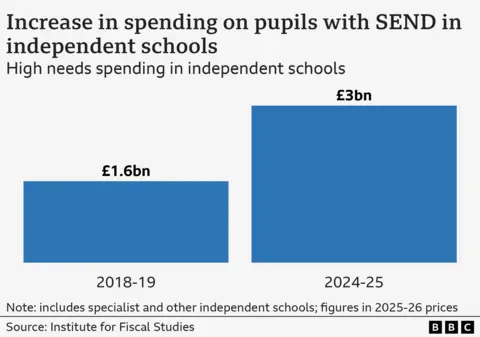
The funding model for SEND in England operates on a tiered system. Mainstream schools are typically responsible for covering the initial costs of supporting pupils with SEND, up to a threshold of £6,000 per pupil from their delegated budgets. Beyond this threshold, or for pupils with EHCPs, further costs are met by a local authority’s ring-fenced high needs funding. A significant contributor to the financial burden is the reliance on independent special schools. Approximately 38,000 pupils are placed in these institutions, often due to a severe shortage of specialist provisions within the state sector. The cost differential is substantial: the IFS reports that the average annual cost for an independent special school place is around £61,500 per pupil, compared to approximately £24,000 in state-funded special schools. This disparity highlights a structural inefficiency and contributes to the overall financial pressures.
Crucially, the funding provided by central government to councils for SEND support has consistently fallen short of the actual expenditure, leading to a mounting accumulation of debt. Many councils have reported significant deficits in their SEND budgets, which have been "artificially held off" their main accounts until 2028. By this point, the OBR forecasts that these accumulated deficits could reach an alarming £14 billion. Recognising the unsustainability of this trajectory, the government has recently committed £5 billion to clear 90% of the SEND deficits accrued by councils up to March of the current year, providing a temporary reprieve but underscoring the systemic nature of the financial crisis.
Systemic Flaws and Calls for Reform
The current SEND system in England has faced severe criticism, with the National Audit Office (NAO) declaring it "broken" in 2024. Despite a 58% increase in funding over the decade leading up to 2024/25, the NAO’s assessment concluded that the system was "financially unsustainable" for local authorities and, critically, was failing to deliver improved outcomes for children with SEND. This assessment resonates with the experiences of countless parents and carers who frequently encounter delays, inadequate provision, and a bureaucratic maze in their efforts to secure appropriate support for their children.

A stark indicator of the system’s dysfunction is the record number of tribunals recorded in 2024/25. These tribunals arise when parents challenge local authority decisions regarding the refusal of SEND support or the inadequacy of the support offered. The increasing frequency of these legal disputes highlights a significant breakdown in trust between families and local authorities, an adversarial environment, and a system struggling to meet its statutory obligations. The emotional and financial toll on families navigating this process is considerable, further emphasizing the urgent need for comprehensive reform. The Labour government, upon inheriting the current system, described it as being "on its knees," underscoring the bipartisan recognition of its critical state.
Proposed Reforms and Future Directions
In response to these pervasive challenges, the government has outlined a series of significant reforms aimed at transforming the SEND system. Ahead of the formal publication of its White Paper, the government announced a substantial investment of £4 billion in SEND over the next three years, with the ambitious goal of making "every school truly inclusive."
This new funding package includes specific allocations: £1.6 billion over three years directed to schools, early years settings, and colleges to bolster their capacity to support children with SEND at a universal level. An additional £1.8 billion over the same period is earmarked for enhancing access to specialist expertise, such as specialist teachers and speech and language therapists, for all children, regardless of whether they hold an EHCP. This emphasis on early intervention and universal provision within mainstream settings is a core tenet of the proposed changes, aiming to reduce the reliance on more costly, higher-level interventions later in a child’s education.
Further proposed reforms, some of which have been subject to prior leaks, include the potential reassessment of EHCPs for children after primary school, commencing from 2029. This measure could lead to fewer children retaining their EHCPs as they transition to secondary education, a move that, while potentially reducing costs, raises concerns about continuity of care and the potential for increased parental appeals. To broaden legal protections for all children, the introduction of new school-led Individual Support Plans (ISPs) is also anticipated. These plans would aim to provide a more standardized and legally underpinned framework for support within mainstream schools, complementing EHCPs for those with the most complex needs.
In a direct response to the spiralling costs associated with independent special schools, a new cap on the fees these institutions can charge is under consideration, likely to be set at £60,000 per pupil per year. This measure seeks to control expenditure and incentivize the development of more affordable state-funded specialist provision. The government has also previously committed £3 billion in capital funding to create 50,000 new specialist places, many of which are intended to be integrated within mainstream schools, partly funded by reallocating resources from planned free schools. Complementing these structural changes, a £200 million investment in SEND training for teachers has also been promised, recognizing the critical role of a well-equipped workforce in delivering effective inclusive education. These comprehensive plans, detailed in the forthcoming Schools White Paper, represent a significant effort to overhaul a system widely acknowledged as being at a breaking point.
Divergent Approaches Across the UK
It is important to note that education is a devolved matter within the United Kingdom, leading to distinct systems for supporting students with additional needs across its constituent nations.
In Scotland, the framework operates under the concept of "additional support needs" (ASN), which employs a broader definition than England’s SEND, encompassing a wider array of barriers to learning. Legally binding "Coordinated Support Plans" are reserved for pupils with the most complex and enduring needs, with a greater emphasis placed on collaborative planning and inclusive practices within mainstream schools.
Wales implemented substantial reforms in 2021, transitioning to a system of "additional learning needs" (ALN). This reformed approach aims to streamline the process of identification and provision, with most individual plans managed by mainstream schools. Local authorities in Wales retain responsibility for overseeing plans for children with more complex needs or those in specialist provisions, fostering a more integrated approach to support.
Northern Ireland, while also using the term SEND, employs "statements of special educational needs" as its legally binding individual plans for children requiring intensive support. Similar to England, Northern Ireland faces its own challenges in ensuring adequate and timely provision amidst growing demand.
These variations underscore the complexity of addressing diverse educational needs and highlight different philosophical and practical approaches to achieving inclusive education across the UK.




 Ayu Aulia
 Safa Marwah
 Aura Kasih