Lisa Mariana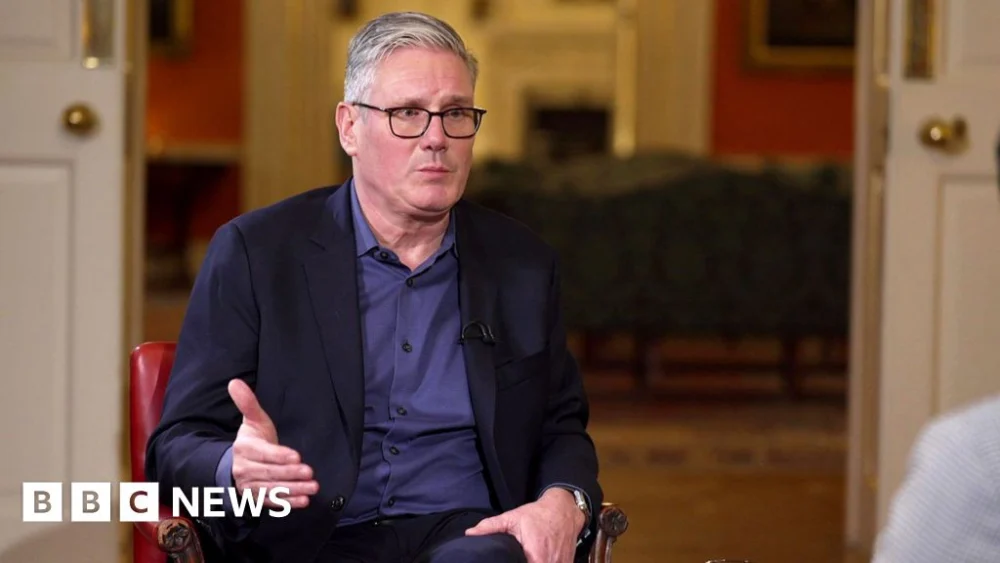
Prime Minister Sir Keir Starmer has underscored the fundamental tenet that no individual, regardless of their status or lineage, stands above the law, a declaration made in response to persistent inquiries regarding Andrew Mountbatten-Windsor and the resurfacing allegations linked to the late convicted sex offender Jeffrey Epstein. The premier’s remarks underscore a crucial moment of public accountability, as newly released documents from US legal proceedings intensify focus on the former royal’s historical associations and alleged conduct.
During a pivotal interview, Sir Keir articulated the constitutional imperative of legal equality, stating unequivocally that this principle "has to apply in this case in the same way it would in any other case." While maintaining a clear stance on the overarching principle, the Prime Minister carefully navigated questions concerning whether Andrew Mountbatten-Windsor should proactively engage with UK law enforcement, deferring such decisions to the independent judgment of police authorities. He did, however, reiterate his previously stated conviction that anyone possessing pertinent information, including Andrew, ought to come forward and testify before relevant bodies, specifically mentioning the US Congress as a potential forum. This distinction highlights the complex jurisdictional and procedural landscape surrounding the unfolding allegations, balancing domestic legal processes with international investigative demands.
The allegations currently under review by UK police forces are grave, encompassing claims that a woman was trafficked into the United Kingdom by Jeffrey Epstein for the express purpose of engaging with Andrew Mountbatten-Windsor. These accusations gained renewed prominence following the recent public disclosure of extensive US court documents related to Epstein’s sex trafficking network. Andrew Mountbatten-Windsor has consistently and forcefully denied any wrongdoing throughout this protracted period of scrutiny. The alleged encounter in question reportedly occurred at Royal Lodge, a former residence of Andrew, in 2010, involving a non-British woman then in her twenties. Her legal representative, Brad Edwards, has detailed claims that following a night at the residence, the woman was offered tea and provided a tour of Buckingham Palace. Such details, now widely disseminated, contribute significantly to the public’s demand for clarity and accountability.
The recent unsealing of millions of pages of documents by the US Department of Justice has cast a stark new light on Andrew Mountbatten-Windsor’s close relationship with Epstein, a figure whose illicit activities spanned decades and involved numerous underage individuals. This latest tranche of information includes various references to the former prince, alongside photographs that have fueled public conjecture and heightened media interest. The timing of these revelations coincides with a period where Andrew Mountbatten-Windsor has already significantly reduced his public profile, moving from his Windsor residence to the Sandringham Estate in Norfolk. Further scrutiny has arisen from disclosed email exchanges between Epstein and Andrew, indicating continued contact even years after Epstein’s initial conviction in the US for soliciting a minor. This persistent communication challenges previous narratives and raises questions about the extent of their relationship post-conviction.
The legal ramifications of these emerging details are substantial and far-reaching. Across the United Kingdom, at least nine police forces have confirmed they are actively assessing whether sufficient grounds exist to initiate formal investigations into Epstein-related allegations. The Metropolitan Police, in particular, has confirmed it is undertaking "initial inquiries" into specific allegations concerning close protection officers formerly assigned to Andrew Mountbatten-Windsor. These inquiries follow reports, including one from LBC, suggesting that members of the Royalty and Specialist Protection (RaSP) unit may have "wilfully turned a blind eye" to illicit activities during visits to Epstein’s private island. While the Met initially stated it had "not identified any wrongdoing," the subsequent commencement of "initial enquiries" underscores a commitment to establishing the facts surrounding these claims. The involvement of protection officers adds another layer of complexity, hinting at potential institutional failings or complicity that extend beyond individual conduct.
Prime Minister Starmer’s measured yet firm stance reflects a delicate balance between upholding the independence of law enforcement and responding to mounting public and international pressure. His refusal to direct Andrew Mountbatten-Windsor to voluntarily engage with UK police, while simultaneously emphasizing the equality of all under the law, illustrates the constitutional boundaries between the executive and judicial branches. However, his advocacy for testimony before the US Congress highlights an acknowledgment of the global scope of the Epstein scandal and the distinct legal processes at play in different jurisdictions. The US, through its officials and the family of prominent accuser Virginia Giuffre, has explicitly called for Andrew Mountbatten-Windsor to provide testimony regarding his associations with Epstein.
Virginia Giuffre, who tragically passed away last year, was a central figure in the allegations, claiming in 2014 that she was trafficked by Epstein and Ghislaine Maxwell at the age of 17 and coerced into sexual encounters with Andrew Mountbatten-Windsor, claims he has vehemently denied. Giuffre initiated a civil lawsuit against him in the US in 2021, a case that was ultimately settled in February 2022 for an estimated £12 million. The settlement, while not an admission of guilt, further cemented public perception of the seriousness of the allegations and the financial implications for Andrew Mountbatten-Windsor. Epstein himself died by suicide in a New York prison cell in 2019 while awaiting trial on federal sex trafficking charges, leaving a trail of unanswered questions and ongoing investigations.
The political and societal implications of this ongoing saga are profound. Starmer’s readiness to facilitate a parliamentary debate on Andrew Mountbatten-Windsor’s links to Epstein, stating he "wouldn’t stand in the way," signifies a recognition of the issue’s national importance and the public’s right to transparency. Such a debate would provide a crucial platform for elected representatives to scrutinize the allegations, discuss the implications for public institutions, and potentially exert further pressure for full disclosure. For the monarchy, these developments represent a continuing challenge to its public image and legitimacy, particularly as calls for accountability resonate across society. The principle that "nobody is above the law" holds particular resonance when applied to individuals historically perceived as enjoying a degree of immunity or exceptionalism.
The future outlook for this complex situation remains uncertain but portends continued legal and public scrutiny. UK police forces face the intricate task of sifting through vast amounts of information, much of it originating from foreign jurisdictions, to determine the viability of criminal investigations. The potential for cross-border cooperation between UK and US authorities will be critical, as will the careful consideration of evidence standards and legal frameworks in each country. For Andrew Mountbatten-Windsor, the path forward is fraught with legal peril and sustained public pressure. The long shadow of the Epstein scandal continues to extend, demanding comprehensive answers and accountability from all those implicated, regardless of their past or present status. Prime Minister Starmer’s unambiguous articulation of the rule of law serves as a potent reminder of the foundational principles underpinning democratic governance, principles that must endure even in the face of the most challenging and sensitive cases involving figures of national prominence.




 Safa Marwah
 Aura Kasih