Safa Marwah
In a significant strategic realignment, OpenAI has announced the impending retirement of its widely recognized conversational artificial intelligence model, GPT-4o, along with several other foundational iterations, citing the demonstrated maturity and superior performance of its successor, GPT 5.2. This decision marks a pivotal moment in the rapid evolution of large language models, reflecting both technological advancement and a nuanced response to evolving user preferences and operational efficiencies within the dynamic AI landscape.
The announcement outlines a definitive timeline for the discontinuation of several key models currently integrated into the ChatGPT platform. Effective February 13, 2026, the venerable GPT-4o will cease to be available to users. This transition will also encompass the retirement of other notable models, including GPT-5 Instant, GPT-5 Thinking, GPT-4.1, GPT-4.1 mini, and the internal ‘o4-mini’ designation. This sweeping consolidation underscores OpenAI’s commitment to streamlining its offerings and concentrating resources on its most advanced and efficient architectures. It is crucial to note that, as of the current communication, these changes are specifically slated for the consumer-facing ChatGPT application, with no immediate alterations planned for the models accessible via OpenAI’s API, a distinction that carries significant implications for developers and enterprise clients.
The rationale behind such a comprehensive model retirement strategy is multifaceted, primarily driven by the exponential progress in AI research and development. In the rapidly evolving field of generative AI, newer iterations of models invariably offer significant enhancements over their predecessors in terms of computational efficiency, response accuracy, contextual understanding, and safety protocols. The explicit statement from OpenAI that GPT 5.2 "started to live up to expectations" indicates a threshold of performance and reliability has been achieved, making the maintenance and continued support of older models less justifiable from an engineering and resource allocation perspective.

GPT-4o, in particular, holds a unique position in the annals of conversational AI. Upon its initial release, and even more so after a temporary withdrawal and subsequent reintroduction, it garnered a distinct reputation among its user base. Users frequently characterized GPT-4o as possessing a more "personal" and "warm" conversational style, often praising its perceived creativity and ability to engage in less constrained dialogue. This qualitative feedback highlighted a critical dimension of user experience beyond mere technical benchmarks: the emotional and psychological connection users formed with the AI. The model’s perceived ability to exhibit a more "uninhibited" or less overtly filtered personality resonated deeply with a segment of users seeking a more dynamic and less predictable interaction, especially for tasks involving creative ideation or open-ended discussions.
The initial user backlash following a brief period of GPT-4o’s unavailability served as a potent illustration of the profound impact of AI personality on user adoption and satisfaction. OpenAI openly acknowledged this sentiment, stating that it reinstated GPT-4o after "hearing clear feedback from a subset of Plus and Pro users, who told us they needed more time to transition key use cases, like creative ideation, and that they preferred GPT-4o’s conversational style and warmth." This episode underscored the complex interplay between technological advancement, user expectation, and the subtle nuances of human-computer interaction. It demonstrated that raw performance metrics alone do not dictate user preference; the subjective experience of interacting with an AI can be equally, if not more, influential.
This critical feedback loop directly informed the subsequent development of OpenAI’s model pipeline. The insights gleaned from GPT-4o’s dedicated user base were instrumental in shaping the design principles and training methodologies for GPT 5.1 and, ultimately, GPT 5.2. This iterative process, driven by real-world user engagement, is a hallmark of modern software and AI development. It signifies a maturation in the approach to AI product development, moving beyond purely technical specifications to incorporate a deeper understanding of human needs and interaction patterns. The goal was evidently to engineer newer models that could retain the desirable qualities of GPT-4o – such as its conversational fluency and perceived warmth – while simultaneously integrating superior analytical capabilities, enhanced safety features, and greater efficiency.
The introduction of the "Personality feature" within ChatGPT directly addresses this demand for customizable AI experiences, acting as a strategic bridge for users transitioning from GPT-4o. This feature allows users to tailor the AI’s interaction style, potentially replicating the conversational nuances and overall "feel" that made GPT-4o so popular. By enabling users to configure aspects of the AI’s persona, OpenAI aims to provide a more adaptable and user-centric experience, ensuring that the retirement of a beloved model does not lead to a significant erosion of user satisfaction. This move is indicative of a broader industry trend towards personalized AI, where the user has greater agency in shaping their digital assistant’s demeanor and output style, balancing the need for advanced capabilities with the desire for a familiar and comfortable interaction.
The significant shift in user engagement data provides a compelling justification for the impending retirement. OpenAI’s internal metrics reveal that the "vast majority of usage has shifted to GPT-5.2, with only 0.1% of users still choosing GPT-4o each day." This dramatic decline in active users for the older model indicates a successful migration to the newer platform, suggesting that GPT 5.2 has indeed managed to meet or exceed user expectations, or at least provide a compelling alternative that satisfies most use cases. This data-driven approach allows OpenAI to make informed decisions about resource allocation, ensuring that engineering efforts are focused on the platforms that serve the broadest user base and represent the cutting edge of their technological capabilities.
Looking ahead, OpenAI has articulated clear objectives for the continued evolution of ChatGPT. The focus remains on enhancing personalization capabilities, allowing for even deeper customization of AI interactions. This could manifest in more granular control over personality traits, specialized knowledge domains, or tailored response styles, making the AI feel even more attuned to individual user needs. Concurrently, a paramount commitment to integrating new safeguards is a continuous priority. The "uninhibited" nature often attributed to GPT-4o, while endearing to some, also presented potential challenges regarding content moderation, bias mitigation, and the generation of undesirable or harmful outputs. Newer models like GPT 5.2 are engineered with more sophisticated safety layers, reflecting the industry’s increasing emphasis on responsible AI development and ethical deployment. These safeguards are crucial for building trust, ensuring the widespread societal acceptance of AI technologies, and navigating the complex regulatory landscapes emerging globally.
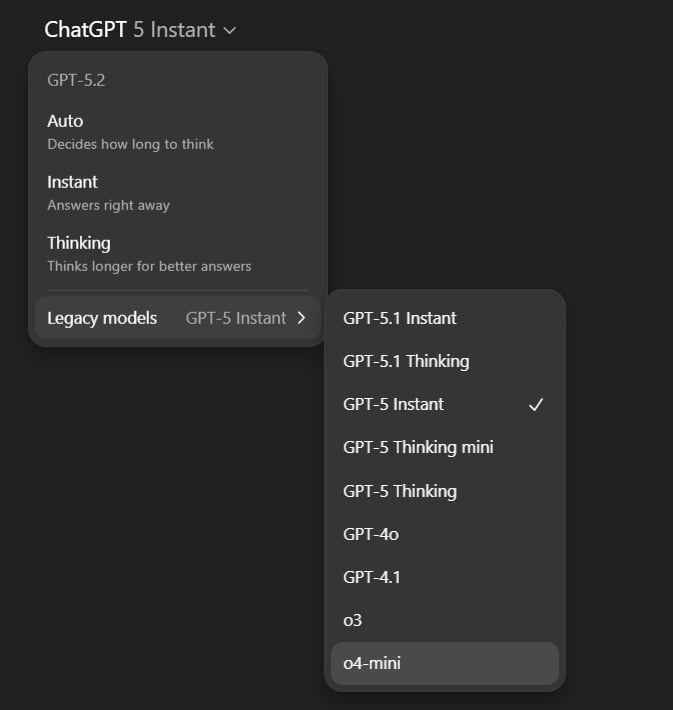
The strategic phasing out of models like GPT-4o is a standard, albeit impactful, occurrence in the fast-paced world of artificial intelligence. As foundational models become increasingly powerful and efficient, older versions, while historically significant, eventually become computationally expensive to maintain and less performant compared to their successors. This relentless innovation cycle pushes the boundaries of what AI can achieve, but also presents challenges for users and developers who must continually adapt to new paradigms and deprecations.
For individual users, such transitions necessitate adaptation to new interaction styles and capabilities. While the "Personality feature" aims to ease this, the inherent differences in underlying model architectures mean that a perfect replication of an older model’s behavior is often elusive. For enterprise clients and developers utilizing the API, the current stability of API access provides a crucial buffer, allowing them to continue building and deploying applications without immediate disruption. However, the long-term trajectory suggests that API models will also eventually undergo similar upgrade cycles, requiring strategic planning for migration and integration of newer, more capable architectures.
Ultimately, OpenAI’s decision to retire GPT-4o and its contemporaries in favor of GPT 5.2 signifies a natural progression in the life cycle of cutting-edge AI. It underscores the company’s commitment to continuous innovation, guided by both technological breakthroughs and invaluable user feedback. This move is not merely an internal restructuring but a reflection of the broader trajectory of AI development: a journey toward more intelligent, safer, and increasingly personalized artificial intelligences that continue to redefine the boundaries of human-computer interaction. The legacy of GPT-4o will endure, not just as a beloved model, but as a crucial learning experience that shaped the evolution of its more sophisticated successors.




 Lisa Mariana
 Aura Kasih

 Ayu Aulia